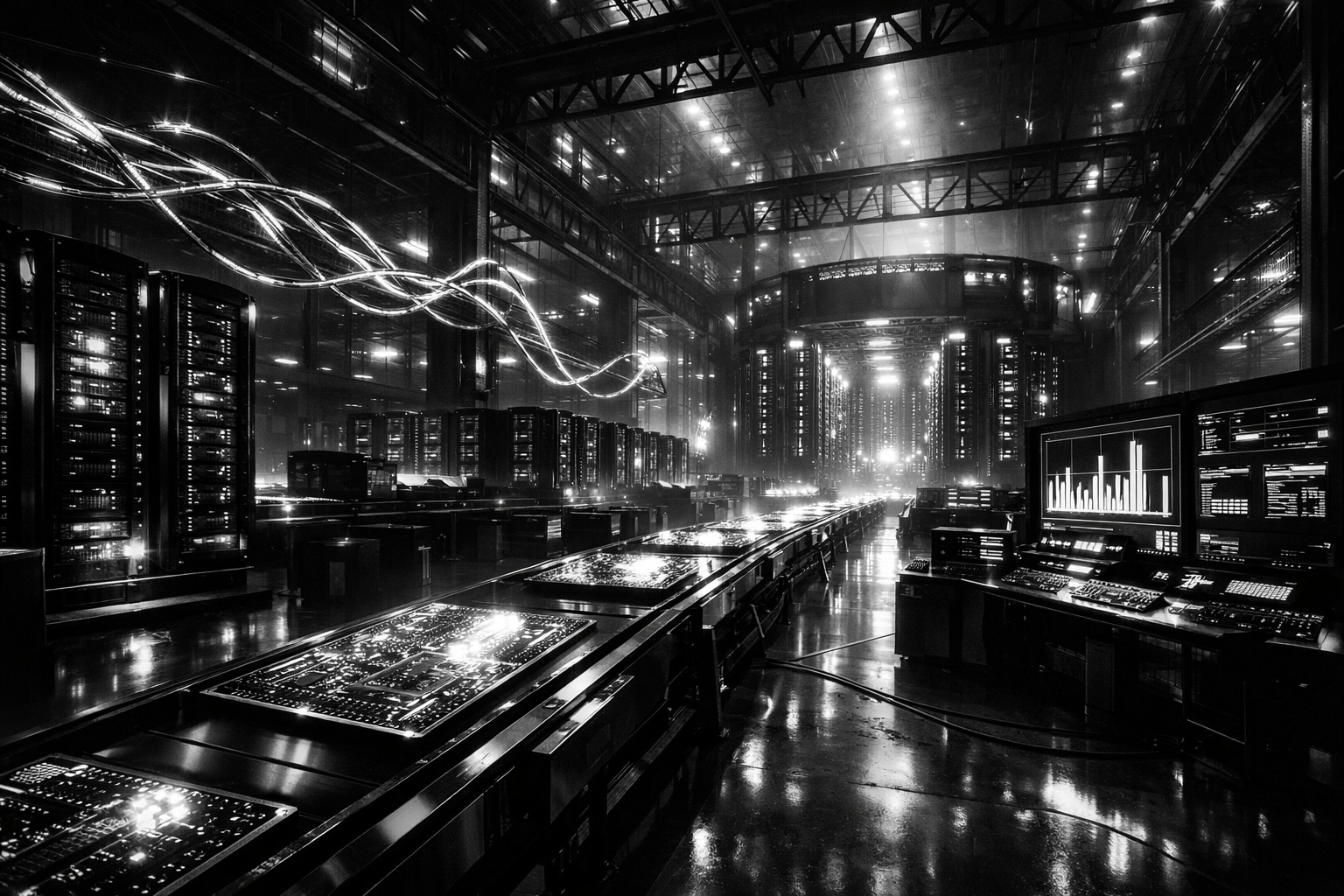
The biggest AI story of 2026 is not a new model. It is a factory schedule. As demand for AI servers spikes, manufacturers are quietly retooling lines, rewriting supplier contracts, and treating compute like the next industrial commodity. If you want to understand where the money, jobs, and leverage are moving next, follow the server racks.
Over the past week, tech communities on X have been buzzing about a familiar pattern that now looks structural: AI is pivoting from a race to train ever larger models to a race to deploy infrastructure at scale. The posts are light on audited order numbers, but heavy on a consistent signal. Hardware makers are seeing stronger order books and renewed investor attention because the world is buying the picks and shovels of AI, not just the gold.
That shift favors high-volume server manufacturing, power delivery equipment, cooling, networking, and the industrial supply chain that feeds them.
From model obsession to infrastructure reality
For the last few years, AI progress was measured in training runs, parameter counts, and benchmark charts. That era is not over, but it is no longer the only scoreboard. The new scoreboard is utilization. How many tokens, tasks, images, and agent actions can you serve per dollar, per watt, per square meter of data center floor.
This is where servers become the main character. Training a frontier model is a headline event. Running AI across customer support, coding assistants, search, security monitoring, robotics, and industrial control is a daily grind. It is also where the recurring revenue lives, and where the infrastructure must be reliable, serviceable, and scalable.
Industry observers have been warning about compute scarcity for years, sometimes in dramatic terms. The tone on X this week suggests that scarcity is no longer theoretical. It is showing up as lead times, allocation conversations, and a renewed willingness to pay for capacity that is available now, not later.
Why AI servers are different from "normal" servers
An AI server is not just a box with chips. It is a tightly engineered system where the bottleneck can move from compute to memory bandwidth, from networking to power delivery, from cooling to rack density. That complexity is exactly why manufacturing is surging. More of the value is in integration, validation, and supply chain execution.
The modern AI server stack pulls in high-end accelerators, advanced CPUs, large memory footprints, fast storage, and high-throughput networking. It also demands careful thermal design. When you pack more compute into a rack, you are not only buying silicon. You are buying the ability to remove heat safely and consistently, day after day.
This is one reason "infrastructure" is becoming the new competitive moat. If inference costs fall sharply, as some expert forecasts suggest could happen in 2026, demand does not necessarily fall with it. Lower unit costs often expand the market. More teams deploy more AI in more places, and the total volume of compute can rise even as the cost per task drops.
The manufacturing surge: what is actually ramping
When people hear "AI server boom," they picture chip fabs. But the manufacturing surge is broader and, in many cases, faster to scale than leading-edge semiconductor production. The winners are often the companies that can build complete systems, ship them on time, and keep them running.
Server original design manufacturers and contract manufacturers are ramping assembly capacity, testing capacity, and logistics throughput. Component suppliers are seeing pull-through demand for power supplies, voltage regulation modules, high-speed connectors, cables, and advanced cooling parts. Networking vendors benefit as clusters grow and east-west traffic inside data centers explodes.
The less glamorous parts matter more than ever. A shortage of a specific connector, a power component, or a cooling manifold can delay an entire rack. In an environment where compute is scarce and expensive, delays are not just inconvenient. They are revenue events.
"Islanded" data centers and the new power play
One of the most telling themes resurfacing in recent discussions is the rise of "islanded" data centers. These are facilities designed to generate or secure their own power, reducing dependence on constrained grids. The idea sounds extreme until you look at the load profiles of dense AI deployments.
AI infrastructure is forcing a rethink of where data centers can be built and how quickly they can be energized. In some regions, the limiting factor is not land or fiber. It is the queue for grid interconnection and the availability of firm power. That pushes operators toward on-site generation, long-term power purchase agreements, and more aggressive investments in cooling efficiency.
This is also where manufacturing intersects with energy hardware. Demand rises for switchgear, transformers, backup systems, and increasingly sophisticated monitoring. The AI boom is not only a server story. It is an electrical infrastructure story.
Funding is tight, demand is not: the 2026 paradox
Another thread in the background is capital. Earlier 2026 predictions pointed to funding challenges for data center expansion, including liquidity pressure among some major backers in the AI ecosystem. That tension is real. Building data centers and buying AI servers is capital intensive, and interest rates and risk appetite still matter.
Yet demand persists because AI is moving into workflows that are hard to unwind. Once a company rewires customer support around AI, or once a factory uses vision models for quality control, the compute becomes operational infrastructure. It is closer to electricity than to a discretionary software subscription.
This is why the market can feel contradictory. Some projects slow because financing is harder. Others accelerate because the business case is clearer, especially when AI is tied to labor productivity, uptime, fraud reduction, or throughput.
Five ways AI server demand is redefining factory futures
1) Factories are optimizing for integration, not just volume
Traditional server manufacturing rewarded scale and standardization. AI servers reward precision. Manufacturers that can validate thermals, firmware, networking, and accelerator performance as a complete system are gaining pricing power. The factory floor becomes a quality lab, not just an assembly line.
2) Supply chains are being redesigned around bottlenecks
In AI infrastructure, the slowest component sets the pace. That is pushing manufacturers to dual-source more aggressively, hold different kinds of inventory, and negotiate allocation earlier. It also increases the value of suppliers that can guarantee consistency, not just low cost.
3) Power and cooling are now product features
Buyers are no longer comparing servers only on raw performance. They are comparing performance per watt, serviceability, and how easily a system fits into a facility's power and cooling envelope. This is where liquid cooling, higher-efficiency power delivery, and smarter rack design become competitive differentiators.
4) The "cloud-only" era is fading into a hybrid reality
As AI moves into physical applications, from robotics to industrial monitoring, not everything can live in a distant hyperscale region. Latency, reliability, and data governance push some inference closer to the edge. That creates demand for smaller, ruggedized, or specialized deployments, and it broadens the manufacturing opportunity beyond a handful of mega data centers.
5) Sovereign AI is turning infrastructure into policy
Governments increasingly treat compute as strategic capacity. Recent chatter has pointed to national initiatives, including pushes in Asia, to secure domestic access to AI infrastructure. Whether the goal is economic competitiveness, security, or resilience, the result is the same. More buyers want dedicated capacity, and that means more servers, more facilities, and more local supply chain commitments.
The constraints that could slow the boom
Manufacturing surges are rarely smooth. The most obvious constraint is chip supply, especially for high-end accelerators and advanced memory. But there are other friction points that can be just as limiting, including skilled labor for data center construction, grid interconnection delays, and the availability of high-quality components that meet strict reliability requirements.
Cost pressure is another theme that keeps resurfacing. Hardware executives have warned that rising component and logistics costs can squeeze margins, even when demand is strong. In practice, that pushes manufacturers to move up the value chain, offering more complete systems, better support, and tighter integration with software stacks.
There is also a quieter risk. If too many buyers overbuild based on short-term scarcity, the market can swing from shortage to glut. The difference this time is that AI workloads are expanding into more categories, which may absorb capacity faster than skeptics expect. But the risk of mis-timed investment never disappears.
How to read the market without getting lost in hype
If you are trying to separate signal from noise, watch three things. First, track lead times and pricing for complete AI server systems, not just individual chips. Second, watch power availability and data center build permits, because compute cannot run without electrons. Third, watch where inference is being deployed, since that is the demand that repeats every day.
The most useful mental model is simple. Training creates breakthroughs. Infrastructure turns breakthroughs into habits. And habits are what reshape industries.
In 2026, the companies that look like "AI winners" may not be the ones with the flashiest demos, but the ones that can ship a rack on schedule, keep it cool under load, and plug it into power that actually exists.
The next time someone tells you AI is slowing down, ask a different question: if the future is software, why are the factories running overtime?