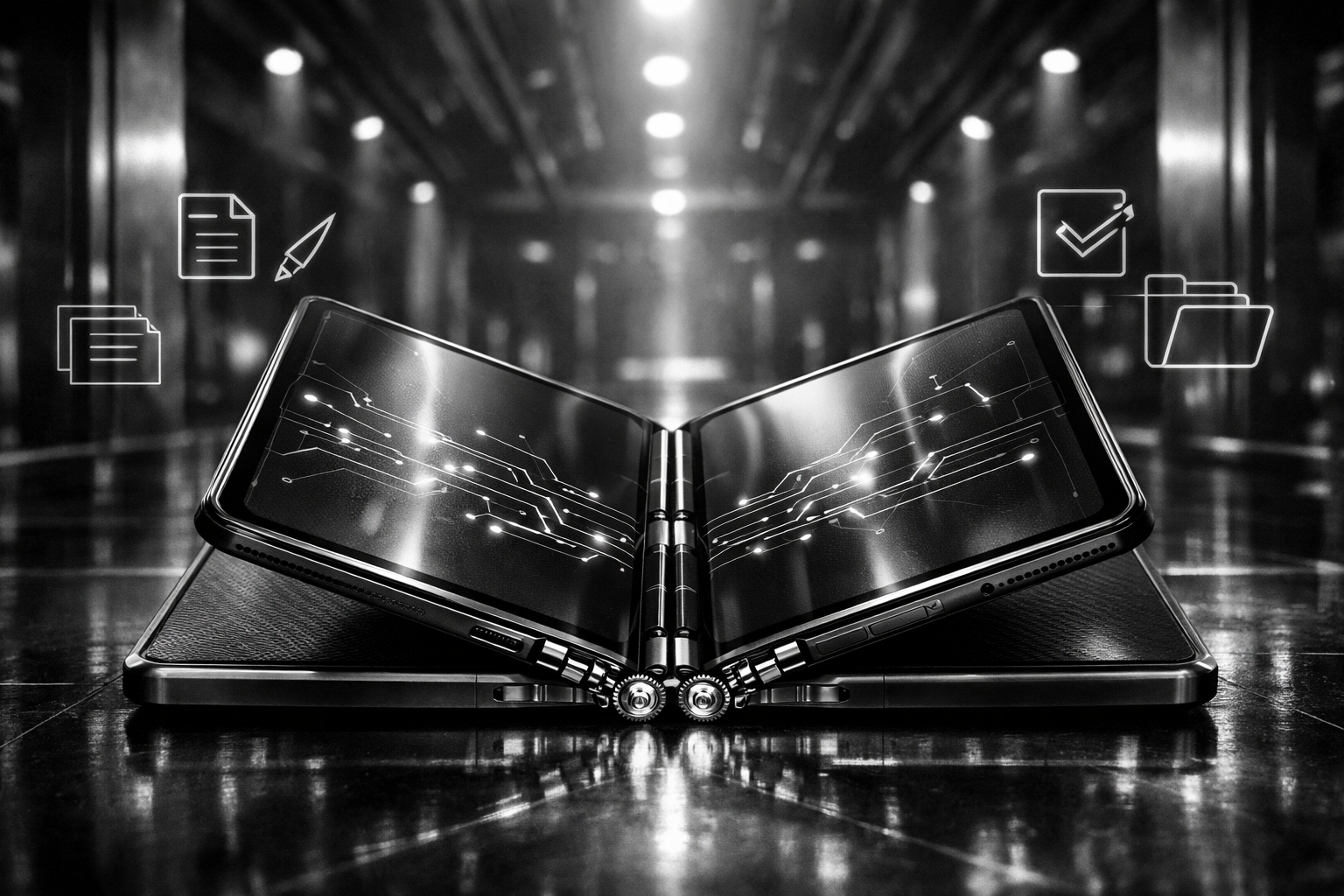
Foldables have spent years trying to answer one uncomfortable question: are they a better phone, or just a more expensive party trick? At CES 2026, Motorola is betting it finally has a convincing reply. The company used the show's opening days in Las Vegas to unveil a book-style Razr Fold, a sharp pivot from the brand's clamshell heritage and a direct shot at the devices that have defined the category so far.
The timing is not subtle. CES floors are already buzzing with display makers showing off crease-reduction breakthroughs and under-display camera tricks, including Samsung Display's latest "crease-less" OLED demonstrations. Motorola's message is clear: the foldable wars are no longer about proving the form factor works. They are about who can make it feel inevitable.
From nostalgia to notebook: why Motorola changed the Razr playbook
The Razr name has been synonymous with the flip phone comeback, and Motorola has leaned into that identity hard. A book-style Razr Fold changes the story. Instead of a compact square that opens into a tall phone, this design aims for a phone that opens into something closer to a small tablet, built for reading, editing, watching, and working in split-screen.
That shift matters because the foldable market has matured into two camps. Clamshells sell the idea of portability and style. Book-style foldables sell the idea of replacing a second device. Motorola is now chasing the higher-stakes promise: fewer compromises, more screen, and a reason to pay four figures.
What Motorola showed at CES 2026, and what it didn't
Early CES chatter and hands-on impressions circulating on social platforms describe the Razr Fold as a premium, productivity-leaning device with a larger form factor and a focus on media consumption. Demos have highlighted a 120Hz refresh rate on the unfolded display and a hinge pitched as more durable than prior generations, two areas where foldables routinely win or lose public trust.
Motorola has not, at least in the initial wave of reporting, locked down the details that buyers obsess over most. Pricing and release timing were not clearly stated in early coverage. Full specifications, including battery capacity, camera sensor sizes, and long-term durability ratings, were also not comprehensively disclosed in the first round of CES noise.
That absence is not unusual at CES, where companies often tease hardware to control the narrative before a formal launch window. But it does shape the conversation. Without hard numbers, the Razr Fold is being judged on intent, industrial design, and whether Motorola can credibly compete with the incumbents on the unglamorous stuff like thermals, battery life, and software polish.
The real battleground: the crease, the hinge, and the hidden camera
Foldables are judged in seconds. People open the device, tilt it under harsh lights, and look for the crease. They close it, press the hinge, and listen for flex or grit. They swipe around the UI and watch for stutters. The category's biggest problems are tactile and visual, which is why Samsung Display's CES demonstrations around crease reduction and under-display camera integration are so strategically timed.
Motorola's Razr Fold arrives into that exact spotlight. If Samsung and other display suppliers can make the crease less visible and the under-display camera less compromised, the bar rises for everyone. A foldable that feels "almost normal" is the one that sells, because it stops asking the buyer to be an early adopter.
Under-display cameras are a perfect example of the trade-off buyers have learned to fear. Hide the camera and you gain immersion, but you often lose clarity, dynamic range, and consistency. If the industry is truly improving the optics and the pixel structure above the sensor, Motorola will need to show that its approach does not turn video calls into a soft-focus tax.
AI stops being a feature and starts being the interface
CES 2026 has been saturated with "AI" labels, but foldables are one of the few places where AI can feel like more than marketing. A larger, flexible screen creates new interaction patterns, and on-device AI can make those patterns useful rather than fiddly.
The most discussed use cases around the Razr Fold include real-time translation, gesture controls, and photography enhancements. These are not new ideas, but the foldable form factor changes how they land. Translation becomes more natural when two people can face different halves of a screen. Gesture controls become more practical when the device is propped like a mini laptop. Photo editing becomes less of a squint-and-zoom chore when you have room for timelines, layers, and previews.
The key phrase being repeated across CES this year is "edge AI," meaning AI that runs on the device rather than in the cloud. For foldables, that is not just about speed. It is about privacy, offline reliability, and battery efficiency. If Motorola can keep AI features responsive without turning the phone into a hand warmer, it will have a real differentiator in a market where many features look identical on spec sheets.
Multitasking is the promise, but software is the proof
Book-style foldables live or die by software. The hardware can be gorgeous, but if app layouts break, if split-screen feels cramped, or if the task switcher becomes a mess, the big screen becomes a big disappointment.
Motorola's challenge is to make multitasking feel intentional. That means predictable window behavior, fast app pairing, and a clean way to move content between panes. It also means making the outer display useful rather than decorative, because most people spend more time on the closed phone than they expect.
There is also a subtle productivity test that separates serious foldables from expensive toys. Can you start a task on the cover screen, open the device, and continue without friction? If the answer is yes, the foldable starts to feel like a single device with two modes. If the answer is no, it feels like two devices awkwardly glued together.
Pricing reality: why the $1,000 line still matters
Analysts and CES watchers expect the Razr Fold to land in the $1,000-plus premium tier, because that is where book-style foldables have lived. The problem is that the market has become less forgiving. Buyers now compare foldables not only to other foldables, but to slab phones with exceptional cameras, long battery life, and years of software support.
Motorola's Razr lineage gives it brand recognition, but the book-style segment is a different fight. It is a fight against Samsung's Galaxy Z Fold line, against Google's Pixel Fold approach, and against a growing set of competitors that have learned how to ship thin hardware with fewer first-generation mistakes.
If Motorola wants to win on value, it will need to be specific about what you get for the premium. Not just a bigger screen, but a better daily routine. Not just AI, but AI that saves time in ways you can feel by lunchtime.
What to watch next if you're considering a foldable in 2026
The Razr Fold's CES debut is a signal that the category is entering a more aggressive phase. Reports and projections circulating around the show suggest foldable shipments could grow meaningfully through 2026, with some analysts pointing to around 25 percent growth. Whether that happens will depend less on hype and more on whether the devices stop asking users to compromise.
If you are tracking this space, the smartest questions are not about how futuristic the phone looks in a demo. Ask how visible the crease is in real lighting. Ask how the hinge feels after thousands of opens. Ask what happens to battery life when the big screen is at 120Hz. Ask whether the under-display camera is good enough that you forget it exists. Ask how many years of updates you will get, and whether repairability is realistic when something goes wrong.
Motorola's book-style Razr Fold is entering a market that finally knows what it wants: a foldable that behaves like a normal phone until the moment you need it to become something more, and then does it without drama.
The company that wins the foldable wars won't be the one that folds first, but the one that makes you forget you ever needed a second screen at all.