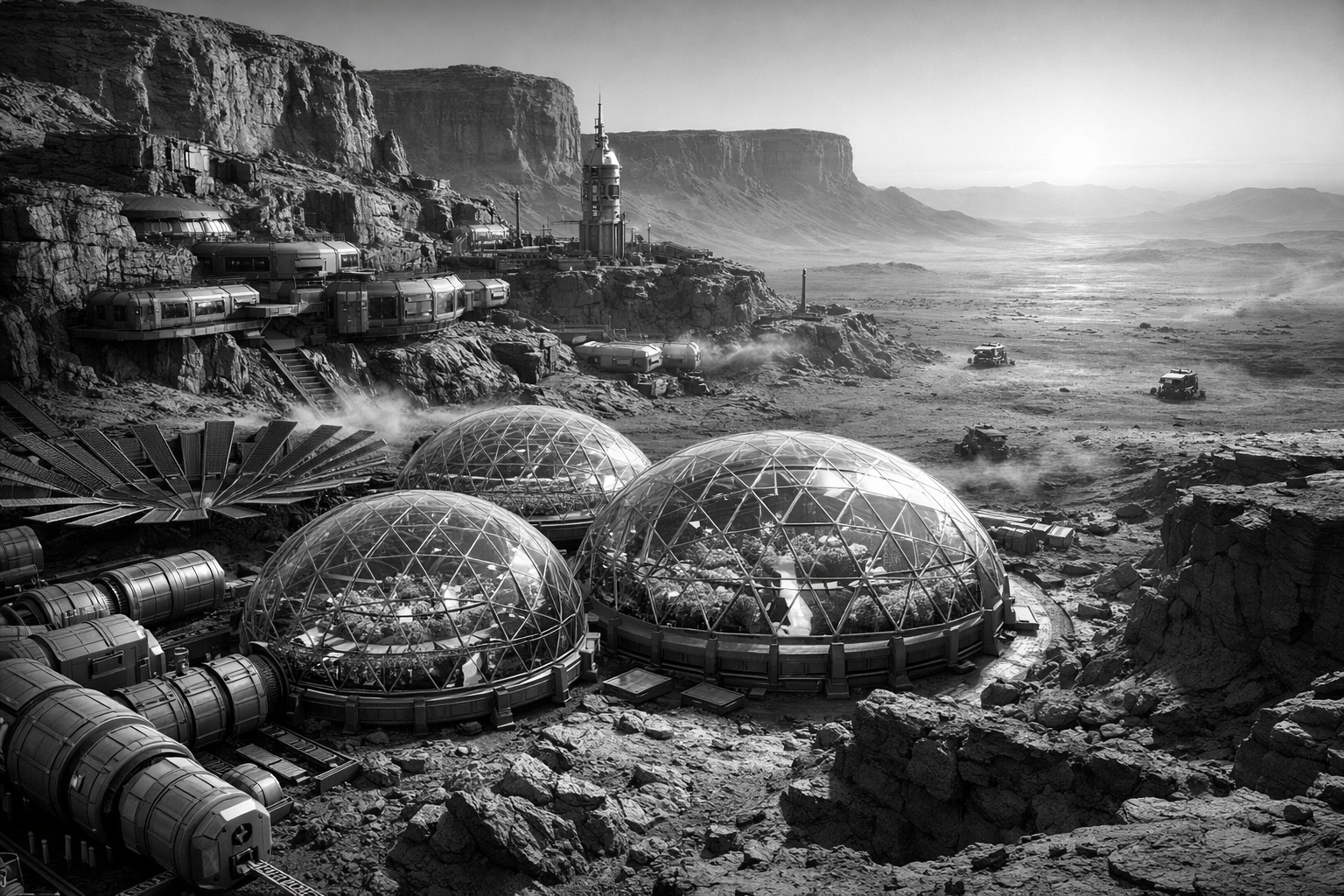
The promise, and the trap, in the phrase "selfsustaining"
A self-sustaining Mars habitat sounds like a clean engineering challenge: bring a base, turn on the machines, grow food, recycle everything, and stop depending on Earth. The reality is messier and more interesting. "Self-sustaining" is not one technology. It is a chain of interlocking loops, and the chain only holds if every link works through dust storms, radiation, equipment wear, human error, and years of maintenance with limited spare parts.
So is it possible to create a completely self-sustaining habitat on Mars? In principle, yes. Mars has carbon dioxide in the air, water ice in the ground, sunlight, and abundant minerals. In practice, the question becomes: can we close the loops tightly enough, for long enough, with systems that can be repaired locally? That is where most optimistic timelines quietly slip.
What "completely selfsustaining" actually requires
A habitat that can run for years without resupply must continuously provide breathable air, safe water, reliable food, stable temperature and pressure, and protection from radiation. It must also handle waste, prevent contamination, and keep working when something breaks. On Earth, cities are "self-sustaining" only because they sit inside a planet-sized life support system and a global supply chain. On Mars, the habitat is the planet-sized system, just shrunk into a few rooms and pipes.
The most useful way to think about it is as five loops that must be closed: air, water, food, energy, and materials. If even one loop stays open, you are not self-sustaining. You are surviving on a schedule of shipments.
Loop one: air is easy to make, hard to manage
Mars gives you an atmosphere that is mostly carbon dioxide, but it is extremely thin. You cannot breathe it, and you cannot rely on it for pressure. A habitat must be sealed and pressurised, and it must keep oxygen levels stable while removing carbon dioxide and trace contaminants.
The good news is that making oxygen from Martian CO is no longer a purely theoretical idea. NASA's MOXIE experiment on the Perseverance rover demonstrated oxygen production on Mars, producing grams per hour and proving the chemistry works in real conditions. That is not enough for people, but it is a proof of concept that can be scaled in principle.
The harder part is not generating oxygen once. It is running an integrated atmosphere system for years. Humans exhale CO and water vapour, habitats off-gas chemicals from plastics and electronics, and dust finds its way into seals and filters. A "closed loop" air system needs redundancy, sensors that do not drift, and maintenance routines that can be done in gloves, in cramped spaces, when the crew is tired.
Loop two: water is the real currency of a Mars settlement
If you can secure water, you can drink, grow food, make oxygen, and even produce fuel. Mars appears to have substantial water ice in the subsurface at many latitudes, but "having ice" and "having a water supply" are different things. You need to locate it precisely, extract it efficiently, purify it, store it without freezing or leaking, and keep the whole system running through temperature swings and dust contamination.
On the recycling side, modern spacecraft life support already recovers most water from humidity and urine, and Earth-based prototypes have pushed recovery rates very high. The remaining challenge is what happens when you scale from a station-like system that gets spare parts to a settlement that must fabricate or refurbish components locally. Filters clog. Membranes foul. Pumps wear. A self-sustaining habitat is less about achieving a headline percentage and more about keeping that percentage from collapsing in month 18.
Loop three: food is where "selfsustaining" becomes a lifestyle, not a feature
Food is the loop that turns a mission into a civilisation project. You can stockpile calories for a while, but a truly self-sustaining habitat must grow a large fraction of what it eats, continuously, with predictable yields. That means controlled environment agriculture, careful lighting, nutrient management, pollination strategies, and a plan for crop failure that does not involve a cargo ship.
Mars soil is not farm soil. It is regolith with awkward chemistry, including perchlorates that are toxic to most life. That pushes early habitats toward hydroponics, aeroponics, or carefully processed substrates rather than "planting in the ground." Experiments in Mars-analog facilities have shown that with the right light, temperature, and CO enrichment, plants can grow well in controlled systems. The open question is not whether lettuce can grow. It is whether a settlement can run multi-year crop rotations, maintain nutrient balance, and recycle human waste into fertiliser safely and reliably.
There is also a human factor that rarely makes the brochure. A self-sustaining food system is labour. It is daily work, constant monitoring, and periodic crisis management. The more you close the food loop, the more your habitat starts to resemble a small farm that happens to be inside a pressure vessel.
Loop four: energy is the silent judge of every other loop
Every life-support loop is an energy problem in disguise. Electrolysis to make oxygen needs power. Water extraction needs power. Lighting for crops needs a lot of power. Heating, pumping, filtering, compressing, and computing all add up. If power dips, everything else becomes a triage exercise.
Solar works on Mars, but it is weaker than on Earth and vulnerable to dust. Dust storms can cut output dramatically, and dust accumulation is a chronic maintenance issue. That is why many serious architecture studies pair solar with nuclear fission for baseload power. NASA's Kilopower concept is often cited as a path to steady electricity that does not care about weather. The strategic point is simple: if you want "self-sustaining," you need an energy system that is boringly reliable, not just impressive on a clear day.
Loop five: materials decide whether you are independent or just well stocked
This is the loop that most discussions skip, and it is the one that makes "completely" self-sustaining so hard. Even if you close air, water, food, and energy, you still consume things. Seals degrade. Valves fail. Electronics die. Tools wear. Medical supplies expire. If you cannot replace parts, you are not self-sustaining. You are living on borrowed time.
In-situ manufacturing is the difference between a habitat and a settlement. Early steps are plausible: 3D printing some tools, producing simple spare parts, making bricks or shielding blocks from regolith. The leap is producing high-reliability components such as pumps, sensors, membranes, and electronics with local inputs. That requires not just printers, but feedstocks, quality control, and a supply chain of its own, built inside the habitat.
The Mars environment is not just hostile, it is creatively hostile
Mars punishes assumptions. The average surface temperature is far below freezing, and the daily swings stress materials. The atmospheric pressure is less than one percent of Earth's sea-level pressure, so any leak is a serious event. Dust is fine, electrostatic, and persistent, and it works its way into joints and seals. Radiation is a constant background risk because Mars lacks a thick atmosphere and a global magnetic field like Earth's.
Radiation is often treated as a shielding problem, and it is, but it is also a design philosophy problem. If you need metres of regolith or water-equivalent shielding to bring exposure down to more acceptable long-term levels, you are pushed toward buried habitats, bermed structures, or thick-walled designs. That affects construction methods, maintenance access, and expansion plans. It also changes psychology. Living under a roof of dirt is safe, but it is not the same as living in a bright dome with a view.
What the last decade has actually proven, and what it hasn't
The strongest signal in recent progress is that key pieces work in isolation. Oxygen can be made from Martian CO, as MOXIE demonstrated on Mars. High water-recovery life support has been proven in spaceflight contexts and in ground prototypes. Controlled environment agriculture can deliver strong yields when conditions are controlled and CO is enriched. Habitat analogs have shown that crews can live and work in Mars-like operational constraints, including communication delays and tight resource planning.
The missing proof is integrated endurance. A self-sustaining habitat is not a set of demos. It is a single organism made of machines, biology, and people. The hardest failures are the ones that happen at the interfaces, when a small change in one loop quietly destabilises another. A water purification issue becomes a crop issue, which becomes a CO balance issue, which becomes a power issue, which becomes a crew performance issue. Mars does not need to "break" your system. It only needs to nudge it until it breaks itself.
A realistic definition of "selfsustaining" that engineers can build toward
If "completely self-sustaining" means zero imports forever, the bar is closer to a small industrial economy than a habitat. A more practical target is a settlement that can survive for years without resupply, while still benefiting from occasional shipments of high-value items such as specialised medicines, advanced electronics, and scientific instruments.
That kind of resilience is achievable in stages. First you close the air and water loops tightly, because they are immediate survival needs. Then you scale food production from "fresh supplement" to "majority of calories." Then you build energy redundancy that can ride out long dust events. Finally, you expand local manufacturing from simple parts to critical spares, and you design everything for repair rather than replacement.
The five technologies that matter most, and why they must be designed as one system
In-situ resource utilisation is the foundation, because importing water and oxygen at scale is a losing game. Closed-loop life support is the stabiliser, because it reduces how much ISRU must deliver every day. Controlled environment agriculture is the multiplier, because it turns water, light, and nutrients into calories and crew morale. Radiation shielding is the enabler, because long-term health is not optional in a "habitat" meant to last. Reliable baseload power is the referee, because every other technology becomes fragile when electricity is scarce.
The trick is that each technology changes the requirements of the others. More crops mean more power and more water circulation, but also more oxygen production and CO consumption. More shielding can mean more construction energy and more excavation, but also lower medical risk and potentially less mass shipped from Earth. A nuclear reactor reduces dependence on sunlight, but increases the need for robust heat rejection and operational procedures. The winning designs will be the ones that treat these as coupled decisions from day one.
So, can we do it?
Physics does not forbid a self-sustaining Mars habitat. The ingredients are there, and the core processes are understood. The real barrier is not a single missing invention. It is the engineering discipline of building a closed, repairable, human-friendly system that can run for years in a place that punishes small mistakes.
If the next era of Mars development gets one thing right, it should be this: the first "self-sustaining" habitat will not be the one with the most futuristic technology, but the one that can be fixed at 3 a.m. with the tools on hand, by people who are hungry, stressed, and still determined to make tomorrow's air, water, and breakfast appear on schedule.
And if that sounds less like building a base and more like learning how to run a tiny world, that is because the moment you stop relying on Earth, you are no longer visiting Mars, you are negotiating a long-term relationship with it.