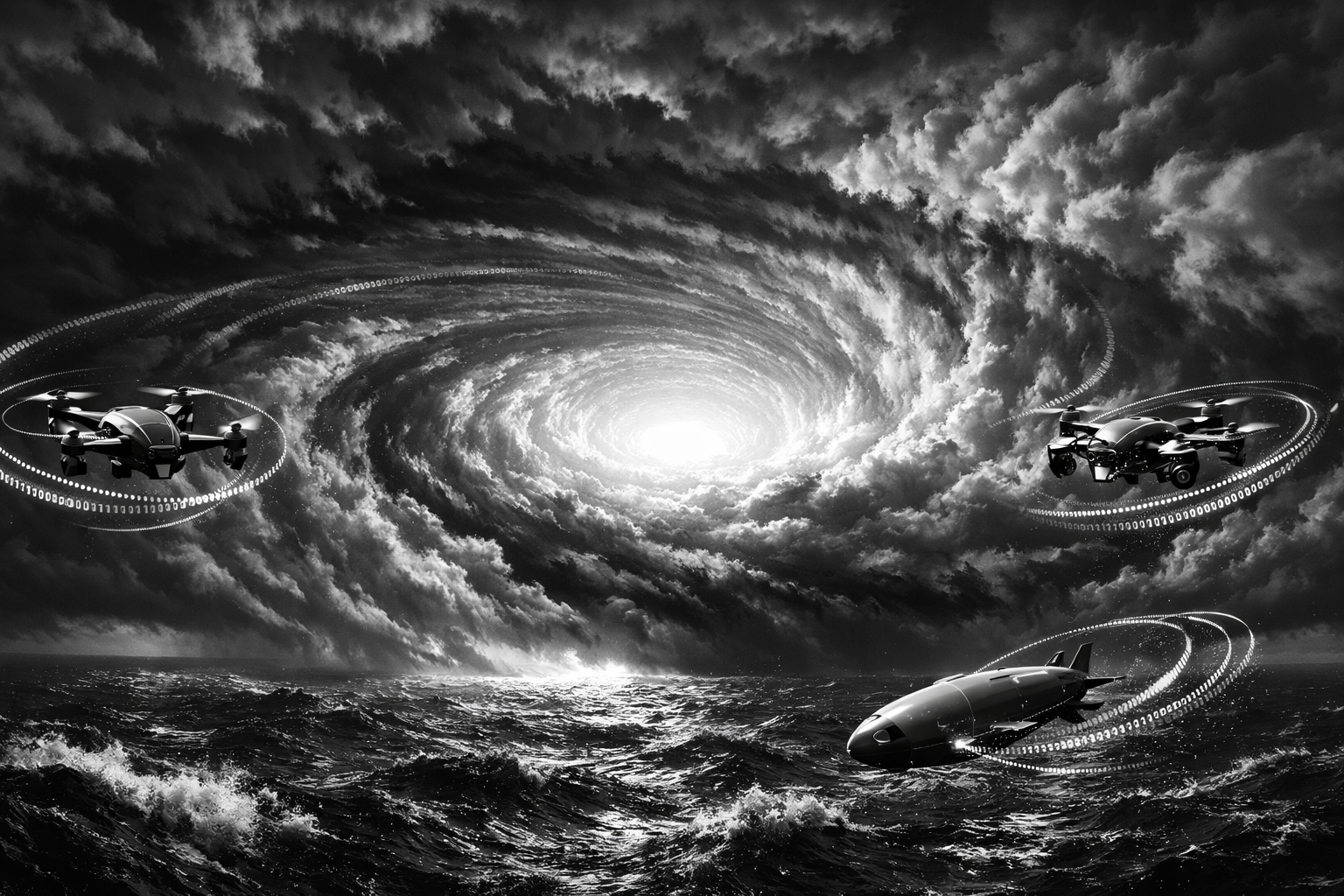
A robot in the eyewall sounds like science fiction. It might also be the next big leap in hurricane forecasting.
If you could place a sensor exactly where a hurricane is most violent, inside the eyewall where winds peak and pressure plunges, you would learn things satellites can only infer and aircraft often avoid. That is why a set of posts circulating on X on January 19, 2026, claiming a robot collected real time data from a storm's core, has grabbed so much attention. If true, it signals a shift from "remote sensing" to autonomous climate science, where machines go where humans and crewed aircraft cannot.
There is an important caveat. As of today, the claim remains unverified in public reporting and has not been confirmed by a named research institution in a way that can be independently checked. Still, the idea is not absurd. It sits squarely on top of a decade of progress in hurricane drones, ocean robots, miniaturized sensors, and AI systems that can navigate messy, dangerous environments.
What we know, what we don't, and why the distinction matters
The X posts describe a robot operating "inside the storm's core" and collecting measurements such as wind speed, pressure, temperature, and moisture. Those are the exact variables forecasters crave because they govern intensity changes, including the rapid intensification events that can turn a manageable storm into a catastrophe in less than a day.
What is missing is the chain of evidence. There is no publicly linked flight log, sensor payload specification, calibration method, data archive, or institutional statement that would let outside experts validate the feat. In climate and weather science, that is not bureaucracy for its own sake. It is how you separate a genuine breakthrough from a dramatic demo, a misinterpretation, or a marketing clip that omits the hard parts.
The most useful way to read the story right now is as a signpost. Whether this specific robot did it or not, the field is clearly moving toward autonomous systems that can sample the most dangerous parts of storms more often, more cheaply, and with less risk to people.
Why the storm's core is still a data desert
Satellites are excellent at seeing the big picture. They track cloud tops, sea surface temperatures, rainfall structure, and broad wind fields. But satellites struggle with the fine scale physics that decide whether a hurricane strengthens or weakens, especially inside the eyewall where turbulence, spray, and rapid vertical motion scramble signals.
Crewed "hurricane hunter" aircraft can fly into storms and drop instruments, but they are expensive, limited in number, and constrained by safety. Even when they fly, they cannot be everywhere at once, and they cannot linger in the most punishing zones for long. Traditional dropsondes provide a vertical snapshot as they fall, which is valuable, but it is not the same as a robot that can hold position, repeat measurements, and adapt its path as the storm evolves.
That gap matters because intensity forecasting is still the hardest part of hurricane prediction. Track forecasts have improved dramatically over the past few decades, but intensity errors remain stubborn, particularly for rapid intensification near land.
What kind of robot could survive 150 mph winds and still send data?
When people hear "robot in a hurricane," they often imagine a humanoid machine bracing against the wind. In reality, the most plausible candidates are specialized autonomous platforms designed to exploit physics rather than fight it.
One path is an uncrewed aircraft system built for extreme turbulence, with a compact airframe, redundant control surfaces, and flight software trained to handle chaotic gusts. Another is a disposable or semi disposable probe that rides the wind, prioritizing sensor survival and data transmission over returning home. A third is an ocean surface vehicle that measures the storm from below, where the air is violent but the platform can be engineered to self right and keep sampling. There are also hybrid concepts, such as a surface robot that releases small aerial probes when conditions are right.
The sensor suite described in the posts is realistic. Pressure sensors can be rugged and precise. Temperature and humidity sensors are common, though they must be shielded from spray and rapid wetting. Wind measurement is trickier because anemometers can be damaged or distorted by turbulence, so many systems infer wind from motion, pressure differentials, or multi sensor fusion rather than relying on a single spinning instrument.
The hardest engineering problem is not only surviving the wind. It is surviving water. Hurricanes are not just windy; they are abrasive. Salt spray, rain impact, and debris can destroy exposed components. Any "storm core robot" needs sealing, corrosion resistance, and a plan for what happens when sensors get soaked, iced, or clogged.
The quiet breakthrough is autonomy, not the airframe
Even if the hardware is impressive, the real shift is software. Autonomy changes hurricane science in three ways: it increases sampling frequency, it enables adaptive sampling, and it reduces the cost of failure.
Sampling frequency is straightforward. If you can deploy multiple robots, you can measure more storms, more often, and for longer periods. That matters because hurricanes are rare events in any single location, and models improve when they see many examples.
Adaptive sampling is the bigger deal. A robot can be told to seek the steepest pressure gradient, to loiter near the radius of maximum winds, or to follow a boundary where dry air is intruding. Those are the features that often decide whether a storm intensifies. In a perfect world, the robot becomes a moving microscope, guided by forecasts in real time and updating its plan as the storm changes.
Reducing the cost of failure is uncomfortable to say out loud, but it is central. Crewed missions are designed around safety. Autonomous missions can be designed around data. If a robot is lost, the mission can still be a success if the data made it out.
Data transmission is the make or break detail
Collecting measurements inside a hurricane is only half the story. Getting them out, reliably and quickly, is what turns a stunt into a forecasting tool.
Real time transmission from the eyewall is difficult because antennas can be blocked by orientation changes, water can attenuate signals, and power budgets are tight. A robust system might use multiple links, such as satellite for low bandwidth essentials and a higher bandwidth burst link when conditions allow. It might also compress data aggressively, sending the most valuable variables first, then uploading raw packets later if the robot survives.
This is also where skepticism is healthy. Many past "we flew a drone into a hurricane" stories gloss over whether the data was continuous, calibrated, and assimilated into operational models. A robot that records data to onboard storage is useful for research. A robot that streams quality controlled data into forecast systems is a different class of achievement.
How autonomous hurricane data could improve forecasts, in practical terms
Forecast models are hungry for observations, but not all observations are equal. The most valuable are those that reduce uncertainty in the storm's inner structure, especially the pressure field, the temperature and moisture profile, and the wind distribution near the surface.
If autonomous robots can repeatedly sample those variables, forecasters could see earlier signs of rapid intensification, better estimate peak winds, and refine storm surge predictions by improving the wind field that drives ocean response. Over time, the same data would also improve the models themselves, because machine learning and physics based models both get better when trained and validated against high quality ground truth.
The economic stakes are not abstract. NOAA has reported that hurricanes and tropical storms have been among the costliest U.S. disasters, with damages that can average tens of billions of dollars per year over recent decades depending on the period measured. Even small improvements in warning lead time and intensity accuracy can change evacuation decisions, port closures, grid preparation, and insurance losses.
The hype traps to watch for in "AI robots in hurricanes"
The current story is a perfect example of how climate tech narratives can outrun verification. There are a few recurring traps that readers should learn to spot.
One is confusing "entered the storm" with "measured the core." Flying in outer rain bands is not the same as sampling the eyewall. Another is confusing "collected data" with "collected usable data." Sensors can saturate, drift, or fail silently. A third is confusing "real time" with "eventually uploaded." In operational forecasting, minutes matter.
Then there is the AI label itself. Autonomy does not require a giant model onboard. In fact, the most reliable storm robots may use relatively simple control laws plus robust state estimation, because compute, power, and heat are limited. The smartest system might be the one that does less onboard and relies on careful mission design, redundancy, and a clean data pipeline.
What would count as credible proof, and what to ask next
If an institution steps forward to confirm a "storm core robot" mission, credibility will hinge on specifics that are easy to request and hard to fake.
Look for a named platform and team, a timestamped mission track, sensor specifications and calibration notes, and a dataset that can be inspected by outside researchers. The gold standard is evidence that the observations were assimilated into a forecast model or at least compared against independent measurements from aircraft, buoys, or radar.
The most interesting follow up question is not "did it fly into a hurricane?" It is "can we do it at scale?" One robot is a headline. A fleet that can be deployed ahead of landfall, coordinate sampling, and feed data into operational centers is a new layer of planetary instrumentation.
The bigger shift: climate science becomes embodied
For years, climate technology has been dominated by remote sensing, supercomputers, and dashboards. Autonomous robots change the texture of the work. They turn the atmosphere and ocean into places where instruments can move, decide, and persist.
That is why the January 2026 rumor matters even before it is verified. It reflects a broader transition toward embodied intelligence, where AI is not just predicting the world but physically sampling it, closing the loop between observation and model. If the next hurricane season includes robots that can safely and repeatedly measure the eyewall, the most valuable forecast improvement may come from a simple new capability: finally seeing, directly and continuously, what the storm is doing at its most decisive point.
When the first publicly released dataset arrives that lets anyone plot pressure, wind, and moisture from inside the core in real time, it will not just be a win for robotics, it will be a reminder that the future of climate adaptation is built as much in the field as it is in the cloud.