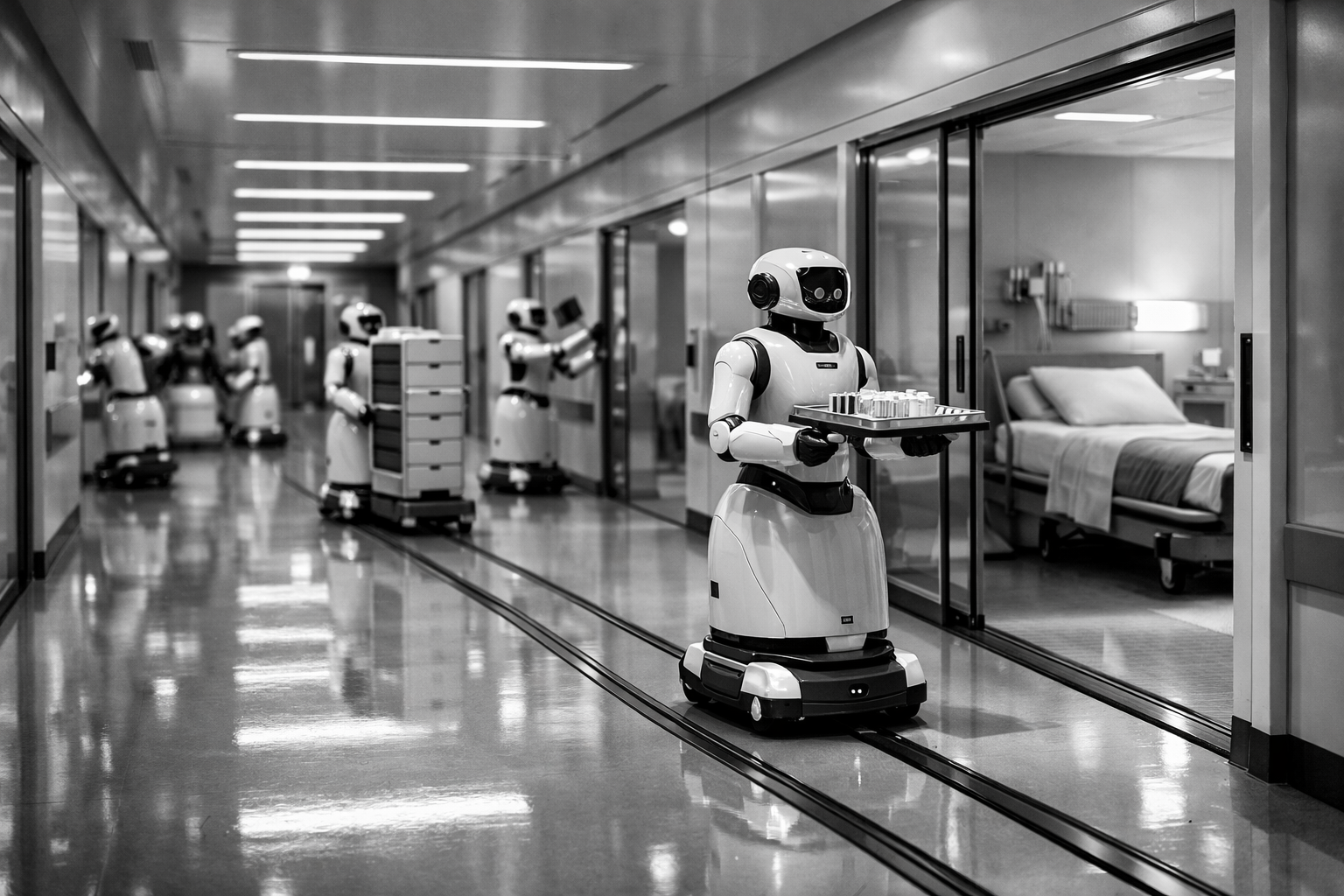
Robotics is having its "smartphone moment" inside hospitals
If you want to understand where robotics is heading next, stop looking at factory arms and start looking at hospital hallways. In January 2026, posts on X claimed Serve Robotics, best known for autonomous sidewalk delivery, has acquired Diligent Robotics, the company behind the hospital service robot often associated with the "Moxi" name. The rumor alone reportedly pushed $SERV higher, which tells you something important: investors and operators increasingly believe the real growth in robotics is moving from novelty deployments to mission-critical work.
The details of the deal are not confirmed in the public information provided here, and the posts themselves urged caution. But the direction of travel is clear. Healthcare is becoming the proving ground for service robots that do unglamorous tasks reliably, all day, in crowded environments where mistakes are expensive.
What "hospital robotics" actually means in 2026
When most people hear "medical robot," they picture a surgical system. That is only one slice of the market. The fastest-growing category is often simpler and more scalable: autonomous hospital assistants that move things, fetch things, and document handoffs. They are not replacing clinicians. They are replacing the constant interruptions that pull clinicians away from patients.
A typical service robot's day looks like a string of small missions. It might deliver lab samples to pathology, bring clean linens to a ward, move medications from pharmacy to a secure drop point, or restock PPE. None of these tasks are complex in isolation. The complexity comes from doing them safely in dynamic spaces, with elevators, doors, visitors, gurneys, and last-minute route changes.
This is why the "boring" robots are winning budget. They target a hospital's most constrained resource: staff time. In many systems, the hidden cost is not wages alone. It is the cascade of delays when a nurse is pulled away to chase supplies, when a specimen sits too long before transport, or when a unit runs short and someone improvises.
Why the Serve and Diligent combination makes strategic sense
Even if the acquisition is only a rumor today, the logic behind it is easy to see. Serve Robotics has built its reputation on autonomous navigation in public spaces, where safety, predictability, and human interaction matter. Diligent's strength is the hospital workflow layer: knowing what to pick up, where to drop it, how to fit into clinical routines, and how to earn trust from staff who do not have time for "beta."
Put those together and you get a playbook that many robotics companies struggle to execute. One side brings robust autonomy and fleet operations. The other brings domain-specific integration, including the messy reality of hospital maps, access control, and the social contract of working around patients.
There is also a commercial reason this pairing is attractive. Sidewalk delivery is visible, but it can be seasonal, city-by-city, and sensitive to local regulation. Hospitals, by contrast, run 24/7. If a robot proves it can reduce delays and free up staff, it becomes part of the operating model, not a marketing experiment.
The real product is not the robot, it is the workflow
Robotics companies love to talk about sensors, autonomy stacks, and AI. Hospital buyers care about something else: whether the robot reliably completes tasks without creating new work. The difference between a pilot and a rollout is rarely the hardware. It is the workflow design.
In practice, successful deployments tend to follow a pattern. First, the hospital picks a narrow set of high-frequency routes, like pharmacy to unit supply rooms. Then it defines handoff rules so staff do not have to "babysit" the robot. Next comes integration with doors, elevators, and badge systems, because a robot that waits outside a locked door is not automation, it is a hallway ornament.
Finally, the hospital measures outcomes that matter to operations leaders. Not "cool factor," but turnaround time for deliveries, reduction in staff steps per shift, fewer missed restocks, and fewer delays in specimen transport. When those numbers move, the robot stops being a gadget and starts being infrastructure.
The market is big, but the constraints are real
The background context circulating with the X posts frames hospital automation as a $15B-plus market with strong growth expectations through 2030. Whether you agree with that exact number or not, the underlying drivers are hard to dispute: aging populations, chronic staff shortages, rising patient acuity, and relentless pressure to do more with the same headcount.
But hospitals are also one of the hardest places to deploy autonomy. The environment changes constantly. Construction reroutes corridors. Units get reconfigured. Infection control rules shift. A robot that performs well in one wing can fail in another because the "last 10 percent" is different everywhere.
There is also a misconception that every hospital robot needs FDA clearance. Many service robots are not medical devices in the regulatory sense because they are not diagnosing or treating. Still, hospitals impose their own governance. Cybersecurity reviews, privacy requirements, and safety committees can slow rollouts, especially if the robot touches systems that log patient-related tasks.
What makes a hospital trust a robot
Trust is built in small moments. Does the robot yield politely in a narrow corridor? Does it avoid startling patients? Does it recover gracefully when someone blocks its path? Does it know when to ask for help, and does that request arrive in a way that does not annoy staff?
The best systems treat autonomy as a spectrum, not a binary. They combine onboard navigation with remote support for edge cases. They log exceptions so the hospital can fix root causes, like a door that closes too quickly or a route that is always congested at shift change. Over time, the robot becomes less of a "thing that moves" and more of a service that improves.
This is also where AI matters in a practical way. Not as a buzzword, but as a tool for better perception, better prediction of human movement, and better scheduling so robots are not all trying to use the same elevator at once.
If you are watching $SERV, watch these signals, not the hype
A stock pop on acquisition chatter is not the same as a durable business shift. If Serve truly is moving deeper into healthcare robotics, the most telling indicators will be operational, not promotional.
Look for evidence of repeatable deployments across multiple hospital systems, not one flagship site. Look for expanding scope, where robots move from a single delivery route to multiple departments. Look for integration partnerships with elevator and access-control vendors, because that is where indoor autonomy either scales or stalls. And look for gross margin stability, because service robotics can quietly become a support-heavy business if reliability is not high.
Also watch the supply chain. The background notes mention power-efficient AI hardware constraints. In robotics, component availability can dictate delivery schedules, and delivery schedules dictate revenue recognition. A company can have demand and still miss numbers if it cannot ship.
The bigger story: robotics is moving from "can it work?" to "can it run every day?"
The most important shift in robotics right now is not a new sensor or a flashier demo. It is the industry learning how to operate fleets in the real world. That means maintenance, uptime, training, incident response, and continuous improvement. It means robots that can be cleaned properly, updated safely, and supported without disrupting care.
If Serve and Diligent are indeed coming together, the bet is that the next robotics winners will look less like hardware companies and more like operators of a dependable service. Hospitals do not need a robot that is impressive once. They need a robot that is quietly useful a thousand times, and still shows up for the thousand-and-first run.
In 2026, the most disruptive robotics innovation may be the one that finally makes "autonomous" feel ordinary, because the hallway is busy, the shift is understaffed, and the robot simply gets on with the job.