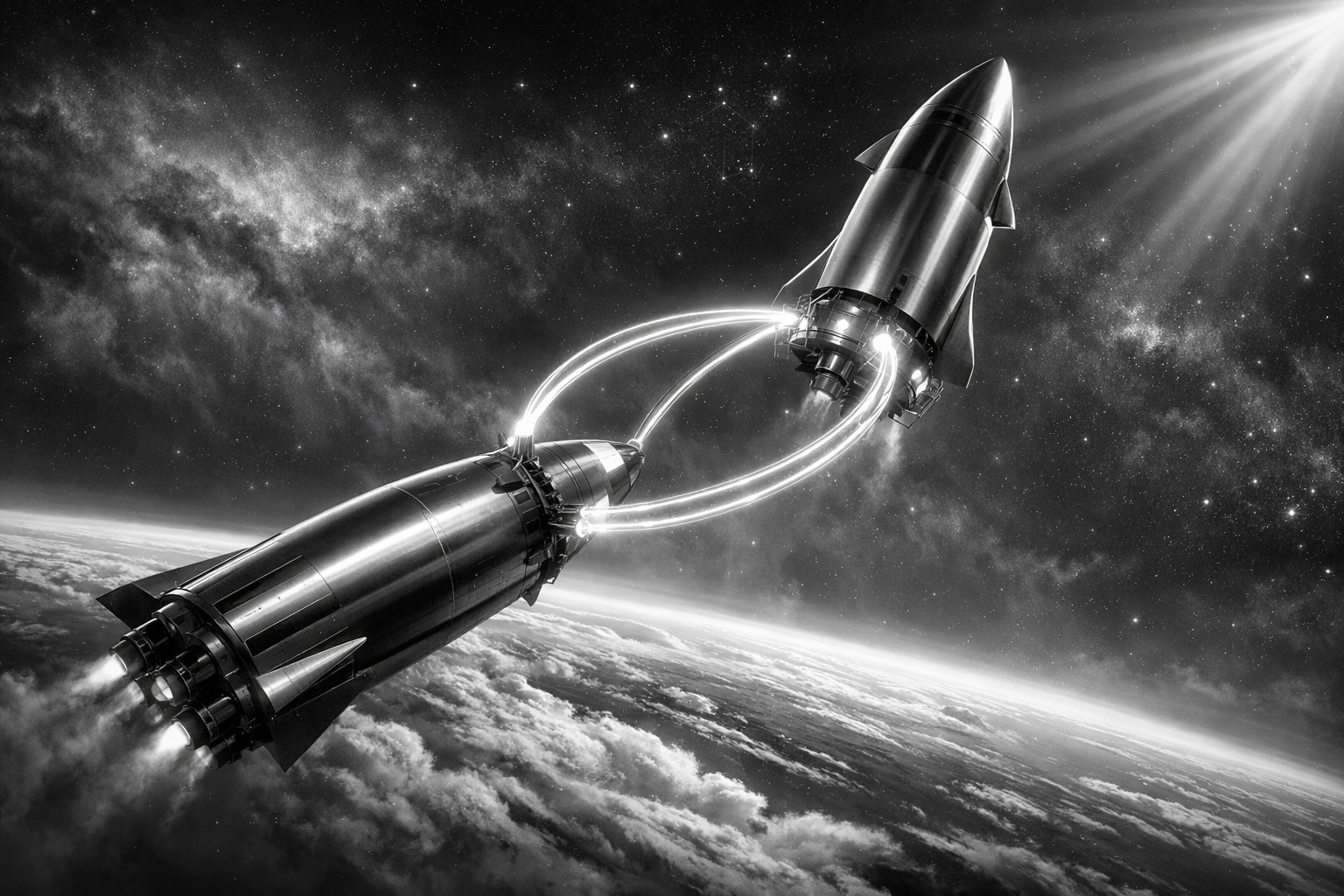
If you want a single test that separates "cool rocket" from "Mars transport system," it is this: moving super-cold propellant from one spacecraft to another while both are flying in orbit. SpaceX says Starship has now done it, completing its first in-orbit propellant transfer during its latest integrated flight test. If the claim holds up under scrutiny, it is one of the most consequential steps yet toward making deep-space missions routine rather than heroic.
The reason is simple. Starship is designed to launch to orbit not as a fully fueled interplanetary ship, but as a vehicle that gets topped up in space by tanker Starships. Without orbital refueling, Mars remains a poster. With it, Mars becomes a logistics problem.
What SpaceX says happened in orbit
According to SpaceX's update, the demonstration transferred roughly 11 metric tons of cryogenic propellant, liquid oxygen and liquid methane, from a tanker Starship to a target Starship in low Earth orbit at around 250 kilometers altitude. SpaceX reported that 98.7 percent of the planned transfer completed without leaks or anomalies, and that the operation took 47 minutes from start to finish.
The company also described automated proximity operations and docking aided by laser-guided systems, with refinements informed by earlier flight data. Telemetry shown during the broadcast indicated stable pressure behavior during the transfer, a detail that matters because pressure swings are often the first sign that a cryogenic system is misbehaving in microgravity.
Orbital refueling is not a "nice to have." It is the enabling technology that lets a vehicle launch with a manageable amount of propellant, then load the rest in space where gravity is no longer stealing performance.
Why propellant transfer is so hard in space
On Earth, liquids settle at the bottom of a tank. In orbit, they float, slosh, and form bubbles. That sounds like a minor inconvenience until you remember that rocket engines do not drink bubbles. They need a steady, predictable flow of liquid at the right temperature and pressure, and they need it without introducing gas that can cause cavitation, unstable combustion, or shutdown.
Then there is the temperature problem. Liquid oxygen and liquid methane are cryogenic, meaning they are stored extremely cold. Any heat leak into the tanks causes boil-off, which raises pressure and can vent valuable propellant. Over days, boil-off becomes a mission-killer unless you have excellent insulation, active cooling, or a plan to refuel quickly and depart.
Finally, there is the choreography. Two large vehicles must rendezvous, match orbits, control relative motion, and connect plumbing in a way that is safe, repeatable, and tolerant of small errors. Doing that once is impressive. Doing it many times, with tanker after tanker, is what a Mars campaign demands.
What this changes for Mars, and what it does not
The headline implication is range. A Starship that reaches orbit with a partial propellant load can, in theory, be refueled to support high-energy departures for the Moon, Mars, or other deep-space destinations. SpaceX has long argued that this is how it can move large payloads and eventually people, because launching a fully fueled interplanetary stack from Earth in one go is brutally inefficient.
But a single transfer, even a clean one, does not automatically mean "Mars in 2028." It means the hardest physics and plumbing problem has been demonstrated in the environment that matters. The remaining work is about scale, reliability, and operations, the unglamorous parts that decide whether a breakthrough becomes a transportation system.
The real milestone is not that propellant moved. It is that the transfer looked controlled, measurable, and repeatable enough to be engineered into a routine.
The hidden scoreboard: what engineers will look for next
SpaceX's reported numbers, transfer mass, duration, and pressure stability, are the kind of details that let outsiders infer whether the system is behaving like a prototype or like a product. Still, the most important questions are the ones that do not fit neatly into a celebratory post.
First is repeatability. Can the same hardware do this again on the next flight without major redesign? Second is precision. How accurately can SpaceX measure transferred mass in microgravity, and how confident is it in the sensors when the propellant is two-phase, part liquid and part gas? Third is contamination control. Even tiny amounts of trapped gas, ice, or debris in valves and couplers can turn a clean test into a future failure.
Then comes the operational question that critics keep returning to: tanker count. Depending on payload and mission profile, a Mars-bound Starship could require multiple tanker flights to fill it. That is not inherently a problem if launches are frequent and cheap, but it is a problem if each tanker requires long on-orbit loiter time, complex scheduling, or extensive refurbishment.
How this fits into NASA's plans, and why that matters
NASA's interest in Starship is not theoretical. The agency has selected a Starship-derived vehicle for Artemis lunar landing work, and it has been clear that cryogenic propellant management and transfer are central to sustainable exploration. If SpaceX can demonstrate reliable orbital refueling, it strengthens the case that large-scale lunar logistics are feasible without building an entirely new class of government-owned tankers.
It also changes the conversation around infrastructure. A future where propellant can be moved around in orbit makes depots, staging orbits, and reusable tugs more practical. It is the difference between every mission being a bespoke stunt and missions becoming something closer to airline routing, with refueling stops and standardized procedures.
What competitors and skeptics are right to point out
The most credible skepticism is not about whether propellant can be transferred. It can. The skepticism is about whether it can be done at the cadence and reliability needed for a sustained Mars program, and whether boil-off and on-orbit timelines will quietly erode the economics.
Even small daily losses add up if a vehicle must wait in orbit for multiple tanker launches. SpaceX says insulation and system upgrades can push losses down, but the proof will come from longer-duration demonstrations, not short transfers. Another open question is fault tolerance. What happens if a tanker has a valve issue, a docking sensor glitch, or a thermal problem? A transportation system needs graceful failure modes, not just success cases.
The near-term roadmap: what to watch on the next flights
The next meaningful step is not necessarily a bigger transfer, although that will come. It is a more operationally realistic sequence: multiple dockings, multiple transfers, longer loiter times, and a clear accounting of propellant losses. If SpaceX can show that a Starship can be topped up over several events and still depart with predictable margins, the conversation shifts from "can it be done" to "how fast can it be industrialized."
Watch for evidence of standardized docking hardware, faster rendezvous timelines, and improved thermal control. Also watch for how quickly regulators clear subsequent flights, because cadence is not just an engineering variable. It is a policy and safety variable too.
The bigger idea hiding inside a plumbing test
It is easy to underestimate a propellant transfer because it lacks the drama of a launch or a landing. But this is the kind of capability that turns rockets into routes. When you can refuel in orbit, you stop treating Earth's gravity well like a one-shot penalty and start treating it like the first leg of a longer trip.
If SpaceX's demonstration stands up and scales, the most important change may not be that humans reach Mars sooner. It may be that, for the first time, leaving Earth starts to look less like an expedition and more like a schedule.