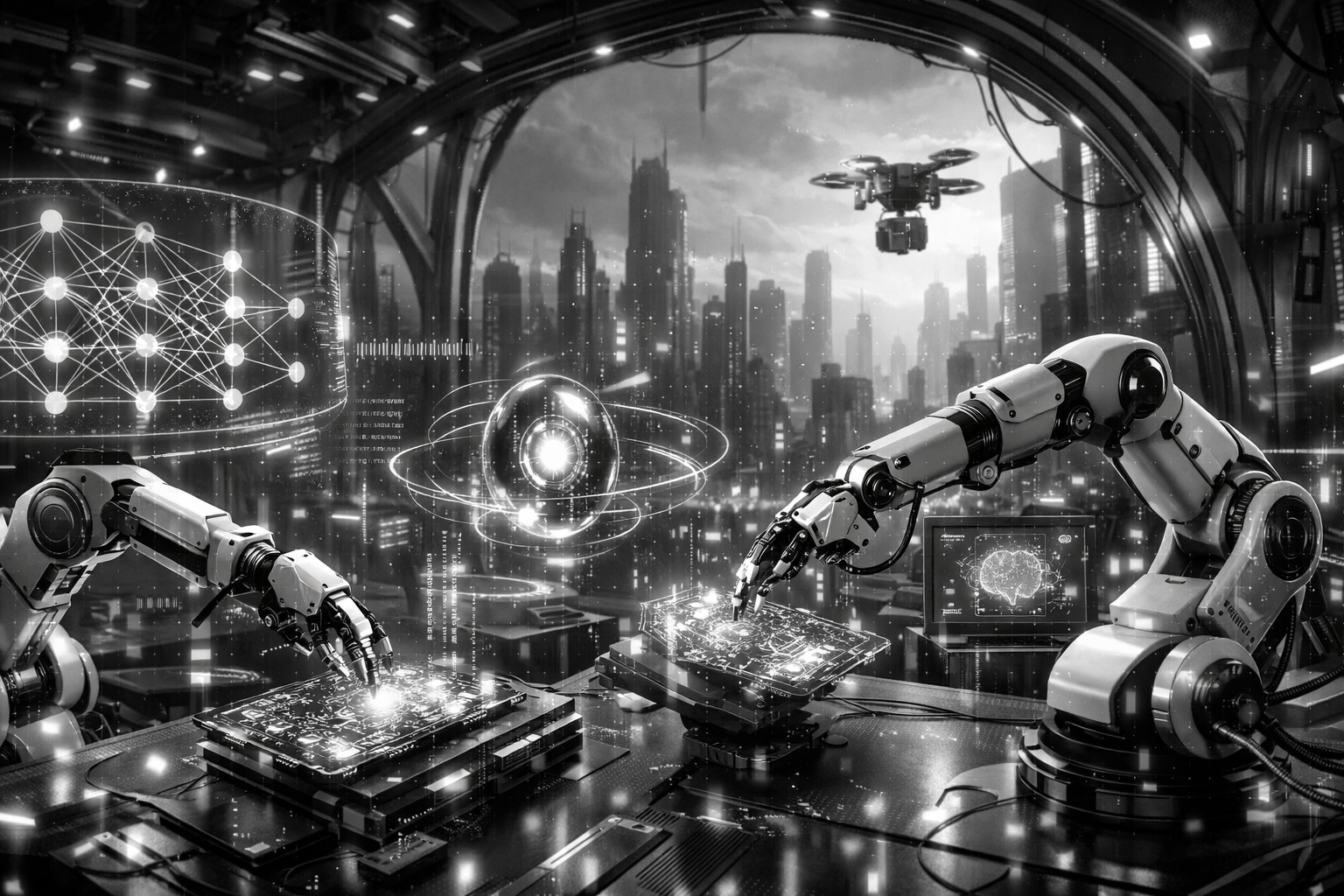
AI CES 2026 Robotics
If you want one signal to cut through the CES noise, watch for this: the moment AI stops being a clever chatbot and starts behaving like a reliable co-worker. That shift is what people mean by agentic AI, systems that can plan, act, and recover when the world gets messy. And it is why a fresh wave of chatter about Meta releasing the first AI models from a new dedicated lab has landed with such force right as CES 2026 is putting real-world robotics on stage.
There is an important caveat. The current buzz is largely driven by unverified social posts, not a detailed technical release. Still, the timing is telling. CES has become a showcase for robots that do more than wave and pose. The industry is chasing machines that can stock shelves, assist in warehouses, support elder care, and handle repetitive tasks in offices and homes. Those jobs do not fail gracefully. They fail loudly, in public, and sometimes expensively.
What we know versus what we don't. Online posts claim Meta has released its first AI models from a newly created lab. As of the information provided here, there are no confirmed specifications, benchmarks, licensing terms, or deployment details. Treat the claim as a lead, not a fact, until Meta publishes an official announcement or documentation.
Why this rumor matters even before it's confirmed
Big AI releases are no longer just about who has the smartest model on a leaderboard. The more consequential question in 2026 is who can ship AI that works outside a demo. That means AI that can handle interruptions, incomplete instructions, sensor noise, and the awkward reality that humans change their minds mid-task.
A dedicated lab, if real, suggests a focus on repeatable engineering rather than one-off research wins. It hints at a pipeline: data collection, model training, evaluation, safety testing, and deployment practices designed for products that must survive contact with the real world. In robotics, that pipeline is the difference between a prototype and a fleet.
Agentic AI, explained like you actually have a job to do
Most people have experienced AI as a single-turn tool. You ask, it answers. Agentic AI is different. You give it a goal, and it breaks that goal into steps, chooses tools, checks its own work, and keeps going until it hits a stopping condition. In practice, it behaves less like a search box and more like a junior operator.
The promise is not magic. It is workflow. An agent can read a policy document, open a ticket, draft a response, request approval, and then update the system of record. In robotics, the same pattern becomes: perceive the environment, plan a route, pick an object, verify the grasp, recover if it slips, and log what happened.
The hard part is not the first step. It is the fifth, when something unexpected happens and the system must decide whether to retry, ask for help, or stop safely.
CES 2026 and the new bar for "real-world" robotics
CES has always loved spectacle, but the market is increasingly allergic to robots that only work under perfect lighting with a friendly operator nearby. The most interesting demos now tend to share three traits: they run longer, they operate in clutter, and they show recovery behavior when things go wrong.
That is where modern AI models matter. Robotics is not just motors and sensors. It is decision-making under uncertainty. A robot that can interpret a messy instruction like "put the fragile items on the top shelf, but not next to the cleaning spray" needs language understanding, spatial reasoning, and a memory of what it has already done.
If Meta's rumored lab models are aimed at this space, the key question is whether they improve reliability, not whether they write better poetry.
What to look for in Meta's "first lab models" if details emerge
When an official release arrives, it will be tempting to focus on parameter counts and flashy charts. Those numbers can matter, but they rarely tell you whether a model will succeed in a robot, a headset, or a consumer device that has to run on a power budget.
Instead, watch for evidence in four areas: how the model handles long tasks, how it uses tools, how it deals with uncertainty, and how it is evaluated. A model that can plan is useful. A model that can plan and then verify its own progress is the one that can be trusted with physical actions.
Also watch for the unglamorous details. Does the release include a clear license? Are there safety notes? Is there a reproducible evaluation suite? Are there deployment targets, such as on-device inference, edge servers, or cloud-only operation? These are the signals that separate a research artifact from a product foundation.
The quiet technical shift: from "answers" to "actions"
The industry is moving from models that generate text to systems that execute. That usually means a model is wrapped in scaffolding: tool calling, memory, retrieval, policy checks, and monitoring. The model becomes the brain, but the system becomes the worker.
In consumer tech, this is how you get assistants that can actually do things. Not just "here's how to cancel your subscription," but "I found the cancellation page, filled the form, and I'm waiting for your confirmation before I click submit." In robotics, it becomes "I attempted the pickup twice, the object is slipping, I'm switching to a different grasp and slowing down."
If Meta is building models in a dedicated lab, the most strategic move would be to optimize for this system-level behavior, not just raw generation quality.
Market impact: why investors and competitors care
AI is now a platform game. The winners are not only those with strong models, but those who can attract developers, integrate into devices, and ship updates safely. A credible new model line from Meta would matter because Meta already controls major distribution surfaces: social apps, advertising infrastructure, and consumer hardware ambitions.
If those models are tuned for agentic workflows, they could accelerate a shift in how consumer products are built. Instead of adding "AI features" as a layer, companies will redesign products around tasks. The interface becomes a goal box, a set of guardrails, and a log of what the system did.
That is also why competitors would pay attention. A model release is not just a model. It is a bet on an ecosystem.
The safety question that will not go away
The more AI can act, the more it can cause harm by mistake. In software, a bad agent might send the wrong email or delete a file. In robotics, a bad agent can knock something over, damage property, or injure someone. That is why "agentic" should always trigger a second question: what are the constraints?
If Meta publishes details, look for practical safety measures rather than vague promises. Things like permissioning for high-impact actions, clear escalation to a human, conservative defaults, and robust logging. In robotics, look for safe stop behavior, speed limits, and explicit handling of uncertainty.
The most trustworthy systems are not the ones that never fail. They are the ones that fail in predictable, recoverable ways.
How to separate hype from signal in the next 30 days
If you are trying to make decisions, whether you are a product leader, a developer, or just a consumer who wants to understand what is coming, you do not need insider access. You need a checklist and a little patience.
A practical verification checklist
First, wait for primary sources. That means a Meta blog post, a paper, a model card, a repository, or documentation that can be cited and inspected.
Second, look for independent replication. If the model is accessible, credible third parties will test it quickly, and their results will converge on what it can and cannot do.
Third, focus on failure modes. Search for what breaks it, not what flatters it. The most useful reviews are the ones that show where the model refuses, hallucinates, or takes unsafe actions.
Finally, track deployment reality. A model that only runs in a controlled cloud environment is different from one that can run on-device, in a headset, or near a robot with tight latency requirements.
What this could mean for everyday life if the trend holds
The near-term future is not humanoid robots doing everything. It is narrower, more practical, and more disruptive. It is software agents that handle the boring parts of knowledge work, and robots that take on repetitive physical tasks in constrained environments.
That is why CES matters. It is where consumer expectations get set. When people see machines that can navigate, pick, place, and recover, they start asking why their devices cannot do the same kind of end-to-end work in digital spaces.
If Meta's rumored lab models are real and designed for action, not just conversation, the most interesting outcome will not be a single killer app. It will be a slow, steady redefinition of what we consider a normal feature, until "it can't do that for me" starts to sound as outdated as "it can't connect to WiFi."