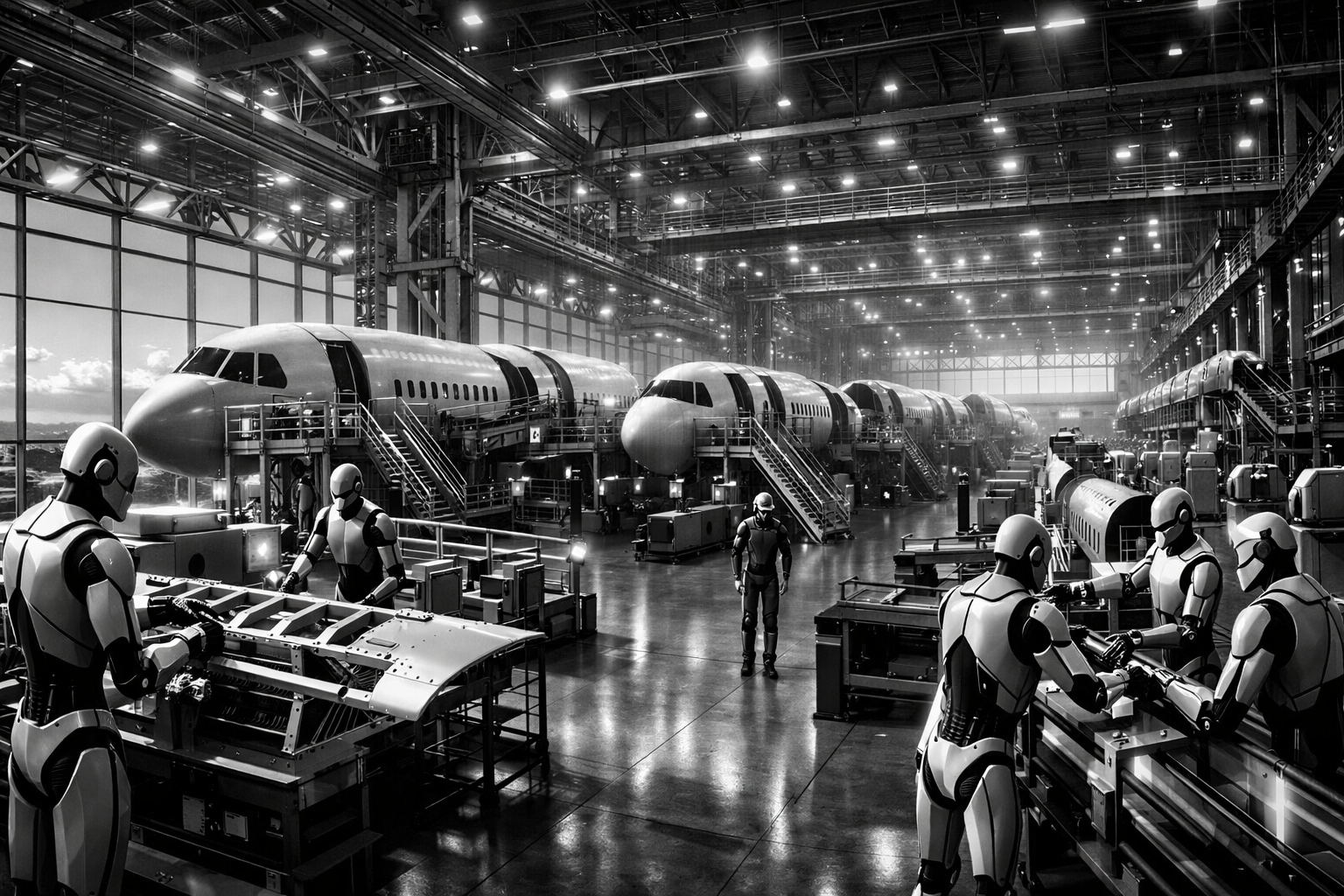
Aviation manufacturing has a new bottleneck, and it is not carbon fiber
Aircraft factories are some of the most automated places on Earth, yet they still rely heavily on people for the awkward, variable, high-mix work that robots struggle with. That is why the latest agreement between UBTech and Airbus matters. It is not another "robot arm in a cage" story. It is a bet that humanoid robots can finally do the in-between tasks that slow production, inflate costs, and quietly drain quality.
On January 21, 2026, UBTech signed a strategic agreement with Airbus to supply humanoid robots for aviation manufacturing, according to Reuters reporting cited in recent tech updates. Financial terms were not disclosed, but the intent is clear: put bipedal, human-shaped machines into real aircraft facilities to support assembly, inspection, and internal logistics in environments built for humans.
What Airbus is really buying when it buys a humanoid
A humanoid robot is not automatically better than a traditional industrial robot. In many cases it is worse. A six-axis arm bolted to the floor is faster, stronger, and more repeatable. The reason Airbus is interested is not raw performance. It is compatibility.
Aircraft factories are full of human-scale constraints: narrow aisles, stairs, tool carts, ladders, mixed workstations, and parts that arrive in different orientations. Rebuilding a plant around fixed automation is expensive and slow. A humanoid, in theory, can walk to where the work is, use the same tools, open the same doors, and operate in the same spaces without a full redesign.
UBTech is best known for its Walker series, bipedal robots designed for human-like dexterity and AI-driven decision-making. The Airbus agreement points to customized units optimized for aerospace standards, which is a polite way of saying the robots will need to meet stricter expectations than a trade show demo. In aviation, "good enough" is rarely good enough.
The tasks that make or break humanoids in aircraft production
The most valuable factory tasks are often the least glamorous. They are also the hardest to automate because they change constantly. Airbus and UBTech have signaled a focus on assembly support, inspection, and logistics. Those three categories cover a lot of pain.
Start with logistics. If a humanoid can reliably move kits, fetch tools, deliver fasteners, and keep workstations supplied, it can reduce the "walking time" that quietly eats hours in every shift. In high-mix manufacturing, the right part arriving at the right time is not a nice-to-have. It is the difference between flow and stoppage.
Inspection is the next prize. Aircraft assembly involves thousands of checks, from verifying torque markings to confirming that a bracket is the correct revision. A humanoid equipped with vision systems can act as a mobile inspection assistant, capturing images, reading labels, and flagging anomalies. The value is not just catching defects. It is creating a traceable record that can be audited later.
Assembly is the hardest category, and the one most likely to be misunderstood. The near-term win is not a humanoid installing critical flight hardware end-to-end. It is a humanoid doing the "third hand" work: holding a panel in place, positioning a jig, presenting tools, or performing repetitive prep steps while a skilled technician does the precision operation. If Airbus is serious about "augmentation," this is where that promise becomes real.
Why this deal is happening now: physical AI is leaving the lab
Humanoids have been "almost ready" for years. What changed is not just motors and batteries. It is the software stack. The post-CES 2026 wave of "physical AI" messaging, including platforms aimed at teaching robots to perceive and act in messy environments, has pushed the industry toward more adaptable machines.
UBTech's pitch, as described in the background reporting, leans on multimodal AI for real-time adaptation, including vision-language capabilities that can help a robot interpret instructions and handle tools. In practice, that means fewer brittle scripts and more behavior that can generalize across similar tasks. It does not mean the robot "understands" aviation. It means it can be trained and supervised in ways that look more like coaching than coding.
Airbus has also been exploring humanoids through trials with other robotics firms. That matters because it suggests Airbus is not shopping for a single magic robot. It is building a playbook: where humanoids work, where they do not, and what safety and quality gates must exist before scaling.
The cost-savings headline is tempting, but the real metric is throughput
Industry benchmarks often cite 20 to 30% manufacturing cost reduction over several years as automation deepens, and that range has been echoed in commentary around Industry 4.0 programs. It is an attractive number, and it will be repeated. But in aircraft manufacturing, the more strategic metric is throughput: how many aircraft can be delivered on time, at spec, without rework.
Humanoids can help throughput in three ways. First, they can reduce micro-stoppages by keeping stations supplied and ready. Second, they can reduce rework by catching issues earlier through consistent inspection support. Third, they can extend effective labor capacity by taking on physically taxing or time-consuming support tasks, allowing skilled workers to focus on the steps that truly require judgment.
If the robots merely replace a small number of labor hours but introduce downtime, safety incidents, or quality escapes, the economics collapse. The factories that win will be the ones that treat humanoids like a production system, not a gadget.
Safety and certification: the quiet battlefield
Putting a humanoid into a live aircraft factory is not like deploying a robot in a warehouse. Aviation manufacturing is governed by strict process control, documentation, and quality assurance. Even if a humanoid never touches a flight-critical part, it still operates in the same environment where traceability and compliance are non-negotiable.
That raises practical questions Airbus and UBTech will have to answer on the floor, not in press releases. How is the robot's work logged? How are its sensors calibrated and verified? What happens when it encounters an unexpected obstacle? Who has authority to override it, and how quickly? How is it prevented from becoming a moving hazard around people, carts, and suspended loads?
This is also where regulators and standards bodies will start paying attention. As humanoids become common in high-consequence manufacturing, expectations around safety cases, interoperability, and audit trails will harden. The first large deployments will effectively write the rulebook for everyone else.
Jobs: the most sensitive part of the story, and the most misunderstood
Airbus has emphasized augmentation over replacement, alongside training programs for workers to oversee robotic fleets. That framing is not just public relations. It reflects a real constraint: aviation faces a long-term skilled labor challenge, with widely cited forecasts pointing to significant workforce gaps by 2030.
In the near term, the most likely shift is not mass displacement. It is job reshaping. More technicians will spend time supervising, validating, and troubleshooting robotic work. More team leads will manage mixed crews of humans and machines. More quality staff will review robot-captured evidence, not just paper checklists.
The uncomfortable truth is that augmentation can still reduce headcount growth. A factory can produce more without hiring as many people. For a company under delivery pressure, that is the point. For workers, the best outcome is that the new roles are safer, better paid, and more sustainable than the repetitive tasks humanoids are designed to absorb.
Geopolitics and supply chains: why this partnership will be watched closely
UBTech is a Chinese robotics firm moving deeper into Western industrial environments at a time of heightened U.S.-China tech tension. Even when a deal is purely commercial, it will be interpreted through a strategic lens. Aerospace manufacturing is not just another vertical. It sits close to national industrial policy, export controls, and security concerns.
That does not mean the partnership is doomed. It means it will likely require careful governance. Data handling, on-premise deployment options, software update controls, and clear boundaries around what is collected and where it is processed will matter as much as walking speed or payload.
Investors noticed the significance immediately. UBTech shares rose after the announcement in Hong Kong trading, reflecting optimism that humanoids are crossing from pilot projects into industries with deep budgets and long production horizons.
What to watch next inside Airbus factories
The first real signal will be scope. If the robots are confined to controlled logistics routes and simple fetch-and-carry tasks, the deployment is cautious. If they are placed near active assembly stations, interacting with tools and fixtures, Airbus is moving faster and taking on more operational risk.
The second signal will be uptime. Humanoids that require frequent resets, manual recovery, or constant babysitting do not scale. The factories that succeed will treat reliability as a product feature, with maintenance routines, spare parts strategy, and clear escalation paths.
The third signal will be how Airbus measures success. If the KPIs are framed around "robot hours" or "tasks completed," expect a lot of impressive charts and limited impact. If the KPIs are framed around reduced rework, fewer line stoppages, and improved station readiness, the robots are being judged the way manufacturing actually works.
And the final signal will be cultural. The moment a technician says, without irony, "send the humanoid to grab the kit," the technology has crossed the hardest gap of all: becoming normal.
If UBTech and Airbus get this right, the most important change will not be that robots can build aircraft, but that aircraft factories can finally stop being redesigned around automation and start letting automation adapt to them.