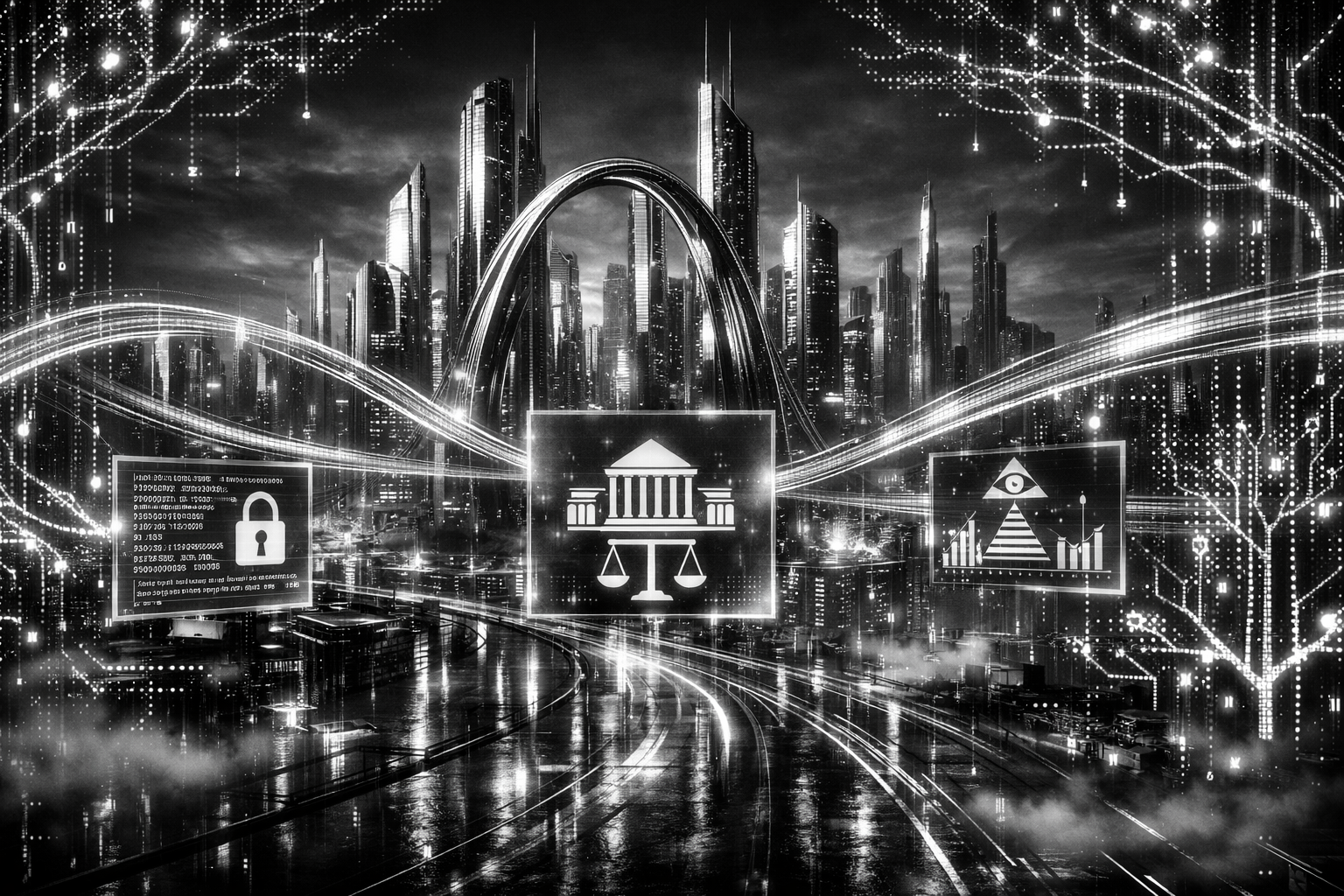
The most dangerous promise in politics: "We can remove humans from the loop"
If corruption is a tax on everyday life, then the idea of a global AI government sounds like a miracle cure. No brown envelopes. No nepotism. No "my cousin got the contract." Just rules, applied consistently, at machine speed.
But the same design that can make bribery harder can also make dissent impossible. A system that sees everything, scores everyone, and allocates resources automatically does not need to be cruel to become tyrannical. It only needs to be unchallengeable.
So would a global AI government eliminate corruption or create a new form of tyranny? The honest answer is that it could do either, depending less on the model and more on who controls it, what data feeds it, and how easily ordinary people can appeal its decisions.
What people mean by "AI government" (and what already exists)
Most proposals for AI governance are not about replacing parliaments with a chatbot. They are about automating the parts of government where corruption thrives: procurement, licensing, inspections, tax audits, welfare eligibility, border processing, and policing priorities.
This is not science fiction. Governments already use machine learning to flag suspicious tax returns, detect procurement anomalies, and verify benefits. The global trend is clear: more national AI strategies now include public service delivery, and regulators are increasingly treating public sector AI as "high risk" because it can affect rights, livelihoods, and freedom.
A "global AI government" is simply the extreme version. Instead of many agencies running many systems, you get a shared, cross-border decision engine. It might set standards, coordinate enforcement, and arbitrate disputes. It might also become the default operating system for public life.
How AI could reduce corruption in the real world
Corruption often depends on three ingredients: discretion, opacity, and weak enforcement. AI can, in theory, attack all three.
It can shrink discretion by standardising decisions
When a permit is approved because an official "used their judgment," you have a corruption opportunity. When the criteria are explicit and consistently applied, the room for favouritism narrows. Risk scoring models can also prioritise inspections based on patterns rather than personal relationships, which is one reason tax agencies and customs authorities have invested heavily in analytics.
The catch is that standardisation only works if the rules are legitimate and the model is trained and tested to apply them fairly. Otherwise you do not remove discretion. You just move it upstream, into whoever defines the features, thresholds, and exceptions.
It can make government actions easier to audit
One of the strongest anti-corruption ideas is not "AI decides," but "AI logs." If every procurement step, document change, and approval is time-stamped and tamper-evident, it becomes harder to quietly rewrite history. Some pilots that combine digital workflows with immutable audit trails have reported fewer procurement irregularities, and the World Bank has highlighted measurable improvements where auditability is built into the process rather than bolted on later.
This is the unglamorous truth: the biggest win may come from better record-keeping and automated red flags, not from handing moral authority to a model.
It can monitor continuously, not periodically
Traditional oversight is episodic. Audits happen months later, after the money is gone and the paper trail is "lost." AI systems can watch spending patterns in real time and flag outliers early. That changes the economics of corruption. It is harder to run a long con when the system notices the first strange invoice.
Yet continuous monitoring also changes the relationship between citizen and state. A government that can detect fraud instantly can also detect behaviour it simply dislikes, especially if the definition of "risk" quietly expands.
It can force explanations, if we demand them
Explainable AI is often oversold, but the principle matters. If an automated decision affects your benefits, your business license, or your freedom, you should be able to see the reasons in plain language and challenge them. Some policy frameworks now push in this direction, treating public sector AI as high-risk and requiring documentation, monitoring, and accountability mechanisms.
The uncomfortable part is that many high-performing models are not naturally explainable. If a global AI government prioritises accuracy and speed over contestability, it may win efficiency and lose legitimacy.
Why a global AI government could become a new tyranny
Corruption is not the only failure mode of government. Concentrated power is another. A global AI regime concentrates power by design, because it centralises data, standards, and enforcement into a single technical stack.
Centralisation creates a single point of capture
If one system governs tax, welfare, procurement, identity, and policing priorities, then whoever controls that system controls the incentives of society. You do not need to bribe thousands of officials. You only need to influence a few model updates, a few data pipelines, or a few access permissions.
This is not hypothetical. Complex systems are routinely "captured" through procurement choices, vendor lock-in, and quiet policy tweaks. In an AI government, capture can look like a technical change request.
Bias becomes policy at machine speed
Human bias is often inconsistent. That is small comfort, but it matters. Algorithmic bias can be consistent, scalable, and hard to detect, especially when it emerges from proxies in the data rather than explicit categories.
The lesson from controversies like risk assessment tools in criminal justice is not that "AI is biased." It is that biased outcomes can be produced by systems that appear neutral, and the people harmed may struggle to prove it. In a global AI government, that struggle becomes a global problem.
Surveillance becomes the default fuel
A global AI government would be hungry. To reduce fraud, it would want identity certainty. To allocate resources, it would want income, location, health, education, and employment data. To enforce rules, it would want behavioural signals. The temptation is to treat privacy as an inefficiency.
Once the infrastructure exists, mission creep is not a bug. It is a political inevitability. Systems built to catch bribery can be repurposed to track journalists, pressure opponents, or chill protest, especially when combined with biometrics and ubiquitous sensors. Human rights groups have repeatedly warned that "efficiency" can become the public relations language of control.
Opacity shifts from officials to engineers and vendors
In a traditional system, you can at least name the decision-maker. In an AI system, responsibility can dissolve into a fog of model cards, subcontractors, and "the algorithm said so." If the model is proprietary, the public may be asked to trust a black box that even the government cannot fully inspect.
That is how you get a new kind of unaccountable power: not a dictator in a palace, but a governance pipeline that cannot be meaningfully questioned.
Failure modes scale from inconvenience to catastrophe
When a human office makes a mistake, it is often local. When a central system fails, it can freeze benefits, block payments, or misclassify millions overnight. Bugs, adversarial attacks, and insider threats are not edge cases in critical infrastructure. They are expected risks.
A global AI government would be the most valuable target on Earth. If you are looking for a single system to disrupt economies, destabilise elections, or extort states, you would not pick a small agency. You would pick the machine that runs everything.
The key question is not "Can AI govern?" It's "Can people overrule it?"
The dividing line between anti-corruption tool and digital tyranny is appeal. If you cannot challenge a decision, you do not have governance. You have automated rule.
A workable model of AI governance looks less like an AI overlord and more like a layered system. AI watches for anomalies, suggests actions, and enforces process integrity. Humans remain responsible for value judgments, exceptions, and rights-sensitive decisions. Courts, ombuds offices, and independent auditors have real power to inspect, pause, and reverse outcomes.
This is also where current regulation is heading. Frameworks such as the EU's AI Act approach treat many public sector uses as high-risk, pushing requirements around documentation, monitoring, and accountability. OECD-aligned principles emphasise transparency, human oversight, and participation. These are not perfect shields, but they are a recognition that legitimacy is a feature, not a byproduct.
If the goal is less corruption, start with "AI for integrity," not "AI for rule"
There is a practical path that delivers much of the anti-corruption upside without building a global command-and-control machine. It focuses on making corruption harder to hide rather than making society easier to control.
Digitise procurement end-to-end so every step is logged, time-stamped, and reviewable. Use anomaly detection to flag suspicious patterns, but require human investigators to justify enforcement actions. Publish contract data in usable formats so journalists and watchdogs can do their job. Make beneficial ownership registries interoperable across borders so shell companies are less effective. Treat explainability as a citizen right, not a technical nice-to-have.
Most importantly, design for graceful failure. Critical services need manual fallbacks, independent incident reporting, and the ability to isolate parts of the system without collapsing the whole state. A government that cannot operate without its model is not modern. It is brittle.
A simple test for any "global AI government" proposal
Before anyone sells the dream of corruption-free governance, ask three questions.
Who can change the model, and how would the public know it happened? If the answer is "a small committee" or "a vendor," you are not looking at democracy. You are looking at a control surface.
What data is required, and what happens to people who refuse to provide it? If participation is effectively mandatory, then privacy becomes a privilege, and privileges tend to be unevenly distributed.
When the system is wrong, who has the power to say so quickly, publicly, and with consequences? If the appeal process is slow, opaque, or symbolic, then the system is not fighting corruption. It is replacing it with something more efficient.
The uncomfortable truth: corruption is a human problem, and so is legitimacy
AI can reduce certain kinds of corruption by shrinking discretion, increasing auditability, and catching anomalies early. Those are real gains, and they are worth pursuing.
But a global AI government does not magically remove power. It relocates it into data, infrastructure, and the people who maintain them. If that relocation is not matched with radical transparency, enforceable rights, and genuine plural oversight, the result will not be a cleaner world. It will be a quieter one, where the most important decisions are made in a place you cannot see.
The future that feels safest is not the one where machines rule, but the one where no ruler, human or machine, can stop you from asking: show me the evidence, show me the logic, and show me the way to appeal.