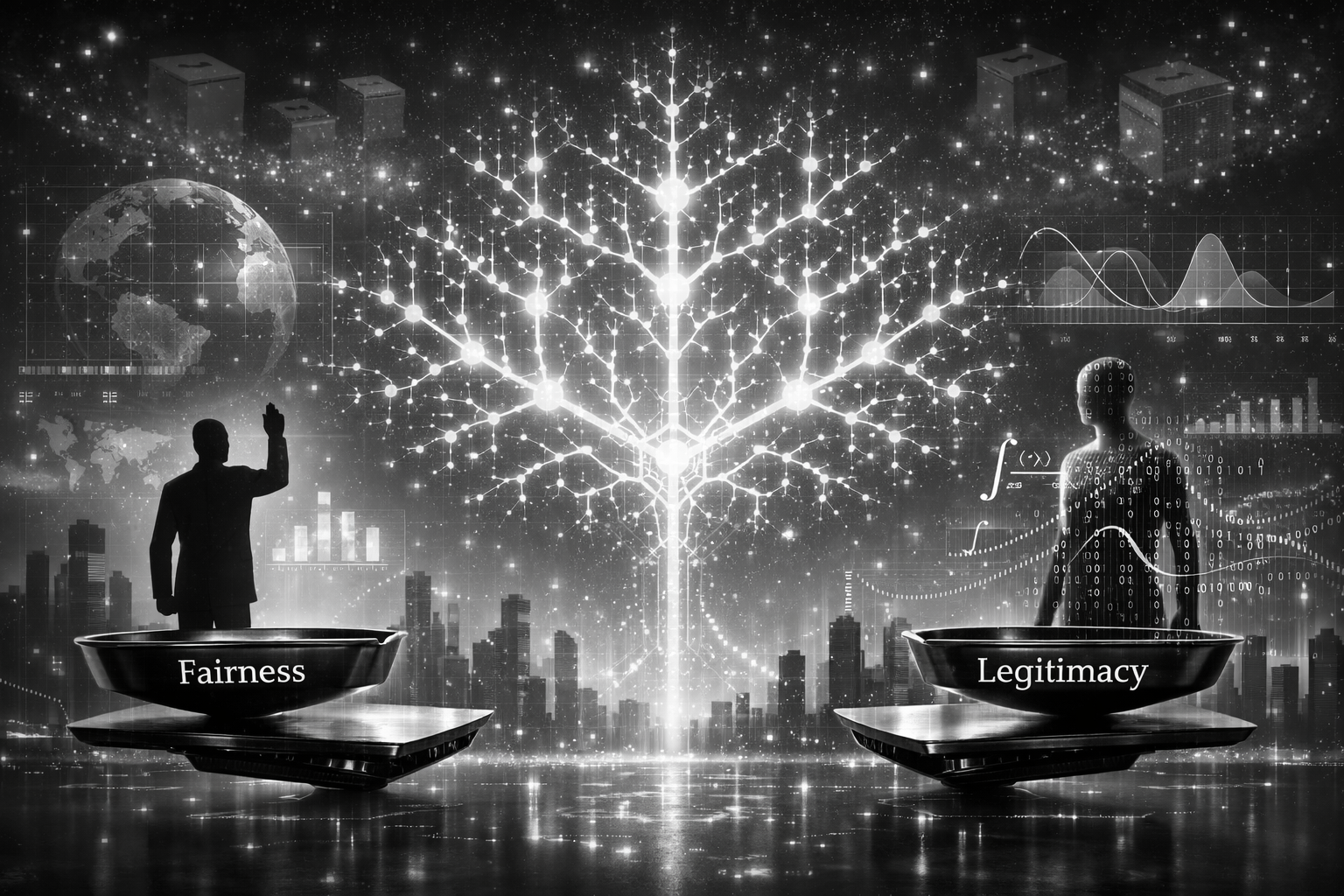
What if the biggest problem with democracy is not the voters, but the machinery? Elections are a blunt instrument for a world that now runs on real time data, targeted persuasion, and complex trade-offs that rarely fit into a campaign slogan. AI promises something seductive: a political system that can measure fairness, simulate consequences, and adjust policy continuously. The question is whether that would be fairer than democracy, or simply a more efficient way to hide power.
Why "fairer than democracy" is a harder claim than it sounds
Democracy is often treated as a single thing, but it is really a bundle of compromises. It aims for equal political voice, peaceful transfers of power, and protection from tyranny. It also tolerates slow decision-making, imperfect information, and the fact that majorities can be wrong or cruel.
When people ask for a fairer system, they usually mean one or more of these: better representation, more transparency, faster responsiveness, and stronger minority rights. The catch is that these goals can collide. A system that responds instantly to majority sentiment can become less protective of minorities. A system that maximizes welfare in the aggregate can still feel unfair to those who lose out, even if the numbers say society is better off.
AI does not remove these trade-offs. It forces them into the open, because an algorithm needs a definition of "fair" before it can optimize anything.
We have tried "better than democracy" before, and it rarely ends cleanly
The twentieth century is full of attempts to improve on liberal democracy by replacing politics with expertise. Technocratic governance appeared in different forms, from post-war administrative states to systems that elevated credentialed elites. Some countries built strong merit-based civil services that delivered stability and growth, while others used "scientific" language to justify coercion and one-party rule.
The lesson is not that expertise is bad. It is that legitimacy is fragile. People accept painful decisions more readily when they believe the process is theirs, even when the outcome is imperfect. A system that is measurably "fair" but socially illegitimate can become unstable fast.
What AI actually adds: three capabilities that change the design space
1) Preference mapping at scale
Traditional politics relies on elections, polls, and lobbying signals. AI can process far more input, including large-scale public comments, service usage patterns, and local economic indicators. Tools like Pol.is, used in civic participation contexts, show how machine learning can cluster thousands of statements into areas of agreement and disagreement, helping groups see where consensus is real and where it is imagined.
2) Simulation before legislation
Governments already model policy impacts, but AI can make this faster and more granular. Agent-based simulations and predictive models can estimate who benefits, who pays, and what second-order effects might appear. In theory, this reduces the "we'll fix it later" style of lawmaking that often leaves vulnerable groups carrying the risk.
3) Optimization with explicit goals
An AI system can be instructed to maximize a defined objective, such as improving access to services while reducing inequality between regions. That sounds clinical, but it has a political upside. It makes the hidden objective functions of politics visible. Today, many systems optimize implicitly for re-election incentives, donor influence, or media cycles. AI can at least force a conversation about what is being optimized and why.
A useful mental model
Democracy is a method for choosing decision-makers. AI is a method for producing and testing decisions. Confusing those two is where most bad proposals begin.
What an AI-designed "fairness-first" political system could look like
The most plausible future is not an AI that replaces parliaments. It is a hybrid system where citizens and elected officials keep formal authority, while AI reshapes how proposals are formed, evaluated, and revised.
Imagine a system with three layers. The first layer is participation. Citizens submit priorities, trade-offs, and local problems through structured platforms, not just free-form posts. The second layer is an AI deliberation engine that groups similar proposals, identifies points of broad agreement, and flags where disagreement is driven by values versus misinformation. The third layer is a policy simulator that stress-tests options against publicly chosen fairness metrics, then publishes the predicted distribution of benefits and harms.
The key design twist is that citizens do not vote only on policies or politicians. They also vote on the weights of the fairness function. How much should the system prioritize reducing child poverty versus lowering taxes? How should it trade off national efficiency against regional equality? Those are political questions, but they can be expressed as parameters that are updated through transparent, periodic public choice.
Where AI could genuinely outperform elections
Democracy is good at legitimacy and peaceful turnover. It is not always good at fine-grained allocation. Many public decisions are not about ideology. They are about distribution, timing, and implementation details that rarely get serious attention until something breaks.
AI can help in areas where fairness is measurable and outcomes can be audited. Think of public transport subsidies, healthcare appointment allocation, school catchment planning, or disaster relief logistics. In these domains, the system can publish a clear target, show the predicted impact by demographic group, and be judged against real outcomes later.
AI can also reduce some forms of partisan capture by making it harder to hide the distributional effects of a policy. If a proposed change shifts benefits toward a narrow group, a well-designed model can surface that quickly, in plain language, with uncertainty ranges and assumptions attached.
The legitimacy paradox: a fair system that people don't feel they control
Even if an AI system produced outcomes that look fairer on paper, it could still fail the basic test of political legitimacy. People want to know who is responsible. They want someone to blame, someone to vote out, and someone who can be pressured by public argument rather than technical credentials.
This is where "black box" concerns become more than a technical complaint. If citizens cannot understand why a model recommended a policy, they cannot meaningfully consent to it. Explainability is not a nice-to-have. It is the bridge between optimization and legitimacy.
A fair AI governance system would need to explain itself in layers. A short reason for the public, a deeper technical report for auditors, and full reproducible documentation for independent researchers. Without that, the system becomes a priesthood with dashboards.
Bias does not disappear. It gets automated
AI learns from data, and political data is messy. Historical datasets reflect unequal access to services, uneven policing, underreporting, and the fact that some groups are simply less visible in official records. If an AI is trained on that world, it can reproduce the same patterns while claiming neutrality.
The uncomfortable truth is that "fairness" in machine learning is not one thing. There are multiple definitions that cannot all be satisfied at once. A system can equalize error rates across groups, or equalize outcomes, or equalize opportunity, but choosing among these is a moral and political decision. If that choice is made quietly by engineers or vendors, the system is not fairer than democracy. It is just less accountable.
Security and manipulation: the new battleground is the input layer
If a political system relies on continuous feedback, then the feedback becomes a target. Coordinated campaigns can flood participation platforms, distort sentiment signals, and exploit the model's blind spots. Foreign influence operations would not need to persuade a majority. They would only need to nudge the data stream enough to shift the optimization.
Any serious proposal needs strong identity verification, provenance for content, and defenses against automated participation. It also needs a plan for what happens when the system is attacked. In traditional democracy, a scandal can change an election. In an AI-mediated system, a successful manipulation could change policy continuously, quietly, and at scale.
What "accountability" would have to mean in an AI political system
Accountability is the part most AI governance visions wave away. In a democracy, responsibility is imperfect but legible. Ministers sign decisions. Legislators vote. Courts review. Journalists investigate. Voters punish.
In an AI-assisted system, accountability must be designed, not assumed. That means clear chains from model output to human decision, and clear rights for citizens to challenge outcomes. It also means independent audits before deployment, and ongoing monitoring after deployment, because models drift as society changes.
One promising idea is a civic equivalent of financial audits. Before an AI system can influence binding policy, it must pass standardized reviews for bias, robustness, and security, conducted by independent bodies with the power to block deployment. Another is citizen juries with real authority to override algorithmic recommendations under defined conditions, especially when rights and minority protections are at stake.
So, could AI generate a system that is fairer than democracy?
AI can generate institutional designs that score better on specific fairness metrics than many current democratic processes, especially in areas where outcomes are measurable and feedback is fast. It can propose voting rules, districting approaches, participatory mechanisms, and resource allocation formulas that reduce certain kinds of inequality or improve responsiveness.
But a political system is not only an outcome machine. It is a legitimacy machine. If AI is used to replace democratic authority, it risks becoming a high-tech version of technocracy, vulnerable to capture by those who control the models, the data, and the definitions of fairness.
The most realistic path to "fairer than democracy" is not AI instead of democracy. It is democracy that uses AI to expose trade-offs, test policies before they harm people, and make fairness measurable without making it unchallengeable.
The future that should worry us is not an AI that takes power in a dramatic coup, but an AI that quietly becomes the place where politics goes to hide its choices.