A missing dog, a perfect pitch, and a system hiding in plain sight
If you can get a hundred million people to root for a surveillance network, you do not need to win the privacy debate. You just need a dog.
"Milo" was a yellow lab with a goofy smile and a red collar. On February 8, 2026, he became the most important dog in America in a Ring Super Bowl ad. He was also fictional. The story was simple: Milo runs off, the family uploads a photo, and a neighborhood's cameras join a feature called Search Party to scan for him in real time. The music swells, the kid hugs the dog, and the viewer feels something warm and civic-minded.
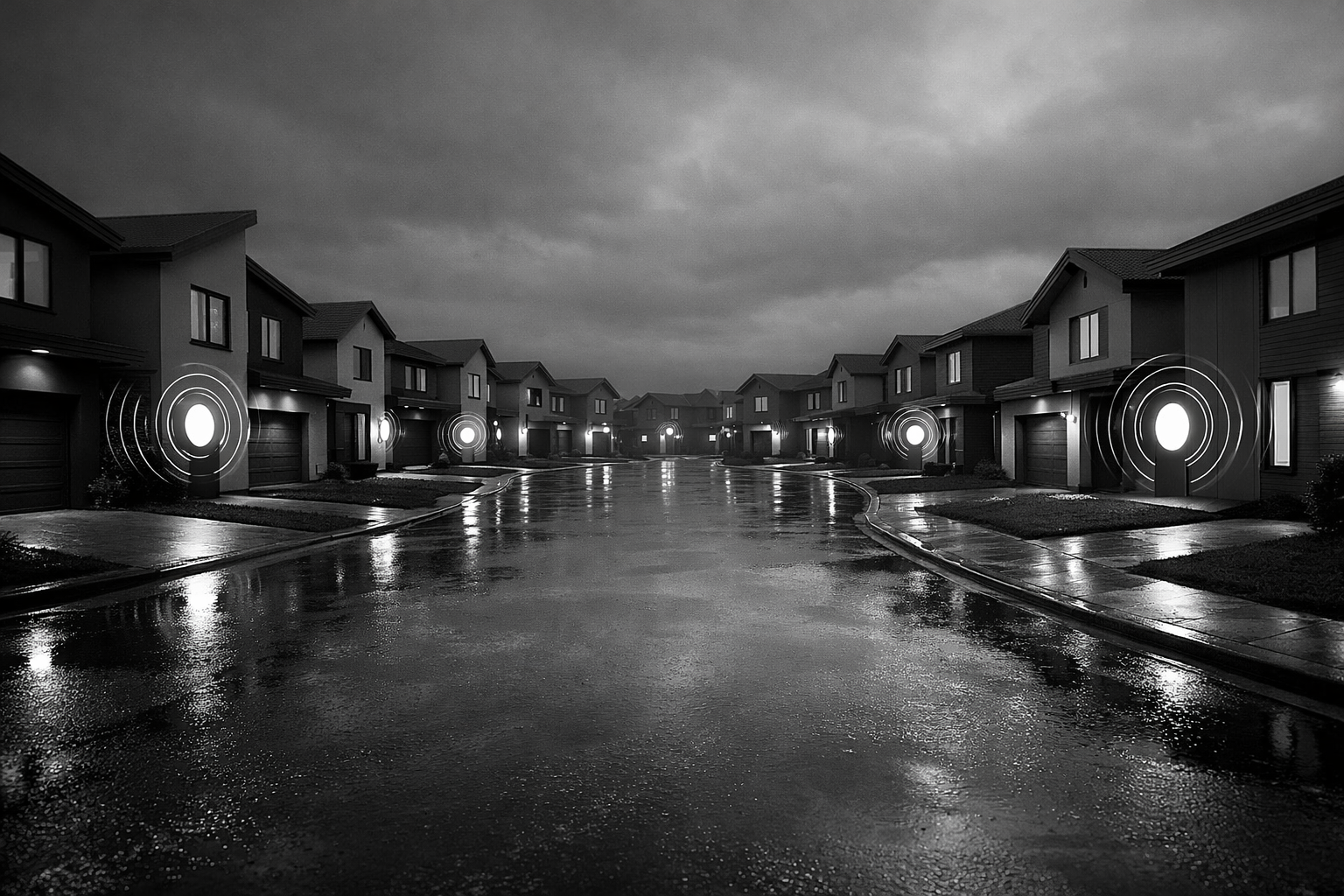
Watch it again without the soundtrack and you see the real product. A networked, AI-powered visual system activates across a residential grid. A photo goes in. Cameras light up. A target is matched, flagged, tracked, and reported. The ad does not lie about what the technology does. It simply chooses the one subject nobody can argue with.
From luxury to ubiquity, and the new social contract at the front door
Doorbell cameras used to feel like a niche gadget. Now they are a default home upgrade. Estimates put doorbell camera ownership at roughly 27 percent of U.S. households, driven by prices that often sit around $99 to $200, far below traditional monitored alarm systems.
That shift matters because the benefits are not imaginary. For renters, seniors, and people living alone, a camera can deter theft, document harassment, and provide evidence when something goes wrong. In places where police response is slow, footage can be the difference between a report that goes nowhere and a case that moves.
But ubiquity creates a trade that is rarely named clearly. The comfort of feeling safer comes bundled with constant recording, retention policies most people never read, and a hierarchy of access that is not evenly distributed. The camera is on your door, but the system is not only for you.
How the feedback loop works, and why it never ends
The modern home security economy runs on a loop that looks like safety, but behaves like a growth engine.
It starts with recording. Cameras capture motion and store footage either locally or in the cloud for days or weeks, often behind a subscription tier. Then come access requests. Police can ask residents to share clips through community request tools, and companies can be compelled through warrants and subpoenas. Insurers may also encourage adoption with discounts, which nudges more homes into the same ecosystem.
Next comes amplification. A single clip is rarely just a clip. It becomes a data point that can be cross-referenced with other footage, other sensors, and other databases. Flock Safety, for example, says its license plate reader network operates in more than 5,000 communities and performs over 20 billion vehicle scans per month, checking plates against law enforcement hotlists in real time.
Finally, the loop sells anxiety back to the user. Neighborhood feeds and alerts highlight suspicious moments, not ordinary life. That changes behavior. People check the app more, store footage longer, add more cameras, and share more readily. Each step generates more data, which improves targeting, which increases alerts, which increases dependence. The loop does not end because every stage can be monetised.
Panopticon, inverted: you invite the watchtower in
Jeremy Bentham's panopticon imagined a central watchtower that might be watching at any time, causing people to police themselves. The smart home flips the geometry. There is no single tower. There are millions of small towers, installed voluntarily, pointed outward, and connected through platforms that can aggregate what they see.
This inversion is why the system feels so normal. It arrives as convenience and care. A package alert. A motion notification. A way to check that an elderly parent got home. The discipline is not imposed with a uniform. It is installed with a screwdriver.
The deeper change is psychological. When cameras are everywhere, people begin to act as if they are always potentially on record. Neighbors watch each other. Posts circulate. Faces become evidence. The social cost of being misinterpreted rises, and the safest move becomes being legible.
The Nancy Guthrie case, and what "deleted" can really mean
The most unsettling surveillance stories are not the ones where cameras fail. They are the ones where cameras "fail" until someone powerful enough asks again.
In early February 2026, an 84-year-old woman, Nancy Guthrie, went missing in the Catalina Foothills north of Tucson. She had a Google Nest doorbell camera. Her family had set it up as a small act of love. They did not pay for the subscription tier that saves footage to the cloud. Local law enforcement initially said the footage could not be recovered. No subscription, overwritten data, end of story.
Then the FBI got involved. On February 11, FBI Director Kash Patel posted images and clips on X that appeared to come from that same camera, describing them as recovered from "residual data located in backend systems." CBS News reported cybersecurity experts noting that cloud systems can retain copies in caches and redundant storage, and that tamper detection could plausibly trigger extended retention.
The detail that matters is not only technical. It is structural. A homeowner is told the footage is gone. A federal agency later produces it. That gap is the access hierarchy made visible for a moment, like a seam in a wall when the light hits it just right.
The ladder of access, and why power decides what exists
It helps to think of modern surveillance as a ladder.
On the bottom rung is the homeowner, who can see their own porch and may or may not pay for storage. One rung up are neighbors, who see what gets posted in community feeds and who can share clips voluntarily. Above that is local law enforcement, which can request footage through official tools and pursue warrants. Above that are federal agencies, which can compel data from backend systems and vendors, including data that may not be accessible through consumer interfaces.
This is why the usual argument between "nothing to hide" and "total conspiracy" misses the point. The system is not binary. It is tiered. The question is not whether the footage exists. The question is who can make it exist.
Flock, Ring, Axon, and the quiet plumbing of integration
In October 2025, Ring announced a partnership with Flock Safety that would have connected Flock's license plate reader network with Ring's Community Requests feature. Privacy advocates, including the EFF and ACLU, raised alarms, especially amid reporting that some police departments had used Flock searches in ways that could support immigration enforcement. After the Super Bowl ad backlash, Ring announced on February 12, 2026 that the partnership was canceled.
Many headlines framed that as a win. It was, in a narrow sense. But the larger mechanism did not disappear. Ring still supports law enforcement request workflows, and it still partners with Axon, a major police technology provider. The controversial brand name was removed from one proposed bridge. The broader pattern of consumer cameras feeding into public safety pipelines remains.
This is the part that is hardest to communicate because it is boring by design. Surveillance does not always expand through dramatic new laws. It expands through procurement, integrations, dashboards, and "community safety" features that sound like customer support.
Why a dog works: moral cover and the proof of concept problem
A lost dog is not just emotional manipulation. It is moral cover. If you object, you sound heartless. That is the genius of the creative choice.
It also functions as a proof of concept for a deeper premise: that a living being moving through a neighborhood untracked is an emergency the system should solve. Once that premise is normal, the same architecture can be justified for bikes, then cars, then "suspicious persons," then anyone who does not fit the model.
Scholar Simone Browne, in Dark Matters: On the Surveillance of Blackness, traces how surveillance has historically been tied to making certain people visible and accountable in public space. Her discussion of lantern laws, which required Black and Indigenous people in colonial New York to carry lights after dark, is a reminder that "safety" has often been the language used to enforce legibility. The technology changes. The logic can persist.
Discord's "Teen-by-Default" moment, and the return of the lantern
One day after the Milo ad aired, Discord announced a global age verification rollout. TechCrunch reported that starting in March 2026, users would be defaulted into a restricted teen experience unless they verified age via facial scan or government ID. Discord has more than 200 million monthly users. That scale makes it one of the largest identity verification pushes in consumer tech.
The stated goal, child safety, is real. The mechanism is the story. Full participation becomes conditional on making yourself identifiable to the platform. If you cannot or will not provide a face scan or ID, your access shrinks.
The timing is what makes it sting. In October 2025, Discord disclosed a breach involving 5CA, a vendor used for age verification appeals, in which at least 70,000 government ID images were stolen, as reported by Bitdefender. Expanding verification after an ID leak is not automatically irrational, but it does reveal the direction of travel. When platforms decide identity is required, the requirement tends to spread, even when the risks are already on the record.
The EFF has also pointed out that age verification can exclude people who lack current IDs, and that those gaps are not evenly distributed. The result is a modern version of "carry your own lantern," not enforced by a magistrate, but by a login screen.
Seeing like a state, now sold as a product
James C. Scott's Seeing Like a State explains how governments simplify messy reality into categories they can manage. He calls it legibility. Forests become timber inventories. People become standardized names and numbers. The simplification often looks efficient at first, then breaks what made the system resilient.
What Scott described as a state project has, in many places, been privatized. The tools that make life legible are now consumer devices and cloud services. Amazon builds Ring. Google builds Nest. Axon builds police workflows. Flock builds vehicle tracking networks. Oracle and Palantir build government-grade data infrastructure. The "system" is not one company. It is the plumbing between them.
This is why the debate feels slippery. People are not choosing "surveillance." They are choosing a doorbell that happens to record. The legibility project arrives as convenience, and then becomes infrastructure.
The benefits are real, which is why the trade is so hard to name
It is tempting to treat this as a simple morality play. Cameras bad, privacy good. That story is comforting and incomplete.
Ring footage has helped investigations, including a December 2025 shooting near Brown University where, according to The Verge, Providence police used Ring Community Requests and received 168 videos from seven neighbors within hours. Flock's readers have helped recover stolen vehicles. Doorbell cameras can reduce porch theft and provide evidence in harassment cases. For people who have been failed by slow or uneven public safety systems, a cheap camera can feel like the first tool that actually works.
The danger is not that the technology never helps. The danger is that the infrastructure built for the best case does not disappear after the best case. The cameras that find Milo do not turn off when Milo comes home. The backend systems that can retain "residual" footage do not stop being capable of retention when the headline fades.
Practical ways to think clearly before you buy, subscribe, or opt in
If you are deciding whether to add a camera, or whether to enable community features, the most useful shift is to stop asking only what the device can do for you and start asking what it can do to other people through you.
Start with retention. How long is footage stored, where, and under what conditions can it be recovered after you think it is gone. Subscription tiers often change the answer, but so can tamper detection and backend redundancy.
Then look at sharing pathways. Some platforms make it easy to post clips publicly or respond to law enforcement requests. Convenience is the point, but convenience is also how a private device becomes part of a public pipeline.
Finally, pay attention to the neighborhood feed. If your app is training you to see your community as a stream of threats, that is not a neutral side effect. It is a product experience. The most profitable emotion in security is not relief. It is vigilance.
The modern forest, and the freedom we traded without noticing
A managed forest looks tidy from above. It is also fragile, because the mess was doing work you did not know how to measure. Our neighborhoods are becoming a kind of managed forest of visibility, optimized for detection and retrieval.
What we are trading is not only privacy in the abstract. It is the ordinary experience of moving through your own street without becoming a data point, a clip, a match, a request, a record that can be escalated up an access ladder you cannot see.
Milo was found because the system worked exactly as designed, and that is precisely why the more interesting question is not whether anyone saw Milo, but who else became visible while everyone was looking.