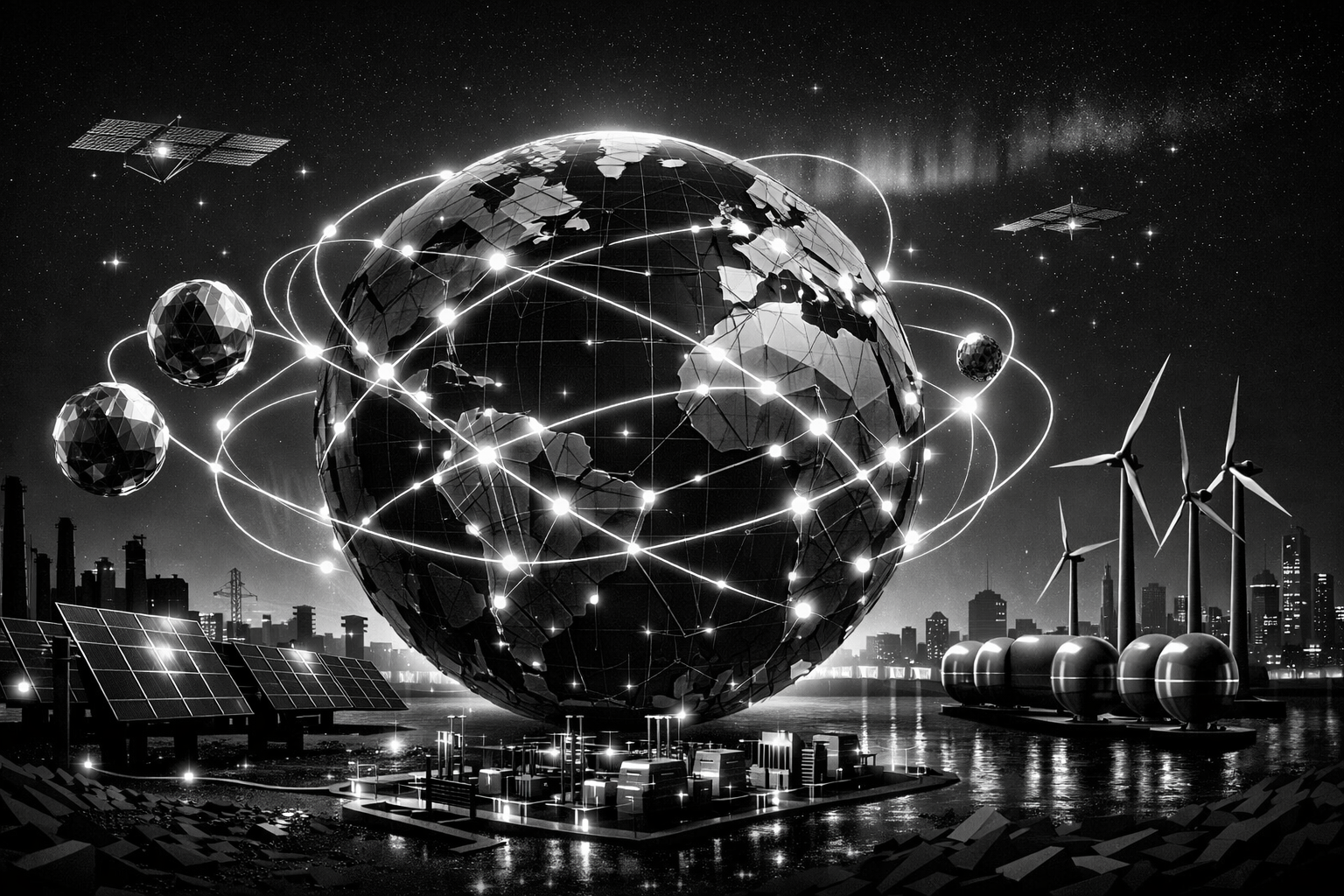
The day energy stops being scarce, geopolitics changes overnight
For a century, global power has been shaped by a simple constraint: energy is expensive, unevenly distributed, and hard to move. That is why oil chokepoints matter, why pipelines become foreign policy, and why a handful of exporters can rattle markets with a single announcement. Now imagine a world where electricity is effectively limitless, clean, and cheap. Not "a bit cheaper solar," but a step change driven by fusion, space-based solar, ultra-high-efficiency photovoltaics, and industrial-scale green hydrogen. The map does not just get greener. It gets redrawn.
Today, fossil fuels still supply roughly four fifths of global primary energy, even as electricity generation diversifies and wind and solar keep climbing. That mix is the foundation of modern leverage. It is also fragile. When Europe cut its dependence on Russian gas after 2021, the geopolitical shock was immediate and expensive, and it forced a crash course in energy resilience. Limitless clean energy would make that kind of coercion harder in some ways, and easier in others.
What "limitless" really means, and why it is different from "more renewables"
The phrase "limitless clean energy" is often dismissed as science fiction. But the more useful way to read it is as a future where the marginal cost of clean electricity trends toward very low levels, and where supply can scale without the same fuel constraints that define coal, oil, and gas. Several pathways could contribute, and they do not need to arrive all at once to reshape power dynamics.
Fusion, if it becomes commercially reliable, would turn seawater-derived deuterium and bred tritium into strategic inputs rather than oil fields. Space-based solar power, if it works at scale, would convert orbital infrastructure and spectrum governance into energy policy. Advanced photovoltaics, including perovskite and tandem cells, could push solar into new surfaces and climates, making generation more local and more abundant. Green hydrogen and synthetic fuels would act as the bridge that turns cheap electricity into molecules for shipping, aviation, steel, fertilizer, and long-duration storage.
The common thread is not just decarbonization. It is a shift from energy as a traded commodity to energy as an engineered capability. That is where the power moves.
The first big loser is the "rent" from geology
Oil and gas exporters do not merely sell energy. They sell scarcity. Their influence comes from the fact that the world cannot quickly replace a missing barrel or a missing cargo. In a world of abundant clean electricity, that scarcity rent shrinks. Some producers will adapt by becoming energy exporters in a new form, such as hydrogen, ammonia, or synthetic fuels. Others will struggle because their fiscal systems are built around hydrocarbon revenue.
This is not a moral story. It is a balance-sheet story. If demand peaks earlier than expected, states that fund public wages, subsidies, and security guarantees through oil revenue face hard choices. The risk is not only economic instability. It is political volatility, as governments attempt to replace a simple revenue stream with more complex industrial policy.
At the same time, the decline of fossil leverage does not automatically mean a calmer world. It means the old levers weaken, and new ones appear.
The new kingmakers are manufacturers, mineral processors, and grid operators
If energy becomes abundant, the strategic question becomes: who can build the machines that make it, and who controls the materials that those machines require? This is already visible in today's clean-energy supply chains. Manufacturing scale in solar, batteries, and many upstream processing steps is concentrated, with China holding a dominant position in several mineral processing categories and a large share of solar PV deployment and manufacturing capacity. Europe, the United States, Japan, and South Korea are responding with industrial policy, subsidies, and friend-shoring, but the gap is real.
In a limitless-energy scenario, that competition intensifies. Fusion plants would require specialized materials, precision components, and a regulatory ecosystem that can certify safety and reliability. Space-based solar would require launch capacity, orbital assembly, high-frequency power transmission components, and ground receiving infrastructure. Advanced PV at terawatt scale would require resilient supply chains and recycling systems to manage constraints and environmental risk. Hydrogen at scale would require electrolyzers, catalysts, compressors, pipelines, storage caverns, and ports.
This is where geopolitics starts to look less like OPEC and more like semiconductors. The leverage shifts toward countries that can mass-produce complex hardware, set standards, and deny rivals access to critical inputs.
Energy independence becomes easier, but not automatic
One of the most seductive promises of abundant clean power is national self-sufficiency. Rooftop solar, local storage, and microgrids can reduce exposure to imported fuels. Fusion, if it becomes modular and widely deployable, could further reduce dependence on fuel supply chains. Even without fusion, a country with strong grids and enough generation can cut its vulnerability to maritime chokepoints.
But independence has a new dependency: components, software, and materials. A nation that can generate electricity locally may still rely on imported inverters, transformers, high-voltage DC equipment, electrolyzer stacks, or rare earth magnets. It may also rely on foreign cloud services, firmware updates, and cybersecurity tooling to keep the grid stable. In other words, the vulnerability moves from tankers to supply chains and code.
That shift changes the playbook for sanctions and coercion. Instead of restricting crude exports, states may restrict advanced manufacturing equipment, grid control software, high-performance magnets, or processing chemicals. The pressure points become more technical, and often less visible to the public until something breaks.
A new kind of "energy geography" emerges
Fossil energy rewards where the hydrocarbons are. Clean energy rewards where the electrons can be produced cheaply and moved efficiently, or converted into molecules and shipped. That creates new winners, including regions with exceptional solar and wind resources, strong institutions, and access to capital.
Places like North Africa, the Middle East, Australia, Chile, and parts of the United States could become clean-energy export hubs, not because they sit on oil, but because they can produce low-cost electricity and turn it into hydrogen, ammonia, or green industrial products. The prize is not just selling energy. It is attracting energy-intensive industry. Data centers, green steel, aluminum, fertilizer, and synthetic fuels will chase the cheapest reliable power.
This is where domestic politics meets global trade. If a country can offer abundant clean power, it can offer jobs, industrial clusters, and strategic relevance. If it cannot, it risks deindustrialization or a permanent premium on energy-intensive goods.
Alliances shift from "who protects the sea lanes" to "who secures the supply chain"
The twentieth century's security architecture was built around fuel logistics. Navies protected shipping routes. Militaries planned around fuel convoys. Diplomacy revolved around stable access to oil and gas. As clean energy scales, the center of gravity moves.
Expect alliances to deepen around critical minerals, processing capacity, and manufacturing ecosystems. Countries rich in lithium, nickel, cobalt, copper, and rare earths gain bargaining power, but only if they can move up the value chain. Otherwise, they risk repeating an old pattern: exporting raw materials while importing high-value finished goods.
This is why mineral processing and refining matter as much as mining. Control of processing can be used to shape prices, restrict supply, and influence industrial outcomes abroad. It is also why recycling becomes strategic. A country that can recover lithium, nickel, cobalt, and rare earths at scale reduces its exposure to external shocks and turns waste into a domestic resource.
The grid becomes a frontline, and cyber power becomes energy power
Abundant electricity is only useful if it is delivered reliably. That makes grids, interconnectors, and control systems central to national security. High-voltage transmission lines, transformers, and substations are already bottlenecks in many countries. In a world racing to electrify transport, heating, and industry, those bottlenecks become geopolitical.
Cross-border electricity trade can create mutual dependence, which can be stabilizing. It can also create leverage. If one country controls a key interconnector, or if a region depends on imported power during peak demand, electricity can be politicized in ways that resemble past gas disputes. The difference is speed. Electricity crises unfold in seconds, not weeks.
Cybersecurity becomes inseparable from energy security. Smart grids, distributed generation, and automated demand response expand the attack surface. A state that can disrupt another's grid, even temporarily, gains coercive power without firing a shot. Conversely, a state that can prove resilience, redundancy, and rapid recovery gains diplomatic credibility and economic attractiveness.
Space-based solar and fusion introduce a new arms-control problem
Some "limitless" pathways are unavoidably dual-use. Space-based solar power relies on transmitting energy via microwave or laser links to Earth. Even if designed for safety, the concept will trigger security concerns because directed energy is adjacent to weapons technology. The geopolitical fight will not only be about who can build it, but who can verify it is being used as promised.
Fusion has a different dual-use shadow. The fuel cycle, materials, and expertise overlap with sensitive nuclear domains, even if fusion power itself is not the same as fission weapons. The result is a likely expansion of international monitoring, export controls, and standards bodies. Countries that shape those rules will shape who gets to scale the technology quickly.
In practice, the next era of energy diplomacy may look like a blend of climate negotiations, semiconductor export controls, and space governance, with a new layer of verification and trust-building that most energy markets never required.
Carbon becomes a trade weapon, and "clean" becomes a passport
As clean electricity becomes abundant, the competitive edge shifts to who can prove their products are clean. Carbon accounting stops being a corporate sustainability exercise and becomes a market access requirement. Policies like the European Union's Carbon Border Adjustment Mechanism point toward a world where emissions embedded in steel, cement, fertilizer, and chemicals affect tariffs and demand.
This creates a new kind of leverage. Countries that can certify low-carbon production gain preferential access to premium markets and can attract investment. Countries that cannot may find their exports discounted or blocked. The politics will be fierce, especially for developing economies that argue, with reason, that they should not be locked out of growth because they lack capital for rapid clean industrialization.
The most interesting twist is that limitless clean energy could make carbon removal economically meaningful. If direct air capture and other removal methods can run on very cheap clean power, "carbon-negative" production becomes plausible in specific sectors. That would turn climate leadership into a tangible trade advantage, not just a diplomatic talking point.
What countries will actually compete over in a limitless-energy world
When energy is no longer the scarce input, the scarce inputs become the things that convert energy into prosperity and security. The competition clusters around four arenas.
The first is industrial capacity. The ability to manufacture at scale, from power electronics to electrolyzers to advanced materials, becomes a national advantage that compounds over time. The second is critical minerals and processing, including recycling, because the clean-energy system is material-intensive even if the energy itself is abundant. The third is infrastructure, especially grids, ports, pipelines for hydrogen derivatives, and the permitting systems that decide whether projects take three years or fifteen. The fourth is trust, expressed through standards, certification, cybersecurity, and the credibility to host and operate systems that others depend on.
Oil once rewarded those who controlled the ground. Limitless clean energy rewards those who control the stack, from atoms and materials to factories, software, and rules.
A practical way to think about the transition: three phases of power shift
In the first phase, fossil leverage erodes unevenly. Exporters with diversified economies and credible transition plans retain influence, while those that rely on oil rents face fiscal stress. Importers gain room to maneuver, but they also face a new vulnerability to clean-tech supply chains.
In the second phase, manufacturing and minerals dominate. Trade disputes increasingly revolve around subsidies, local content rules, export controls, and access to processing. This is the era where "energy security" is argued in the language of factories, not fields.
In the third phase, if truly abundant clean power arrives, the strategic premium shifts again toward resilience and governance. When everyone can generate plenty of electricity, the differentiator becomes who can keep systems stable, secure, and trusted at scale, and who can turn cheap power into high-value goods without breaking water systems, land use, or social consent.
The surprising upside: abundance can reduce conflict, if it is shared well
Energy scarcity has always been a quiet accelerant of conflict. It raises food prices through fertilizer costs, destabilizes budgets, and turns infrastructure into targets. Abundant clean energy could lower those pressures. It could make desalination cheaper, reduce the cost of cooling in hotter climates, and expand the feasible set of development paths for countries that currently import expensive fuels.
But abundance does not automatically produce fairness. If the technologies, minerals, and standards are controlled by a small club, the world simply trades one dependency for another. The most stabilizing version of the future is not one where every country builds everything. It is one where supply chains are diverse, recycling is scaled, standards are interoperable, and financing allows emerging economies to industrialize cleanly rather than being trapped as raw-material appendages.
The real geopolitical question is not whether limitless clean energy is possible. It is whether the world treats it like a shared platform for prosperity, or like the next arena for zero-sum dominance, because the countries that learn to turn abundance into trust will end up with the kind of influence oil could never buy.