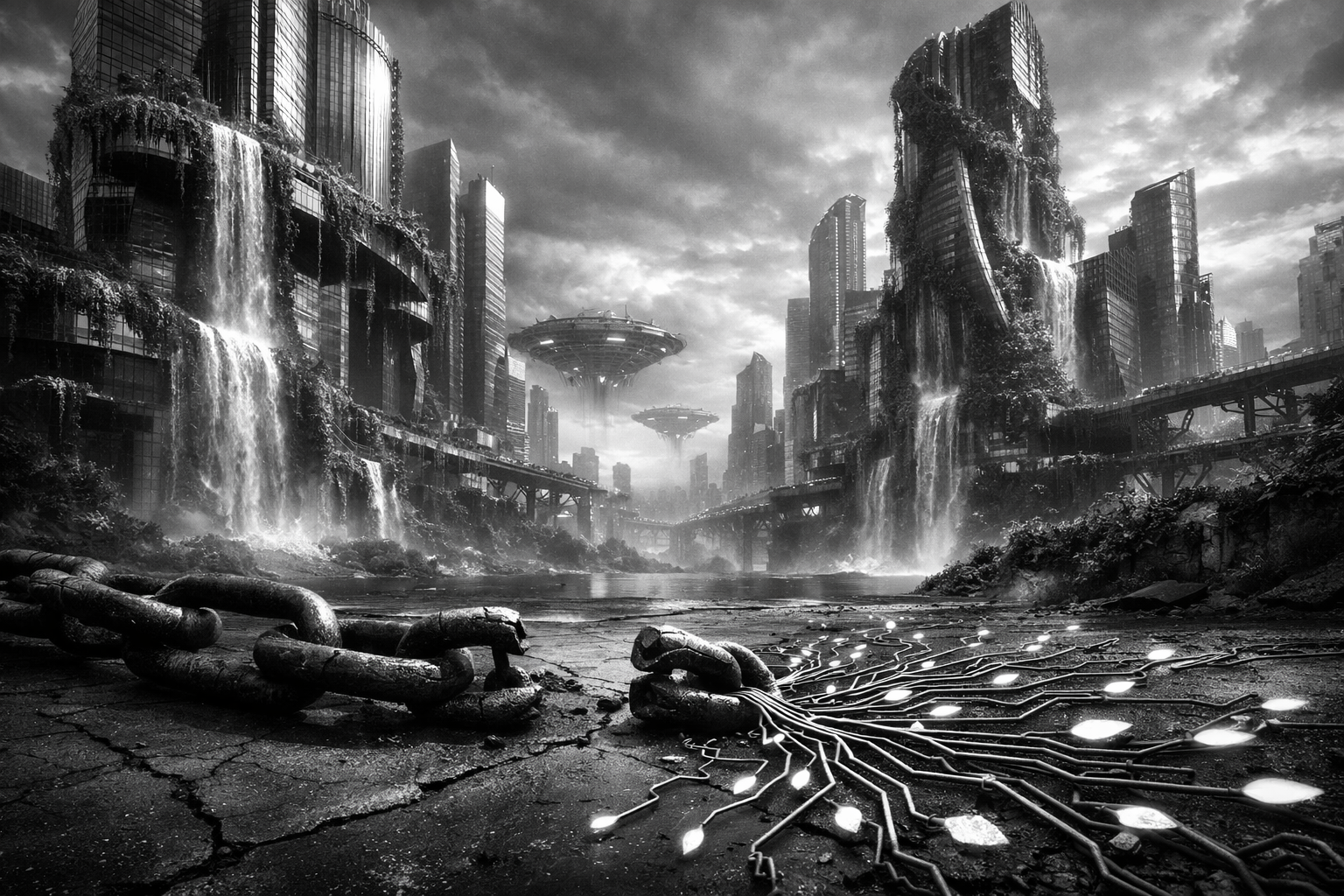
Capitalism has always been good at pricing what it can measure, and famously bad at pricing what it can ignore. Climate change is the moment when the "ignored" part shows up on the balance sheet. Not as a moral argument, but as higher insurance bills, broken supply chains, stranded assets, and new taxes at the border. The real question is not whether markets will adapt. It is whether the rules of capitalism, what counts as profit, risk, and value, will have to change to keep the system functioning.
The old deal: growth now, costs later
Modern capitalism is built on a simple engine. Firms compete, costs are cut, output expands, and capital accumulates. The system rewards speed and scale. It also rewards pushing costs onto someone else when possible, whether that "someone" is a worker, a community downstream, or the atmosphere.
Climate change is the largest externality in history. For decades, greenhouse gas emissions were effectively a free input. That shaped everything from power generation to global shipping routes to the design of cities. It also created a kind of hidden subsidy for carbon intensive business models, because the damage was real but not priced.
What is changing now is not the science. It is the ability of markets and governments to keep pretending the costs are elsewhere.
When physics becomes finance
Climate risk is often discussed as a future problem. In practice, it is already being translated into today's financial variables. Extreme weather can destroy assets in hours, but the deeper shift is slower and more structural. Heat reduces labour productivity. Flood risk changes property values. Drought changes food prices. Sea level rise changes the lifespan of infrastructure. These are not abstract "climate impacts". They are inputs into inflation, credit risk, and long term growth.
Insurance is the canary in the coal mine because it is a business that lives on pricing risk. When insurers raise premiums sharply, add exclusions, or stop writing policies in high risk areas, they are not making a political statement. They are signalling that the old pricing model no longer works. And when insurance becomes unavailable or unaffordable, mortgages, construction, and local tax bases start to wobble. That is how climate change moves from the environment section to the capitalism section.
The quiet restructuring already underway
If you want to see whether capitalism is being forced to change, look for places where the profit motive is being redirected rather than replaced. Three forces are doing most of the work: policy, technology, and finance.
Policy is turning carbon into a line item
Carbon pricing is the cleanest idea in economic theory: make polluters pay, let markets find the cheapest reductions. In reality, carbon prices vary widely, are politically fragile, and often come with exemptions. Even so, the direction of travel matters. Once carbon has a price, even an imperfect one, it becomes a variable in investment decisions, procurement contracts, and corporate strategy.
Regulation can be blunter but faster. Emissions standards, clean electricity mandates, and vehicle rules force technology upgrades and shift competitive advantage toward firms that can redesign products and supply chains quickly. This tends to reward scale and access to capital, which can reshape market structure by favouring larger incumbents or well funded challengers.
Then there is industrial policy. The European Green Deal and the United States' Inflation Reduction Act have made a simple point: the state is not just a referee. It is a customer, a subsidiser, and a market maker for clean technologies. That is not a break from capitalism so much as a return to a familiar pattern, where governments shape markets when strategic infrastructure is at stake.
Technology is changing what is profitable
The most underappreciated climate story is that clean energy is no longer only a sacrifice. In many regions, new solar and wind are cost competitive with fossil generation on a levelised cost basis, and batteries are improving quickly. When the cheapest new power is low carbon, the transition stops being purely ideological and starts looking like a normal capital reallocation.
Electrification is the second lever. As transport, heating, and parts of industry move toward electricity, value shifts from fuel supply chains to grids, storage, software, and demand management. That creates new profit pools. It also creates new chokepoints, especially around critical minerals and grid capacity, which is where the next round of political economy will play out.
Finance is trying to price the unpriceable
Investors have two climate problems. One is physical risk, what happens to assets in a hotter, more volatile world. The other is transition risk, what happens to assets when policy, technology, and consumer preferences move faster than expected.
Climate disclosure rules and investor pressure have pushed companies to quantify emissions and scenario test their business models. This has created a new corporate language of "net zero", "scope 1, 2, and 3", and "transition plans". Some of it is serious, some of it is marketing, and much of it is still inconsistent. But the direction is clear: carbon data is becoming part of how capital is allocated, even if the measurement is messy.
Does this add up to a new capitalism, or just capitalism with new inputs?
There is a tempting story that climate change will automatically break capitalism because capitalism requires endless growth on a finite planet. There is also an equally tempting story that capitalism will solve climate change because markets innovate when incentives change. Both are too neat.
What is more plausible is a restructuring inside the system. Capitalism is not one fixed design. It is a set of institutions, property rights, regulations, and norms that have changed repeatedly under pressure, from the rise of labour protections to the creation of central banks to the post war welfare state. Climate change is pressure of the same magnitude, but with a tighter deadline.
The key question is whether the system can internalise climate costs fast enough to avoid cascading instability. If it can, you get a version of "green capitalism" where carbon is treated like any other cost, and clean infrastructure becomes a major investment cycle. If it cannot, you get a more chaotic mix of crisis management, protectionism, and political backlash.
Where the stress fractures are most visible
The transition is not happening on a blank slate. It is happening on top of existing assets, existing debts, and existing political bargains. That is why the hardest parts are not the technologies. They are the write downs and the distribution fights.
Stranded assets and the politics of loss
Fossil fuel infrastructure is long lived. Pipelines, refineries, coal plants, and gas networks were financed on the assumption of decades of use. If policy and technology shorten that timeline, someone eats the loss. Shareholders resist. Workers fear job losses. Regions built around extraction demand compensation. Governments often end up smoothing the transition with subsidies, buyouts, or delayed phase outs, which can look like climate policy and fossil support at the same time because, politically, it often is.
Insurance retreat and the repricing of place
When climate risk makes certain locations expensive to insure, the market starts to question whether those places should keep growing at all. That is a profound shift because real estate is not just a sector. It is collateral for the financial system and a store of household wealth. If climate change forces a repricing of coastal and fire prone regions, it can ripple into banking, municipal finance, and inequality.
Carbon borders and the return of industrial strategy
As countries tighten domestic climate rules, they face a problem: emissions can be outsourced. Carbon border measures are designed to reduce that by charging imports based on their carbon intensity. Whatever you think of the politics, the economic implication is clear. Climate policy is becoming trade policy. That pushes capitalism toward a world where supply chains are judged not only on cost and reliability, but also on embedded emissions.
Critical minerals and the next resource frontier
A low carbon economy uses less fossil fuel, but it uses more of certain minerals. Lithium, nickel, cobalt, copper, and rare earths sit at the centre of batteries, grids, and motors. This creates a new kind of extractive pressure, often in countries that already carry the burdens of commodity dependence. If the clean transition repeats the old pattern of resource booms with weak governance and limited local value capture, it will not look like a moral upgrade. It will look like capitalism changing its fuel.
The "green capitalism" experiment, and why it feels unstable
Green capitalism is not one thing. It is a bundle of attempts to make decarbonisation compatible with profit seeking. Some of it is straightforward, like building renewables because they are cheap and scalable. Some of it is more fragile, like voluntary carbon markets that struggle with credibility and measurement. Some of it is genuinely transformative, like redesigning products and logistics to cut emissions across supply chains.
The instability comes from timing. Climate physics demands rapid emissions cuts. Capital markets often demand quick returns. Democracies run on election cycles. Infrastructure runs on multi decade lifetimes. When these clocks disagree, the system lurches. You see it in sudden policy reversals, in investor whiplash between "green boom" and "green bubble" narratives, and in public anger when costs are visible but benefits feel distant.
What a climate shaped capitalism is likely to look like
If climate change forces restructuring, it will not arrive as a single dramatic overhaul. It will arrive as a series of new defaults that become hard to reverse.
Carbon will be treated less like an ethical issue and more like a regulated liability. Companies will compete on their ability to prove, not just claim, that their products are low carbon. Supply chains will shorten in some sectors, not because globalisation ends, but because carbon, resilience, and geopolitics become part of the cost equation.
The state will play a larger role than the free market story admits, because grids, rail, ports, building standards, and industrial clusters are not built by vibes. They are built by planning, permits, and public money that reduces risk for private capital. That does not abolish capitalism. It changes who sets the direction.
Inequality will become a central variable, not a side effect, because transitions that raise household costs without visible fairness tend to trigger backlash. "Just transition" policies are often framed as compassion. They are also system maintenance, a way to keep decarbonisation politically durable.
So will climate change force capitalism to restructure?
Climate change is already forcing a restructuring of capitalism's operating conditions. The deeper question is whether that restructuring stays within the familiar logic of profit and competition, or whether repeated shocks push societies toward more explicit planning, stronger redistribution, and tighter constraints on what markets are allowed to do.
The most realistic answer is that capitalism will try to do what it always does under constraint: adapt, financialise, and find new frontiers of value. The most important open question is whether those new frontiers are built around real decarbonisation and resilience, or around clever accounting that postpones the hard work.
In the end, the fight is not between "capitalism" and "the climate". It is between different versions of capitalism, and the one that wins will be the one that can make a liveable planet pencil out on a spreadsheet before the planet sends the invoice in full.