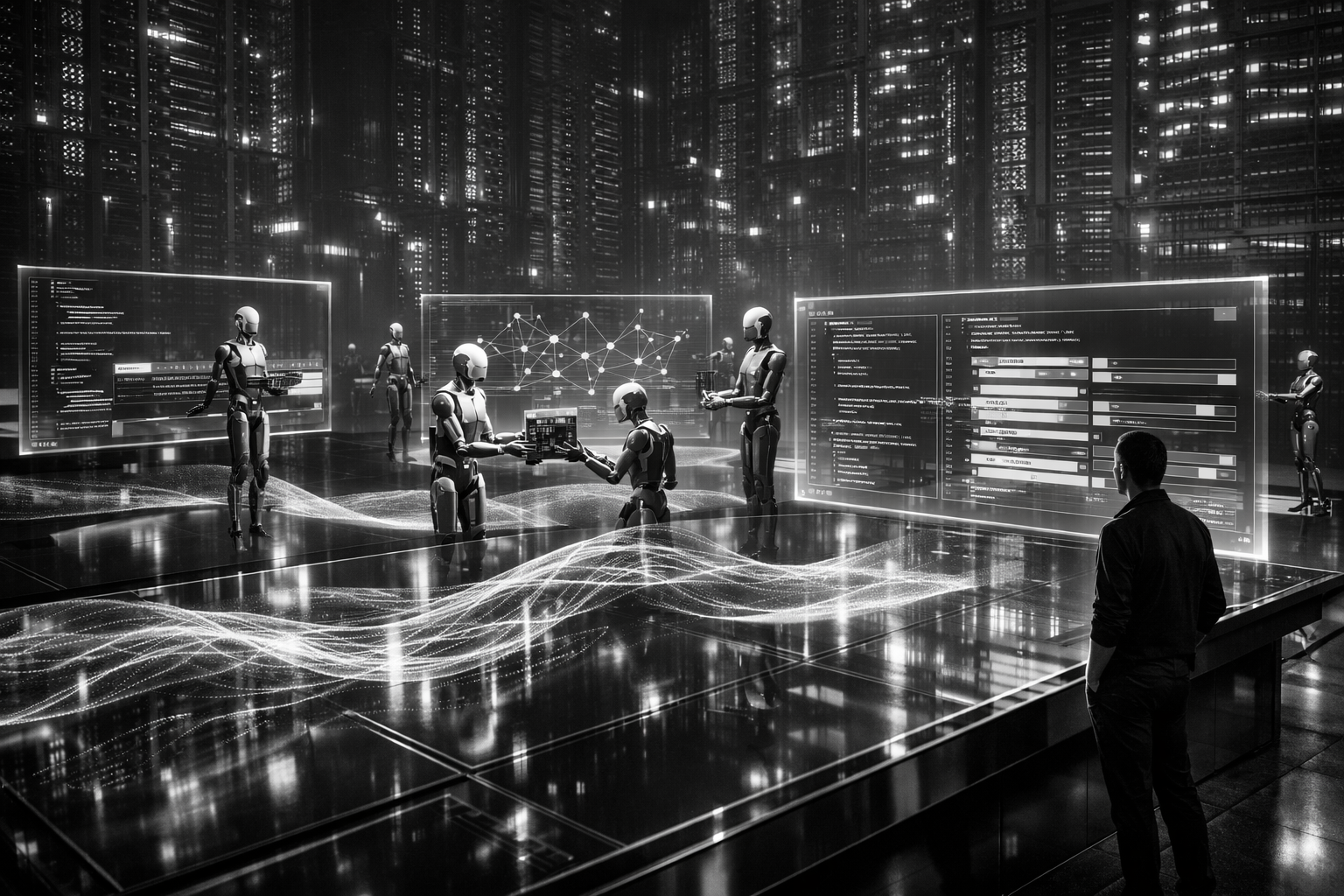
The IDE isn't dying. It's being outgrown.
If you still think "programming" means living inside a single IDE window, you are about to feel the ground move. Not because editors are suddenly bad, but because the unit of work is changing. More developers are spending their best hours specifying intent, delegating to coding agents, and reviewing diffs than typing line by line. The IDE is still on the desk. It just isn't always the desk.
This is the real question behind "Is the IDE dead?" It is not whether Visual Studio Code, IntelliJ, Xcode, or Vim vanish. It is whether the IDE remains the primary surface where software gets built, or becomes a specialist tool you open when you need precision, debugging, and deep inspection.
From inner loop to intent loop
For decades, IDEs optimized the tight inner loop. Open files, edit, build, debug, repeat. That loop is still real, but it is no longer the only loop that matters, and in some teams it is no longer the dominant one.
The emerging loop looks different. You describe the outcome, delegate the work, observe progress, review a set of changes, then merge or iterate. The productivity gain is not "autocomplete, but better." It comes from tool-using autonomy. Agents can plan multi-step work, modify multiple files, run tests, and present a coherent proposal for review.
Once that becomes normal, the bottleneck shifts. Typing speed matters less. Attention management matters more. The best interface is no longer the one that helps you edit faster. It is the one that helps you direct, monitor, and verify work done on your behalf.
Why "agent management" is suddenly the main UI
Look across the tools developers are already using and a pattern shows up. Whether it is a web-based agent experience, a desktop orchestrator, or an agent that opens pull requests in your repo, the control plane is becoming the product. The editor becomes one instrument underneath it.
Cursor's Glass made this shift hard to ignore because it puts agent work up front and makes the traditional editor feel like the place you go when you need to zoom in. Developers immediately described it as feeling more like an agent orchestrator than an IDE. That reaction matters because it reveals a new expectation. People want to run multiple workstreams in parallel and stay in control without living inside every file.
You can see similar thinking in tools that run agents in isolated environments and surface progress in a browser, and in systems that create branches, run tests, and hand you a PR. The common thread is that the agent becomes the unit of work, not the file. The interface worth optimizing becomes the one that makes autonomy governable.
The orchestration layer is converging on a few primitives
The "IDE is dead" argument only becomes convincing when you stop treating these tools as novelty chat boxes and start noticing the interface patterns they share. They are converging because they are solving the same operational problems.
First is work isolation. Parallel agents cannot safely edit the same working directory. Serious tools tend to land on git worktrees or equivalent isolation so each agent gets its own workspace. Without that, you get conflicts, overwritten changes, and a slow collapse into manual coordination. Isolation is not a feature. It is the price of parallelism.
Second is planning and task state as the primary navigation. Instead of tabs and files, the top-level view becomes tasks and statuses. You define a piece of work, assign it to an agent and a model, and track it like a lightweight board. It looks suspiciously like project management, except the "team" is a set of autonomous runtimes that can implement and test.
Third is async-first execution. Some of the most useful agent workflows assume you should not be watching. You hand off a task, step away, and come back to a diff. That is a sharp break from the IDE's synchronous feedback loop, and it is also a bet that your attention is the scarcest resource in the system.
Fourth is attention routing. When you run multiple agents, the hard part is not starting them. It is knowing which one needs you now. Terminal multiplexers and orchestration dashboards are starting to treat "needs attention" as a first-class event, with badges, notifications, and triage views. That is not an IDE problem. That is an operations problem.
Finally, the orchestration layer is attaching itself to the software lifecycle rather than the editing experience. When an agent can open a branch, run CI, and propose a PR, the natural home for that workflow is the same place your team already governs change. Issues, pull requests, checks, approvals, audit logs. The IDE becomes less like the center of the universe and more like a microscope you pick up when needed.
Why developers still reach for an IDE when it matters
The strongest critique of "the IDE is dead" is simple. IDEs compress several hard problems into a high-fidelity loop that still beats everything else when correctness is on the line.
Precise navigation is one. When you are trying to understand a large codebase, jumping through types, call sites, and references with reliable indexing is not a luxury. It is how you build a mental model. Agents can summarize, but summaries are not understanding, and they are not always anchored to the exact code paths that will execute in production.
Interactive debugging is another. When a system is "almost right," the fastest path to truth is often a breakpoint, a watch expression, and a controlled reproduction. Agents can run tests, but debugging is not just running. It is interrogating.
Then there is the failure mode that keeps experienced developers cautious. Agents are frequently 90 percent correct. The last 10 percent is where the time goes, because subtle bugs hide in assumptions, edge cases, and integration details. When the cost of finding the flaw exceeds the cost of writing the code, you want the IDE's precision tools, not another round of prompting.
That is why even the most agent-forward tools keep an escape hatch. Review the diff, comment, then open the result in your editor for targeted fixes. The workflow is telling you something. Human intervention is not a failure case. It is part of the design.
The new tax: review fatigue and governance overhead
If you can run many agents in parallel, you inherit problems that look less like programming and more like managing a distributed system. Observability, permissions, isolation, and policy become daily concerns.
The labor also inverts. Instead of writing, you review. That sounds like a win until you are staring at a stack of diffs from multiple agents, each plausible, each needing careful scrutiny. Review fatigue is real, and it is one reason the best agent experiences emphasize structured plans, explicit checkpoints, and review gates rather than pushing full autonomy by default.
Security expands from "who can push to main" to "what can the agent touch while you are not watching." As agents gain access to repositories, package managers, cloud consoles, databases, and the web, the question becomes less about capability and more about control. What tools can it use. What secrets can it read. What actions require approval. What gets logged for audit.
This is where IDE-centric thinking starts to feel incomplete. IDEs were built to help a human edit code safely. Agent systems must help a human govern change safely, even when the change is produced asynchronously and at scale.
So what replaces the IDE: a dashboard, a control plane, or a bigger IDE?
A literal "death of the IDE" is the weakest version of the claim. The stronger, more accurate version is that the IDE is being de-centered.
In this future, the primary workspace is an orchestration surface. It is where you define intent, split work into parallel streams, assign agents, monitor progress, and review outcomes. The editor is still there, but it is no longer the front door. It is what you open for the parts that demand high-resolution thinking.
There is also a second possibility that looks, from a distance, like the same thing. The IDE does not disappear. It expands until it includes orchestration, isolation, permissions, audit logs, diff-first review, reliable tool connectivity, and attention routing. In other words, the "new IDE" becomes a system, not a window.
Either way, the center of gravity moves outward. Programming becomes less about continuous editing and more about supervising a fleet of changes, each one proposed by an agent, each one needing a human to decide what "good" means in this codebase, on this team, under these constraints.
The most valuable developers will still know how to write code. They will also know how to run work like a control room, where the hardest skill is not typing, but choosing what to delegate, what to verify, and what to never allow an agent to do unattended.