The promise of a simple experiment
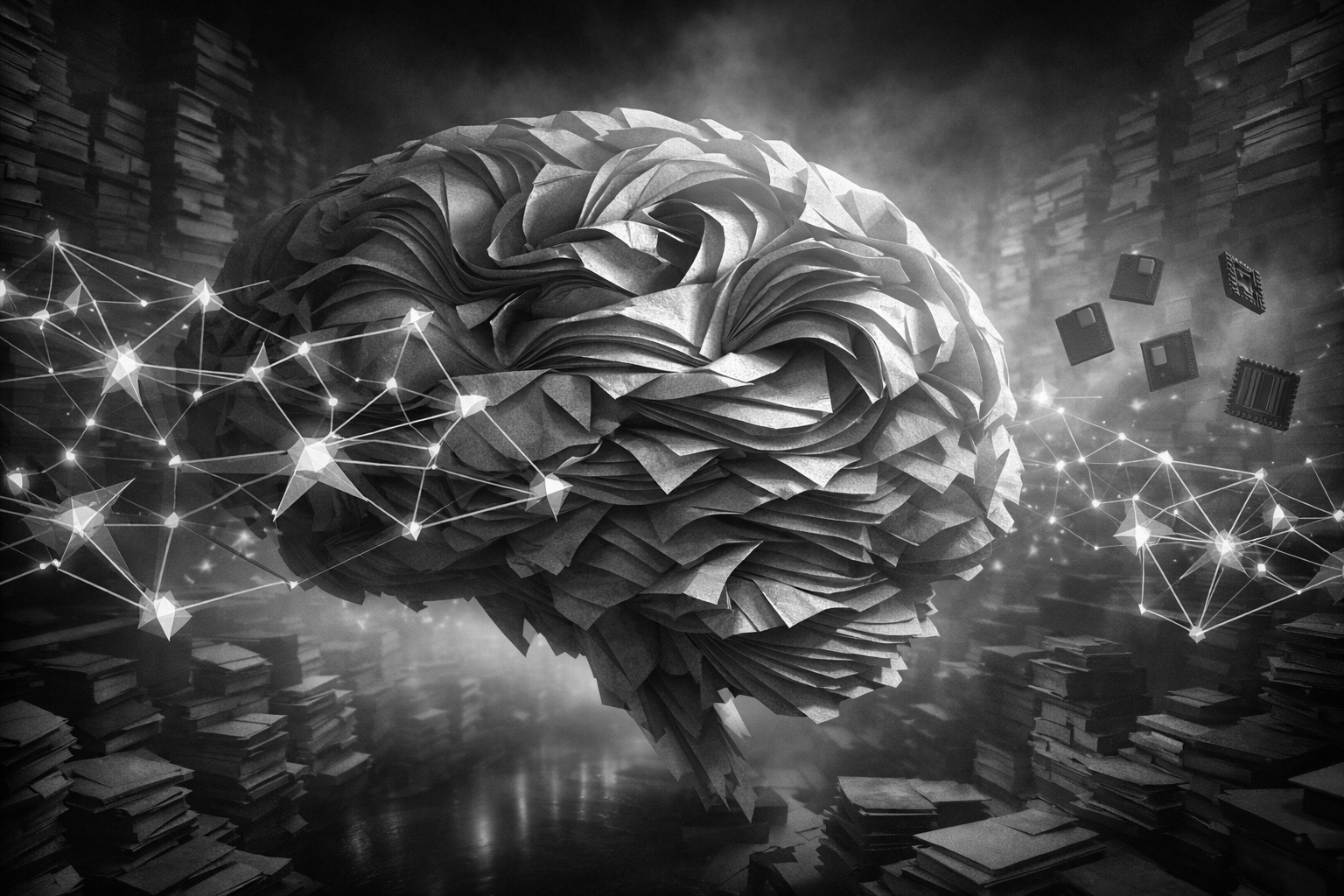
If a machine can think, then in principle you should be able to point to what, exactly, is doing the thinking. The Paper Test is popular because it tries to force that moment of honesty. It says: take a computer at a given instant, write down every 1 and 0 in order on a sheet of paper, then do the same for the next clock tick, and the next. Stack the pages and flip them like a childhood animation. If the computer is conscious, then the flipbook should be conscious too, because it contains the same sequence of internal states.
Most people feel the punchline immediately. The flipbook is not alive. It has no point of view. It does not understand what it "computes." So, the argument goes, neither does the computer. Electricity is just page flipping at high speed. More transistors only means more pages.
That is the promise of the Paper Test. It cuts through hype with a single image: a mind made of stationery.
What the Paper Test gets right about computers
The Paper Test is strongest when it targets a common confusion: mistaking impressive output for inner life. Modern AI can write essays, generate code, diagnose from images, and hold long conversations. It is easy to slide from "it behaves intelligently" to "it is intelligent in the way we are." The Paper Test pushes back by reminding readers that digital computers are, at their core, systems that move between discrete, engineered states under fixed rules.
That description is not an insult. It is the reason computers are reliable. A digital machine is designed so that messy physics collapses into stable symbols. Voltages are forced into ranges that count as 0 or 1. Memory is built to be read and written predictably. The whole point is to make the physical substrate irrelevant, so the same computation can run on different chips, or be simulated, or even be enacted by a person with enough time and paper.
In that sense, the Paper Test is a vivid restatement of a real property of digital computation: the abstract pattern is what matters, not the material. If you can preserve the pattern, you can preserve the computation.
Where the Paper Test quietly changes the subject
The leap from "a flipbook is not conscious" to "therefore no computer can be conscious" feels natural, but it hides a crucial assumption. It assumes that if two systems share the same formal sequence of states, then they share everything that matters for mind. Then it uses our intuition about paper to deny mind to the computer.
But the same move can be used in reverse. If you believe consciousness is an organizational property, you could say the flipbook is implementing the same computation, just extremely slowly and with a human hand providing the transitions. If the computation is what matters, then the flipbook is not a joke. It is a strange, impractical implementation of the same process.
That sounds absurd to many people, and that reaction is important. It reveals that the real disagreement is not about whether computers have states. It is about what kind of thing consciousness is. Is it tied to a particular physical kind of process, or can it arise from the right abstract organization regardless of substrate?
The Paper Test does not settle that. It forces you to pick a side.
The brain is not a clocked grid of bits, but that alone does not decide AGI
A common extension of the Paper Test says the brain is different in kind because it is not a digital device. Brains do not tick in lockstep like a CPU clock. Neural activity is continuous in time, distributed, noisy, and deeply entangled with chemistry, blood flow, hormones, immune signaling, and the rest of the body. Even at the level of a single synapse, there are many interacting processes, not a clean on off switch.
This is broadly true as biology. Neurons integrate signals in complex ways. Synapses change strength. Glial cells modulate signaling. Ion channels open and close stochastically. The brain is a living organ, not a neat circuit diagram.
But here is the key point that often gets lost: "the brain is not digital" does not automatically imply "AGI is impossible." It implies that if human level general intelligence depends on specific biological dynamics, then a simple digital approximation might fail. That is a different claim. It is a claim about what is required, not about what is possible in principle.
To argue impossibility, you need more than "brains are complicated" or "brains are continuous." You need to show that the relevant properties cannot be captured by any computational or physical system we could build, even in principle. That is a much higher bar.
Discrete versus continuous is not the real dividing line
The Paper Test leans heavily on discreteness. Computers have discrete states, so they can be written down. Brains have continuous states, so they cannot. Therefore, brains are not machines in the relevant sense.
There are two problems with using that as the decisive wedge.
First, continuous systems can be simulated to arbitrary precision for many purposes. In practice, you never get infinite precision in physics either. Real measurements are finite. Real biological systems operate under thermal noise and constraints. If the claim is that consciousness requires literally infinite precision, that is a strong metaphysical position, not an empirical one, and it needs its own defense.
Second, digital computers are not "purely discrete" in the physical sense. They are built on analog electronics and quantum physics, then engineered to behave discretely at the level we care about. The discreteness is a design choice layered on top of continuous substrate. So the question becomes: is the brain's continuous substrate essential to mind, or is it simply the substrate that evolution happened to use?
That is not a question paper can answer.
The strongest version of the Paper Test is really about meaning
There is a deeper intuition behind the Paper Test that deserves respect. It is not just "paper is not alive." It is the sense that symbols do not interpret themselves.
A page full of 1s and 0s has no meaning on its own. Meaning appears when a system uses those symbols to guide action in the world, and when those symbols are connected to perception, goals, and consequences. A flipbook of states, sitting on a desk, is not coupled to anything. It does not sense. It does not act. It does not care. It is not even wrong. It is inert.
This is where the Paper Test can be sharpened into a more serious challenge: if you strip away the world, leaving only formal state transitions, where does understanding come from? If a system's "knowledge" is just patterns in weights and activations, what makes those patterns about anything?
Philosophers call this the problem of intentionality, the "aboutness" of mental states. Engineers meet it in a practical form when models produce fluent nonsense. The model can be statistically competent and still fail to be grounded.
That is a real limitation of many current AI systems, especially those trained primarily on text. They inherit meaning from human language communities rather than generating meaning from lived interaction. The Paper Test resonates because it dramatizes that gap.
Why "AGI is not possible" is a different claim than "today's AI is not a mind"
It is one thing to say that current AI systems are not conscious, not alive, and not morally comparable to humans. Many careful researchers and practitioners agree with that, even while being impressed by capabilities. It is another thing to say that no artificial system could ever achieve general intelligence.
To make the impossibility case, you need to argue that mind requires something that cannot be instantiated in an artifact. There are a few routes people take.
One route is biological essentialism. It says life and mind depend on the special organization of living tissue, perhaps down to molecular or quantum effects, and that silicon cannot replicate it. This is possible, but it is not established. It is also not obvious that an engineered system could not reproduce the relevant dynamics using different materials.
Another route is metaphysical. It says intellect is not material at all, or that consciousness involves irreducible first person properties that cannot arise from physical processes. If you accept that, then the Paper Test becomes a rhetorical illustration of a prior commitment. The argument is not really about paper. It is about what you think a person is.
A third route is semantic. It says computation manipulates syntax, not semantics, and therefore cannot produce understanding. This is close to famous arguments like Searle's Chinese Room. It is powerful as a critique of "mere symbol pushing," but it still leaves open whether a system that is embodied, world coupled, and self updating could develop genuine semantics through use rather than through static symbol tables.
The brain is different in kind in one way that matters more than microtubules
Discussions about microtubules, cytoskeletal dynamics, and quantum effects in neurons are fascinating, but they often distract from a more obvious difference that is easy to miss because it is so ordinary.
Brains are parts of animals. Animals have needs. They must regulate temperature, energy, hydration, injury, reproduction, and social belonging. They are born, they develop, they suffer, they die. Their intelligence is not a detachable app. It is a strategy for staying alive in a world that pushes back.
This matters because much of what we call general intelligence is not just problem solving. It is prioritizing under uncertainty, learning what to care about, and integrating perception, memory, emotion, and action into a single ongoing life. A language model can be brilliant at producing text and still lack the basic structure that makes human cognition coherent: a persistent organism with stakes.
If you want a "paper test" that bites harder than the flipbook, ask a simpler question. What does the system need, and what happens if it does not get it?
A more useful way to read the Paper Test in 2026
The Paper Test is best treated as a warning label, not a proof. It warns against confusing representation with reality, and against treating "emergence" as a magic word that replaces explanation. It also warns that if you can describe a system entirely as a sequence of formal states, you may have described something that is functionally powerful yet still empty of experience.
But it does not, by itself, demonstrate that artificial general intelligence is impossible. It demonstrates that if you think a mind is nothing but a list of states, you will end up attributing mind to things that feel obviously mindless. That is a problem for a certain picture of mind, not a final verdict on machines.
The most productive outcome of the Paper Test is not panic or complacency. It is clarity. If someone claims AGI is around the corner, ask what they mean by general, what they mean by intelligence, and whether they are talking about competence, autonomy, understanding, or consciousness. Those are not the same, and the future will look very different depending on which one you quietly smuggle into the headline.
Because the real question is not whether a flipbook can think, but whether we are brave enough to define thinking in a way that does not change every time the machine gets better at talking.