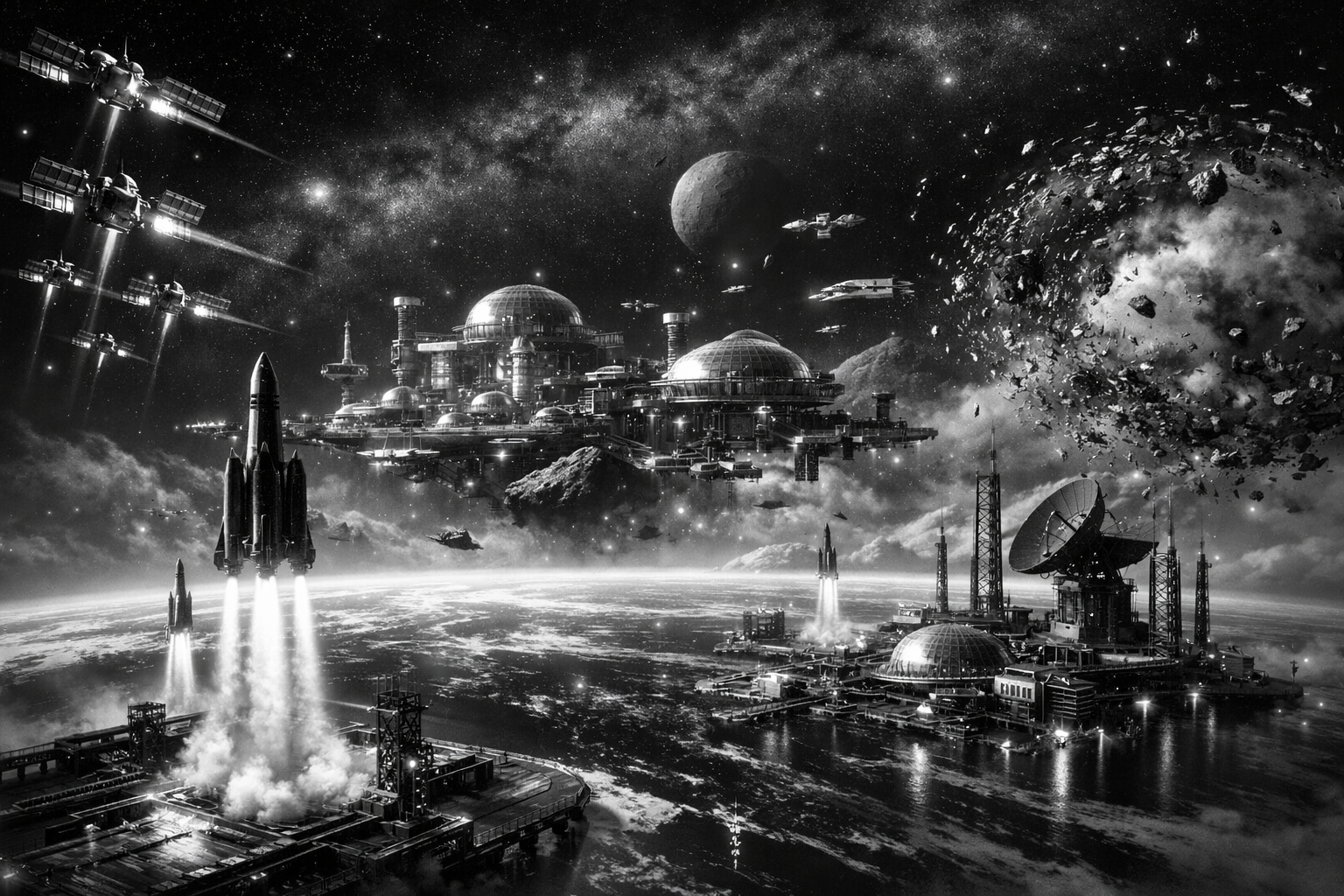
By 2055, "space industry" will either mean a quiet utility you rely on all day without noticing, or a brittle battlefield of crowded orbits and rising insurance bills. The difference will not be decided by a single moonshot technology. It will come down to three unglamorous levers: how cheap it is to reach orbit, how safely we manage traffic and debris, and whether geopolitics turns satellites into targets.
The noise today is loud. Fully reusable rockets promise airline-like operations. Mega-constellations are rewriting communications. Governments are returning to the Moon while militaries harden space systems. It is tempting to pick one trend and draw a straight line to a sci-fi future.
A better way to think is in scenarios. Not predictions, but plausible paths that help investors, operators, and policymakers stress-test decisions. Here are three versions of Space 2055: pessimistic, realistic, and optimistic. Each is anchored in what is already visible in launch economics, orbital congestion, and the shifting balance between commercial markets and national security.
The three forces that decide Space 2055
1) Launch cost is the master variable
Space becomes "normal" only when access is cheap enough and frequent enough that you can plan around it. Reusability has already changed the industry's psychology, but the next step is not just a lower sticker price per kilogram. It is high cadence. A rocket that is technically reusable but flies rarely behaves like an expensive custom machine, not like transport infrastructure.
If fully reusable systems reach airline-like operations, the second-order effects are bigger than the first-order savings. Hardware can be iterated faster. Constellations can be replenished routinely. In-orbit servicing becomes practical because you can afford to launch the servicer and the spare parts without treating every mission like a national event.
2) Debris and traffic management decide whether growth is allowed
The space economy can expand for a while in a messy orbit, but not forever. The risk is not only a dramatic "Kessler syndrome" cascade. The nearer-term danger is financial. A few high-profile collisions can push insurance premiums up, raise the cost of capital, and make operators more conservative. That slows innovation even if rockets get cheaper.
By 2055, the winners will be the ecosystems that treat orbit like airspace. That means tracking, coordination, enforceable end-of-life rules, and a real market for debris removal and life-extension services. Without that, the industry does not stop, but it becomes more defensive, more expensive, and less ambitious.
3) Geopolitics shapes who pays, who shares, and what gets targeted
Space is already a layer of national power. Navigation, communications, missile warning, intelligence, and targeting all depend on satellites. That reality pulls budgets toward resilience and redundancy. It also makes international cooperation harder, because shared infrastructure can become shared vulnerability.
The uncomfortable truth is that government demand is both a stabilizer and a distortion. It can keep launch providers and satellite manufacturers alive through downturns. It can also steer the market toward dual-use systems and away from purely commercial bets that need patient capital and predictable regulation.
If launch gets cheap but debris governance fails, you get a crowded orbit with rising risk costs. If debris governance works but launch stays expensive, you get a stable but slow-growing space economy. If both improve and geopolitics stays contained, you get compounding growth.
Scenario 1: The "Divided Orbit" future (pessimistic)
In this 2055, space is indispensable but disappointing. Launch is cheaper than it was in the 2020s, yet not cheap enough to unlock mass markets. Access to orbit still feels like buying a bespoke industrial service, not booking transport. Most missions are tied to government programs, and the government share of spending is larger than many people expected.
Commercial space stations exist on paper and in prototypes, but the business case never stabilizes. Microgravity manufacturing produces impressive demonstrations, then struggles with operating costs, quality control, and the brutal math of returning product to Earth. Tourism remains a niche for the ultra-wealthy and for occasional corporate stunts.
The real brake is risk. Satellite numbers rise quickly, but rules arrive late and enforcement is weak. A handful of major collisions create debris fields that make certain orbital shells meaningfully harder to insure and operate in. Operators spend more on shielding, maneuvering fuel, and redundancy. Insurers respond by raising premiums and tightening terms. Investors respond by demanding faster payback, which pushes companies toward government contracts.
Geopolitics does the rest. Space becomes openly security-first. Nations build parallel stacks of capability, from launch to navigation to communications, because dependence is seen as a liability. Anti-satellite capabilities exist in the background like a permanent threat, and "inspection satellites" and electronic warfare become normal parts of the orbital environment.
The space industry still grows, but it grows like a defense sector. It is strategic, expensive, and fragmented. The average person benefits from satellite services, yet the dream of a broad, self-sustaining commercial space economy never quite arrives.
Scenario 2: The "Managed Growth" future (realistic)
This is the most likely 2055 if today's trends continue without a major breakthrough or a major catastrophe. Space becomes busier and more commercial, but it does not become effortless. Launch costs fall, reusability improves, and cadence rises, yet not to the point where orbit feels cheap. It feels accessible, which is different.
Low Earth orbit is dominated by large constellations. Communications and Earth observation become the backbone. Satellite internet is no longer a novelty. It is a standard part of national connectivity, especially for remote regions, maritime routes, disaster response, and backup capacity when terrestrial networks fail.
Earth observation becomes less about pretty pictures and more about decisions. Agriculture uses it to manage water and yield. Insurance uses it to price risk and verify claims. Logistics uses it to monitor ports, roads, and supply chain choke points. Climate monitoring becomes more continuous, with faster revisit rates and better integration into forecasting models.
A small number of commercial stations replace the role once played by the International Space Station. They host research, technology demonstrations, and limited tourism. The most valuable work is not "science for science's sake" but applied experimentation that improves materials, sensors, and manufacturing processes back on Earth.
The Moon becomes a regular destination, but not a gold rush. A permanent lunar outpost exists, supplied through a mix of government missions and commercial logistics. Water extraction at the poles is attempted and partially operational, but it is not yet a giant propellant economy. It is a capability that reduces some mission costs and increases flexibility, rather than transforming everything overnight.
Debris is treated as a serious operational cost. By 2055, traffic coordination is more formal, and end-of-life disposal is more consistently enforced. A market for life-extension, tug services, and selective debris removal exists, but it is still smaller than enthusiasts once imagined. It grows because it has to, not because it is glamorous.
Governments remain the largest customers, especially for resilient communications, navigation, and reconnaissance. Many companies are commercial on the surface but dual-use in practice. That is not necessarily a failure. It is simply the shape of a space economy that has become infrastructure.
Scenario 3: The "Cislunar Flywheel" future (optimistic)
In this 2055, the space industry finally gets its flywheel. Fully reusable launch systems reach high cadence, and the cost of getting mass to orbit drops by an order of magnitude. The key change is not that everything becomes cheap. The key change is that planning becomes routine. You can build businesses that assume frequent launches the way modern logistics assumes frequent shipping.
Low Earth orbit hosts multiple commercial stations with clear roles. Some are labs. Some are assembly yards. Some are mixed-use destinations where research, manufacturing, and tourism share the same infrastructure. The most successful stations are not the ones with the best marketing. They are the ones with the best uptime, power, thermal management, and docking throughput.
Microgravity manufacturing becomes a real, if still niche, market. The winners are products where microgravity offers a step-change advantage, not a marginal improvement. Think high-value pharmaceuticals, specialized optical materials, and components where defect rates matter more than raw volume. The industry learns, painfully, that "made in space" is not a business model by itself. "Made in space because it is measurably better" is.
In-orbit servicing becomes normal. Satellites are designed to be refueled, repaired, and upgraded. Constellations are managed like fleets, with planned maintenance rather than planned obsolescence. That reduces debris and improves economics at the same time, which is the rare kind of win that scales.
The Moon becomes a logistics node. A small but permanent base operates near the poles. Water extraction supports local life support and produces limited propellant. The point is not to turn the Moon into a city by 2055. The point is to make deep-space missions less fragile by adding a refueling and staging option outside Earth's gravity well.
Mars is visited by humans in this scenario, but it is not a colony story. It is a program story. Regular missions follow, driven by a mix of national prestige, scientific ambition, and the simple fact that the cislunar supply chain makes big missions less punishing. The public narrative is romantic. The operational reality is logistics, redundancy, and risk management.
Even the flashier ideas, like space-based compute and power, get a more grounded treatment. Some orbital data processing makes sense when it reduces latency, bandwidth, or downlink bottlenecks for Earth observation. Space-based solar power remains hard, but pilot systems exist where the economics work for specific customers and geographies. The industry learns to separate "possible" from "bankable," and that discipline is what keeps the optimism from collapsing under its own hype.
What to watch between now and 2055
If you want a signal through the noise, watch for compounding, not announcements. The first signal is launch cadence, because it reveals whether reusability is truly operational. The second is whether satellite operators treat end-of-life disposal as a cost of doing business, not a public relations line item. The third is whether insurers, regulators, and operators converge on shared traffic rules that are actually enforced.
Then watch where the money becomes boring. When space revenue comes from renewals, service contracts, and predictable utilization rather than one-off missions and speculative valuations, you are no longer looking at a frontier. You are looking at infrastructure.
By 2055, the space industry will not be defined by a single flagship rocket or a single heroic mission. It will be defined by whether humanity learns to run orbit like a place we live with every day, because in practical terms, we already do.
The most important question is not whether we can reach space cheaply, but whether we can keep it usable long enough for the cheap access to matter.