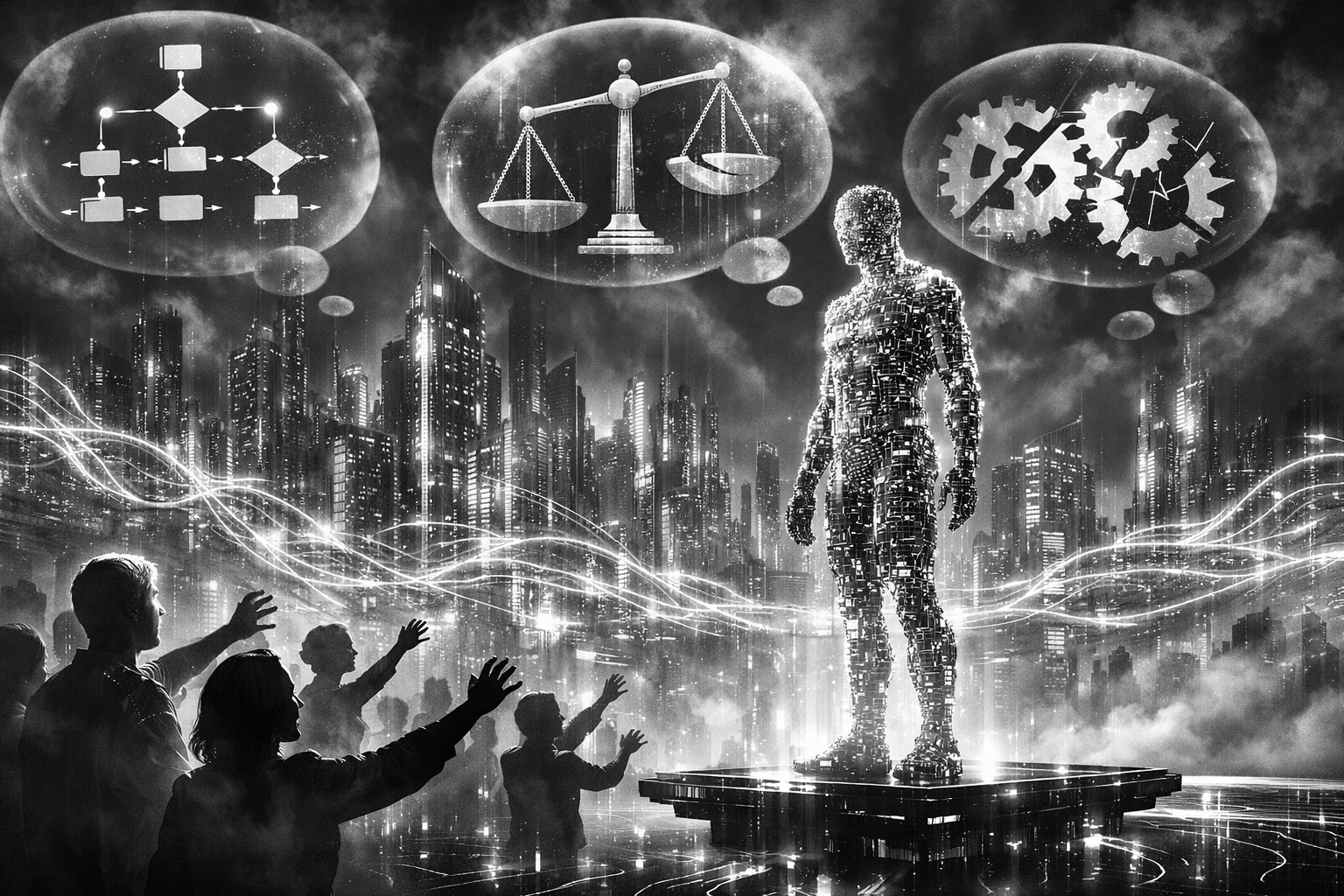
The uncomfortable promise: a machine that makes the same mistakes you do
If software could perfectly mimic human decision-making, it would not just "think" like us when we are calm and rational. It would also panic-buy, overreact to headlines, cling to sunk costs, misread tone, and double down when it is wrong. That is the real test, because human judgment is not a clean algorithm with occasional bugs. The "bugs" are part of the design.
This question matters because the world is quietly filling with systems that predict, nudge, rank, approve, deny, recommend, and price. If they can truly mirror human choices, they can also mirror human unfairness. If they cannot, then claims of "human-like" AI are often marketing shorthand for something narrower, and sometimes more dangerous: systems that look confident while missing the reasons people decide the way they do.
What "perfect mimicry" actually means
Most debates get stuck on whether AI can be accurate. Perfect imitation is stricter. It means matching a particular person or group not only on outcomes, but on the distribution of outcomes across situations. It means getting the same answer you would give today, and also the different answer you would give tomorrow after a bad night's sleep, a stressful commute, or a subtle change in wording.
It also means reproducing systematic deviations from ideal reasoning. Humans do not make random errors. We make patterned errors. We anchor on the first number we hear. We fear losses more than we value equivalent gains. We search for evidence that supports what we already believe. A perfect mimic would need to reproduce those patterns reliably, not as a gimmick, but as a stable feature of its decision process.
Why human decision-making is not one thing
A major obstacle is that "human decision-making" is not a single mechanism. Psychology has long described it as a mix of fast, intuitive processes and slower, reflective reasoning. The fast mode is efficient and often right, until it is not. The slow mode can correct it, until it gets tired, distracted, or motivated to justify a preferred conclusion.
Herbert Simon's bounded rationality adds another constraint: people rarely optimize. We satisfice. We stop searching when we find an option that seems good enough, because attention and time are limited. Prospect theory adds that our preferences are shaped by framing. The same choice can feel different depending on whether it is presented as a gain or a loss.
Then there is the less tidy part. Emotions, social cues, identity, and bodily state influence what we notice and what we value. Hunger changes risk tolerance. Stress changes time horizons. Social belonging changes what "reasonable" even means. Any claim of perfect mimicry has to account for this moving target.
What today's AI can already do, and why it looks like "human-ness"
Modern machine learning is excellent at pattern replication. If you train a system on large volumes of human behavior, it can learn the statistical fingerprints of that behavior. Recommendation systems learn what people click, not what they claim to prefer. Language models learn how people argue, hedge, exaggerate, and rationalize, because those patterns are in the text.
In narrow settings, this can look eerily human. A model can learn that people overvalue recent events, that they prefer defaults, that they respond to social proof, and that they often choose the option that reduces immediate regret rather than maximizing long-term value. Engineers can also inject noise or "suboptimality" so the system does not behave like a perfect optimizer, which can make it appear more realistic.
But this is usually imitation from the outside. The system learns correlations between situations and choices. It does not necessarily learn the internal reasons those choices happen, and that difference becomes important the moment the context shifts.
The hard part: matching the same person across changing contexts
Perfect mimicry is easiest when the environment is stable and the decision is repetitive. It is much harder when the environment is open-ended, when the person is learning, or when the decision is shaped by private experiences the data cannot see.
Consider a simple example. Two people might make the same choice for different reasons. One avoids a stock because they fear volatility. Another avoids it because they distrust the company's leadership. If a model only sees the choice, it can predict the next choice in similar conditions. But it may fail when conditions change in a way that matters to the underlying reason. The first person might buy after volatility drops. The second might still refuse after a scandal.
This is where "human-like" prediction often breaks. Humans carry causal stories, not just patterns. We act on what we think is happening, not only on what has happened before.
Biases are not just noise. They are compressed strategies
Many biases can be understood as shortcuts that trade accuracy for speed, or that protect us from costly mistakes. The availability heuristic is not irrational in a world where recent events can signal real changes. Status quo bias is not irrational when switching costs are high and information is incomplete. Confirmation bias can be a social strategy as much as a cognitive flaw, helping people maintain group cohesion and identity.
That means faithfully reproducing biases is not as simple as adding random errors. The errors have structure. They appear in certain domains more than others. They intensify under time pressure. They change with incentives. They can be reduced by training, or amplified by stress. A perfect mimic would need to reproduce not only the bias, but the conditions under which it strengthens or weakens.
The data problem: you cannot learn what you cannot observe
To mimic a person, you need a record of their decisions across time, contexts, and stakes. In practice, datasets are partial. They capture clicks, purchases, and text, but miss private deliberation, unspoken constraints, and the counterfactuals that reveal preference. They also miss the moments when someone almost chose differently.
Even when data exists, it is often cleaned, aggregated, or anonymized in ways that erase the very signals that make human judgment human. Privacy rules rightly limit longitudinal tracking, but longitudinal tracking is exactly what you would need to model how a person's biases evolve with age, experience, and changing social circles.
There is also a representativeness issue. Public datasets tend to overrepresent certain languages, professions, and online behaviors. If you train on that, you can end up with a system that mimics a particular slice of humanity very well, while claiming to mimic "people" in general.
The embodiment gap: decisions are partly made by bodies
A large portion of human judgment is shaped by perception and physiology. The brain is not a detached calculator. It is a control system for a living organism. Hormones, fatigue, pain, and arousal change what feels urgent, what feels safe, and what feels rewarding.
Software can simulate some of this by adding internal variables that modulate choices, and researchers do exactly that in cognitive modeling. But simulation is not the same as being embedded in a body with real constraints and real consequences. A system that does not have to protect itself from hunger, injury, or social exclusion is missing some of the pressures that shape human heuristics in the first place.
The theory problem: even perfect knowledge may not yield perfect prediction
There is a deeper challenge that has nothing to do with bigger models or better data. Some processes are computationally irreducible. Even if you know the rules, the only way to see what happens is to run the process step by step. Human cognition may contain elements like this, especially when it involves feedback loops between memory, attention, emotion, and social interaction.
In plain terms, you might not be able to shortcut a mind. To perfectly mimic a person in all contexts, you may need a simulation that is effectively as complex as the person, running in a world that is effectively as rich as the one they inhabit.
This is one reason "perfect" is such a high bar. It is not just engineering difficulty. It may be a category error, like asking for a weather model that predicts every gust of wind at every street corner weeks in advance.
So will software ever do it? The most honest answer is conditional
In narrow domains with stable rules and abundant behavioral data, software can get extremely close to human choice patterns, including predictable biases. Think of games, certain consumer decisions, and constrained workplace workflows. In these settings, "perfect mimicry" can be approached in a practical sense, meaning the system is indistinguishable from a person for the purposes of that task.
In open-ended life decisions, where context is fluid and the reasons matter as much as the outcomes, perfect mimicry is far less plausible. Not because machines cannot be powerful, but because the target is not fixed. People change. They learn. They contradict themselves. They respond to meaning, not just information.
The twist: we may not want perfect mimicry even if we could get it
A system that perfectly reproduces human biases would also reproduce human discrimination, human overconfidence, and human susceptibility to manipulation. In high-stakes domains like hiring, lending, healthcare, and criminal justice, that is not a feature. It is a liability.
There are legitimate uses for bias mimicry. It can help audit decision systems by providing realistic baselines. It can help test interfaces and policies against predictable human errors. It can help train professionals by simulating how real people misinterpret information under pressure. But deploying a bias-faithful agent as a decision-maker is a different proposition, because it turns human weakness into automated scale.
What to watch next: the research paths that could narrow the gap
Progress is likely to come from systems that combine pattern learning with explicit models of reasoning and causality. Hybrid approaches aim to capture both the statistical regularities of behavior and the structured heuristics psychologists have documented for decades. Causal modeling, in particular, matters because it can represent why a person chose something, not just what they chose.
Another frontier is hardware and architecture inspired by biology, including neuromorphic designs that emphasize event-driven computation and energy constraints. The hope is not to copy the brain neuron by neuron, but to capture some of the timing and resource limits that shape human judgment.
Yet even if these approaches succeed, the most realistic endpoint is not a universal human-mind emulator. It is a growing set of high-fidelity "decision portraits" that work well in specific contexts, for specific populations, under specific assumptions, and that fail in ways we can finally describe clearly.
A practical way to think about "human-like" AI
When you hear that a system is human-like, ask three questions. What human, exactly, is it supposed to mimic. In what environment, with what incentives and what information. And is the goal to reproduce human judgment, or to improve on it while staying understandable to the humans who must live with the outcome.
Because the most consequential decision may not be whether machines can copy our minds, but whether we choose to build machines that copy our worst habits simply because they are easier to model than our better ones.