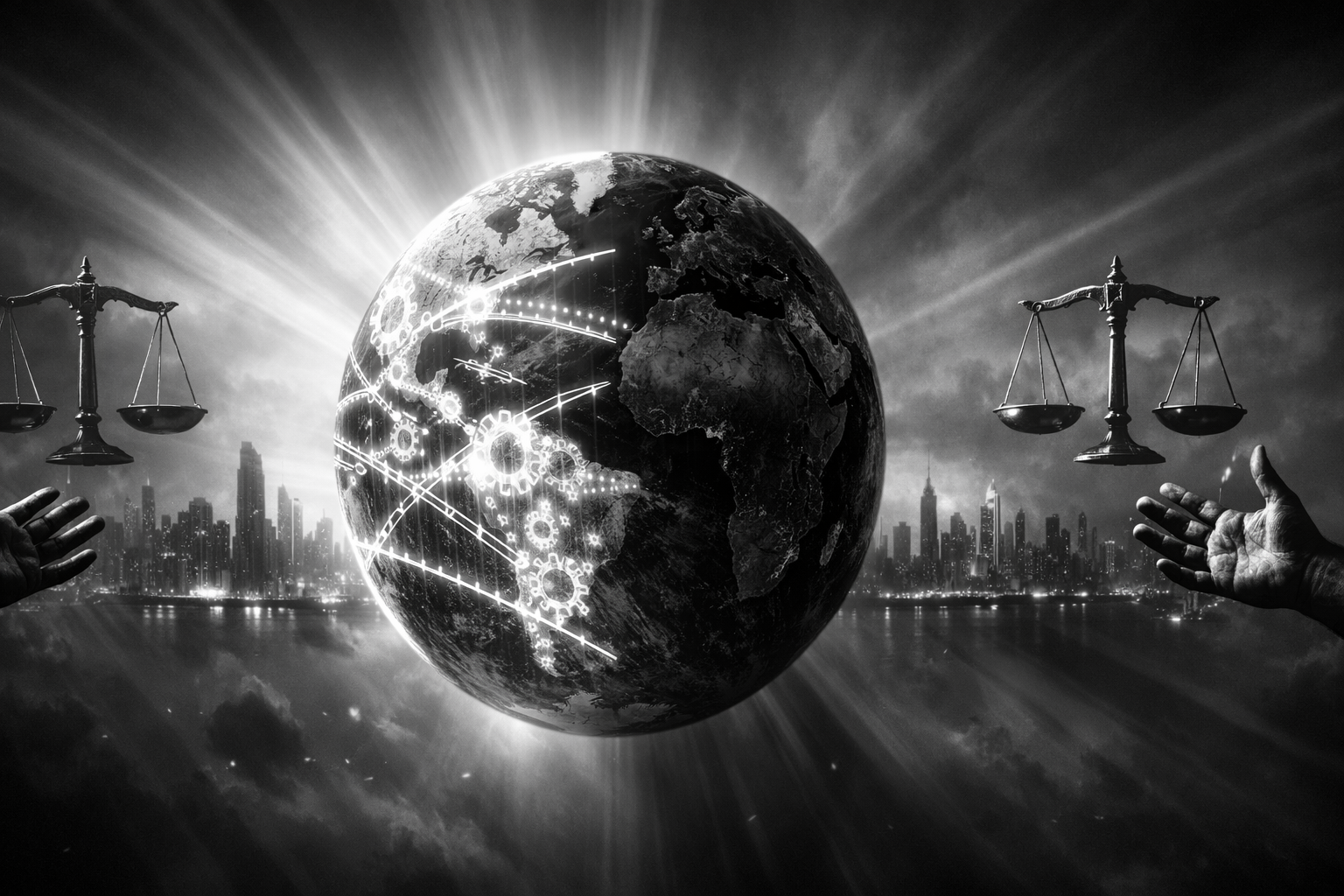
The most dangerous idea in politics might also be the most efficient
Imagine waking up to a world where war between countries is impossible because there are no countries. One passport. One legal system. One budget. One chain of command. It sounds like the cleanest fix for climate gridlock, trade wars, and arms races. It also sounds like the cleanest path to a single point of failure for the entire human species.
This is the core tension behind a single nation-state controlling the whole world. The upside is coordination at a scale we have never achieved. The downside is that every safeguard we rely on today, competition between governments, the ability to vote with your feet, the existence of rival power centers, could vanish at once.
What "one world state" actually means, and what it does not
A one-world government is not the same thing as global influence, a dominant superpower, or a strong United Nations. It is direct sovereignty over every territory and institution. It writes the laws, collects the taxes, runs the courts, controls the security forces, and ultimately decides what is legitimate everywhere.
History offers analogues but not true examples. Empires such as Rome, the Mongols, and Britain controlled vast regions, often through local elites and uneven administration. Even at their peak they did not govern the planet, and they did not face modern expectations of universal rights, mass participation, and instant communication. The closest modern parallel is not an empire but a system, the way global finance, supply chains, and standards already bind states together without replacing them.
The strongest argument for a single world state: peace through one monopoly on force
The most obvious benefit is the elimination of interstate war. If there is only one sovereign, there is no "foreign" enemy with equal legal standing. Border disputes become internal administrative questions. Arms races lose their logic. Nuclear deterrence becomes a relic because there is no rival nuclear state to deter.
This is not a utopian claim so much as a structural one. Many of the deadliest wars in history were wars between organized states with comparable legitimacy and capacity. Remove the competing sovereignties and you remove a major engine of large-scale conflict.
But peace is not the same as safety. A world state could still face civil wars, insurgencies, separatist movements, and political violence. The violence might even become more intense in some places because there is no external refuge, no sympathetic neighboring state, and no alternative jurisdiction to appeal to.
Economic upside: fewer frictions, one rulebook, and a truly global safety net
A single authority could remove tariffs, harmonize regulations, and standardize contracts. That sounds technical, but it touches everyday life. It could mean fewer supply shocks, faster infrastructure buildouts, and less waste from duplicated systems. Today, the world pays a "coordination tax" every time a product crosses a border, a company navigates conflicting rules, or a crisis triggers competitive hoarding.
A world state could also, in theory, build a global fiscal system that stabilizes downturns. When one region suffers a disaster or recession, a central budget could transfer resources automatically, the way some national governments already do across provinces and states. That is one of the quiet strengths of large federations: risk pooling.
The catch is that economics is never just economics. A single tax system and a single budget would force a single answer to questions that currently have many answers. How progressive should taxes be. How much should be spent on welfare versus defense versus research. Which regions get infrastructure first. Those fights would not disappear. They would become the only fights that matter.
Climate and pandemics: the problems that make world government sound practical
Climate change is the best advertisement for centralized coordination. Emissions do not respect borders, and neither do the consequences. A world state could set one carbon price, enforce one emissions regime, and stop the familiar pattern where ambitious pledges collide with domestic politics and free-riding incentives.
The same logic applies to pandemics and biosecurity. A unified authority could standardize surveillance, fund rapid response, and prevent the early-stage information bottlenecks that often come from political fear and fragmented responsibility. It could also coordinate stockpiles and manufacturing capacity without export bans and bidding wars.
Yet centralization cuts both ways in public health and climate. If the central authority gets the science wrong, or politicizes it, there is no competing jurisdiction to provide an alternative model. Diversity of policy can be wasteful, but it can also be a form of resilience, like having multiple experiments running at once.
Technology and standards: faster progress, or one global brake pedal
A world state could fund mega-projects without negotiating among dozens of governments. It could unify technical standards for energy grids, digital identity, AI safety, and telecommunications. It could reduce duplication in research and accelerate deployment of breakthroughs, especially in areas where coordination is as important as invention.
But innovation thrives on competition and on the freedom to try unpopular ideas. A single regulator can become a single bottleneck. If the world state chooses the wrong standard, the entire planet can get locked into it. If it becomes risk-averse, it can slow disruptive progress everywhere. If it becomes captured by a narrow set of interests, those interests can shape the future of technology for everyone.
The biggest risk: tyranny without an exit
The most serious drawback is not bureaucracy or cultural blandness. It is the concentration of coercive power. In today's world, authoritarianism is constrained, imperfectly, by external pressure, internal pluralism, and the fact that people and capital can sometimes leave. A world state removes the ultimate check: the existence of another sovereign.
If a single global authority becomes oppressive, there is no rival jurisdiction to offer asylum, no competing legal system to set a better example, and no balance of power to limit its reach. The nightmare scenario is not merely a bad government. It is a bad government with nowhere else to go.
Even well-intentioned leaders face temptations when the stakes are planetary. Surveillance can be justified as "global security." Censorship can be framed as "social cohesion." Emergency powers can become permanent because the world is always in some kind of emergency.
Cultural and political diversity: what gets lost when everyone is governed the same way
A single world state does not automatically erase cultures, but it creates pressure toward uniformity. One legal code tends to privilege one set of assumptions about family, property, speech, religion, and education. Even if the state promises tolerance, the center still decides what tolerance means.
There is also a practical issue. Diversity is not only a moral value. It is a problem-solving asset. Different societies try different policies, build different institutions, and learn from each other's successes and failures. When governance becomes monolithic, the world loses parallel experimentation.
Supporters of world government often reply that diversity can be protected through federalism. That is true in principle. The question is whether local autonomy would be a constitutional reality or a permission that can be revoked when it becomes inconvenient.
Bureaucracy at planetary scale: the efficiency myth and the coordination reality
Centralization is often sold as efficiency. In practice, very large organizations can become slow, opaque, and self-protective. A world state would need to administer everything from fisheries to financial fraud, from migration to mining rights, from education standards to disaster relief. That is not one government. It is thousands of governments stacked on top of each other.
The danger is not only waste. It is distance. When decision-makers are far from the consequences, policy becomes abstract. People feel ruled rather than represented. That legitimacy gap is where unrest grows, and where the state is tempted to substitute consent with enforcement.
Legitimacy: the question that decides whether a world state is stable or brittle
Every durable political order answers two questions. Who gets to decide, and why should anyone accept it. A world state would need legitimacy across languages, religions, histories, and economic conditions that often pull in opposite directions.
Democracy sounds like the obvious answer until you scale it. A global election raises hard design problems. How do you prevent permanent majorities and permanent minorities. How do you balance population size against regional voice. How do you stop a single media ecosystem from becoming a single propaganda channel. How do you keep elections meaningful when the administrative machine is too large for ordinary citizens to understand.
Technocracy sounds tempting because it promises competence. But expertise is not legitimacy. People do not accept painful trade-offs simply because a panel of experts says they are necessary. They accept them when they believe the process is fair, the burdens are shared, and the decision-makers can be removed.
Three models people imagine, and why the middle one keeps resurfacing
The strict version is a single capital with uniform rules everywhere. It maximizes coordination and minimizes local discretion. It also maximizes the risk of authoritarian drift and policy blindness.
The federal version keeps a global layer for truly global problems such as war prevention, climate limits, pandemic response, and certain trade rules. It leaves culture, education, local policing, and much of taxation to regional governments. This model is often proposed because it tries to capture the peace and coordination benefits without turning the planet into one administrative monoculture.
The technocratic hybrid delegates major decisions to expert bodies, especially in science-heavy domains. It can be fast and consistent. It can also become unaccountable quickly, particularly when "the data" is used to shut down political disagreement rather than inform it.
A practical way to think about the trade-off: coordination versus contestability
The real benefit of many-state politics is not romance or flags. It is contestability. When governments compete, citizens can compare outcomes. Dissidents can sometimes find refuge. Bad ideas can be contained geographically. When one system fails, others may still function.
The real benefit of one-state politics is coordination. When everyone is inside the same system, collective action becomes easier. The world can, in theory, move as one on problems that punish delay.
So the question is not whether a world state could do good. It could. The question is whether humanity can afford a system where the ability to challenge power, escape power, or outcompete power is reduced to internal procedures controlled by the same power.
If it ever happened, what would determine whether it becomes a golden age or a global trap
The decisive variables would be boring on paper and everything in reality. How power is divided between levels of government. How courts are insulated from politics. How speech is protected when it is inconvenient. How budgets are audited. How leaders are removed. How minorities are protected from majorities. How regions can opt out of policies without opting out of the world.
A single world state is often debated as if it is a switch you flip. In practice it would be an architecture you live inside. The design details would not be footnotes. They would be the difference between a planet that finally solves its shared problems and a planet that discovers, too late, that it has built a cage with no outside.
The most unsettling part is that the same forces pushing us toward tighter global coordination, climate physics, supply chains, AI-enabled administration, are also the forces that could make centralized power feel normal, even comforting, right up until the moment it stops being optional.