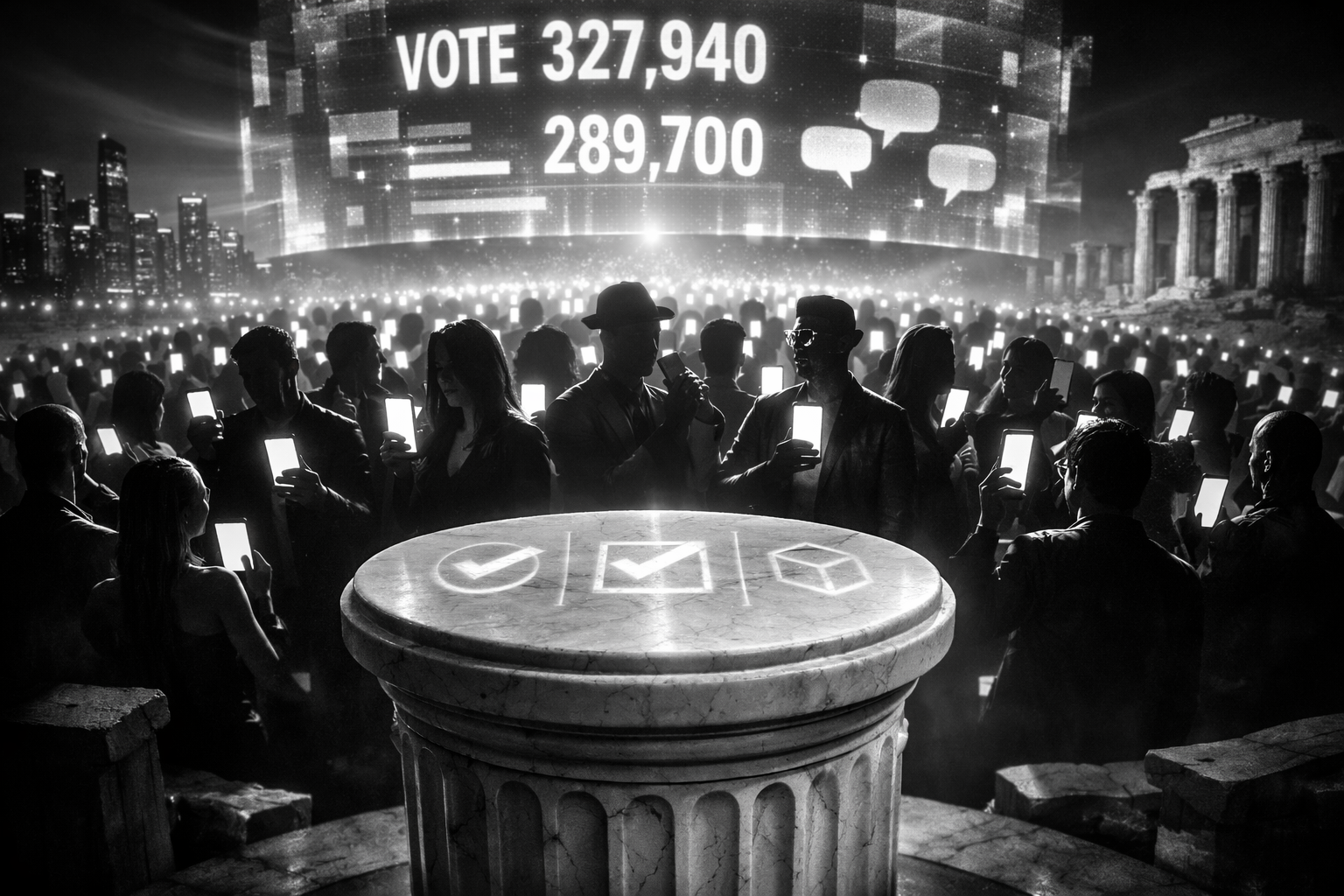
Politics is starting to look like entertainment. That is not an insult. It is a strategy.
If you feel like elections are increasingly about who can dominate the feed, win the meme war, or command a room like a talk-show guest, you are not imagining it. Celebrity-focused politics is rising because attention has become the scarcest resource in public life, and fame is the most efficient way to buy it without paying for it.
This shift is not just about actors running for office. It is about politicians behaving like celebrities, celebrities behaving like political operators, and voters being asked to judge leadership through the same cues they use to judge performers: authenticity, charisma, relatability, and narrative.
What "celebrity politics" actually means in 2026
The obvious version is a famous person becoming a candidate. The more common version is subtler. It is when political success depends on celebrity mechanics: constant visibility, personal branding, parasocial connection, and a storyline that can survive in short clips.
In that world, a candidate's "platform" is not only a set of policies. It is also a character arc. The underdog. The fighter. The outsider. The truth-teller. The competent grown-up. These archetypes are not new, but social media and 24-hour commentary have made them the primary unit of political communication.
This is not new. The incentives are new.
Politics has always borrowed from fame. John F. Kennedy understood television. Ronald Reagan and Arnold Schwarzenegger proved that name recognition can be converted into votes. But earlier eras still forced candidates to pass through gatekeepers. Party structures mattered more. Local newspapers and broadcast newsrooms filtered what counted as "serious."
Today, the gatekeepers are weaker and the platforms are stronger. A candidate can build a national profile without a party's blessing, and a celebrity can become a political force without ever appearing on a debate stage. The result is not simply more famous candidates. It is a political marketplace where fame behaves like a superpower.
Why fame wins elections more easily than policy
Celebrity is a shortcut. It reduces the cost of being known. In a crowded information environment, being recognizable is half the battle, and sometimes more than half. Voters cannot deeply research every race, every issue, every claim. So they use signals. Familiarity is one of the strongest signals humans have.
Fame also comes with a ready-made distribution network. A politician with a modest following must pay for reach or earn it slowly. A celebrity starts with millions of subscribers, a press apparatus that already cares, and a fan base trained to amplify.
Then there is emotional resonance. Fans often feel they know a celebrity personally. That bond can translate into trust, even when the topic shifts from music or sport to taxes or foreign policy. It is not that voters are irrational. It is that emotion is a faster decision tool than policy analysis, and modern media rewards speed.
The media system now pays a premium for personalities
Cable news, podcasts, and social platforms all compete for attention. Personalities are easier to package than policy. A fight travels faster than a white paper. A gaffe outperforms a committee hearing. A viral clip beats a nuanced explanation almost every time.
This is why even traditional politicians increasingly adopt celebrity tactics. They do "content." They cultivate catchphrases. They stage moments designed for clips. They appear on entertainment shows and influencer channels because that is where audiences are, especially younger ones.
The feedback loop is brutal. The more attention a figure gets, the more coverage they receive. The more coverage they receive, the more "important" they appear. Importance then becomes a self-fulfilling metric, and policy competence can become secondary to the ability to stay on screen.
Social media did not invent celebrity politics. It industrialised it.
Platforms reward engagement, not accuracy. Engagement is often driven by identity, outrage, humour, and intimacy. Those are celebrity strengths. A famous person can post a political message and instantly trigger a wave of reactions, stitches, duets, commentary videos, and news write-ups.
Even when the message is thin, the reach is thick. That matters because reach shapes what people think is being discussed, which shapes what journalists cover, which shapes what parties respond to. In practice, a celebrity can set the agenda simply by being interesting enough to talk about.
There is also a structural advantage that rarely gets said out loud. Many celebrities are already trained in performance under pressure. They know how to deliver lines, handle hecklers, and project confidence. In a media environment that treats politics as a series of moments, that skill can look like leadership.
Three ways celebrity power shows up in modern elections
The first is the celebrity candidate. This is the most visible form, and it can work because it solves the hardest early problem in politics: getting noticed. Jesse Ventura in the United States and entertainment-to-office pathways in multiple countries show that voters will sometimes trade experience for a compelling outsider story, especially when trust in institutions is low.
The second is the celebrity endorser as a campaign asset. Endorsements used to be about party elders and newspapers. Now they can come from musicians, athletes, streamers, and creators whose audiences are large and tightly bonded. The endorsement is not just a statement. It is a distribution event.
The third is the politician as influencer. This is arguably the dominant trend. Many elected officials now communicate like creators, building a direct relationship with supporters and bypassing traditional media. That can be healthy when it increases transparency. It can also be corrosive when it turns governance into perpetual campaigning.
Does celebrity politics help democracy or hollow it out?
It can do both, which is why the debate is so heated. On the positive side, celebrity involvement can pull disengaged people into civic life. A voter who ignores parliamentary procedure might still show up for a cause if a trusted public figure makes it feel relevant. In countries with low youth turnout, that is not trivial.
Celebrity politics can also force issues into the mainstream faster than institutions can. Public health campaigns, disaster relief fundraising, and human rights advocacy have all benefited from famous voices that can mobilise attention quickly.
The risk is that attention becomes mistaken for competence. Governing is not performing. It is staffing, negotiating, reading, listening, and making trade-offs that rarely look heroic in a clip. When voters are trained to reward the most compelling persona, the system can select for confidence over capability.
There is also a fairness problem. Fame is not evenly distributed, and it is often tied to wealth, industry access, and algorithmic luck. If celebrity becomes a prerequisite for viability, politics becomes less open, not more.
Why some countries resist it more than others
Celebrity politics is not uniform. In parts of Europe, stronger party systems and different media norms can make it harder for celebrity candidacies to dominate. In many emerging democracies, celebrity status can carry cultural authority, and parties may actively recruit famous figures to signal modernity, strength, or national pride.
The common denominator is not geography. It is trust. Where trust in institutions is low, outsider fame becomes more attractive. Where trust is higher, celebrity can still matter, but it is less likely to substitute for experience.
How to spot when a campaign is selling fame instead of leadership
A useful test is to listen for verbs. Serious governing language is full of verbs that imply process and constraint: fund, regulate, negotiate, audit, enforce, repeal, implement. Celebrity-style politics leans on identity verbs and vibe statements: "I am," "they are," "people like us," "they hate you," "believe me," "everyone is saying."
Another test is staffing. Competent campaigns talk about teams, advisers, and institutional plans because governing is collective work. Celebrity campaigns often centre the individual as the solution, as if the state is a stage and the leader is the entire cast.
A third test is how they handle detail. When pressed, do they welcome specifics, admit trade-offs, and show their workings, or do they pivot to a story about themselves? Stories matter in politics, but when story replaces substance, voters are being asked to buy a brand.
What voters can do without becoming policy experts
You do not need to read every bill to resist celebrity drift. You can ask three practical questions that cut through performance.
First, what is the candidate promising to do in the first one hundred days, and what power do they actually have to do it. This exposes magical thinking quickly.
Second, who will they appoint and listen to. Personnel is policy, and it is also competence.
Third, what would count as failure. Leaders who can define measurable outcomes are usually more serious than leaders who only define enemies.
The next phase: synthetic celebrity and AI-shaped politics
The line between politics and celebrity is likely to blur further as AI-generated content becomes cheaper and more convincing. Deepfakes, voice cloning, and automated "supporter" accounts can manufacture the appearance of popularity, which is dangerous in a system already addicted to signals of attention.
At the same time, AI can also help voters, journalists, and watchdogs summarise proposals, compare claims, and track contradictions. The technology will not decide whether celebrity politics wins. People will, through what they reward with clicks, votes, and patience.
If democracy is a competition for power, then modern democracy is also a competition for attention, and the most important civic skill may be learning when to look away from the spotlight long enough to see who is actually doing the work.