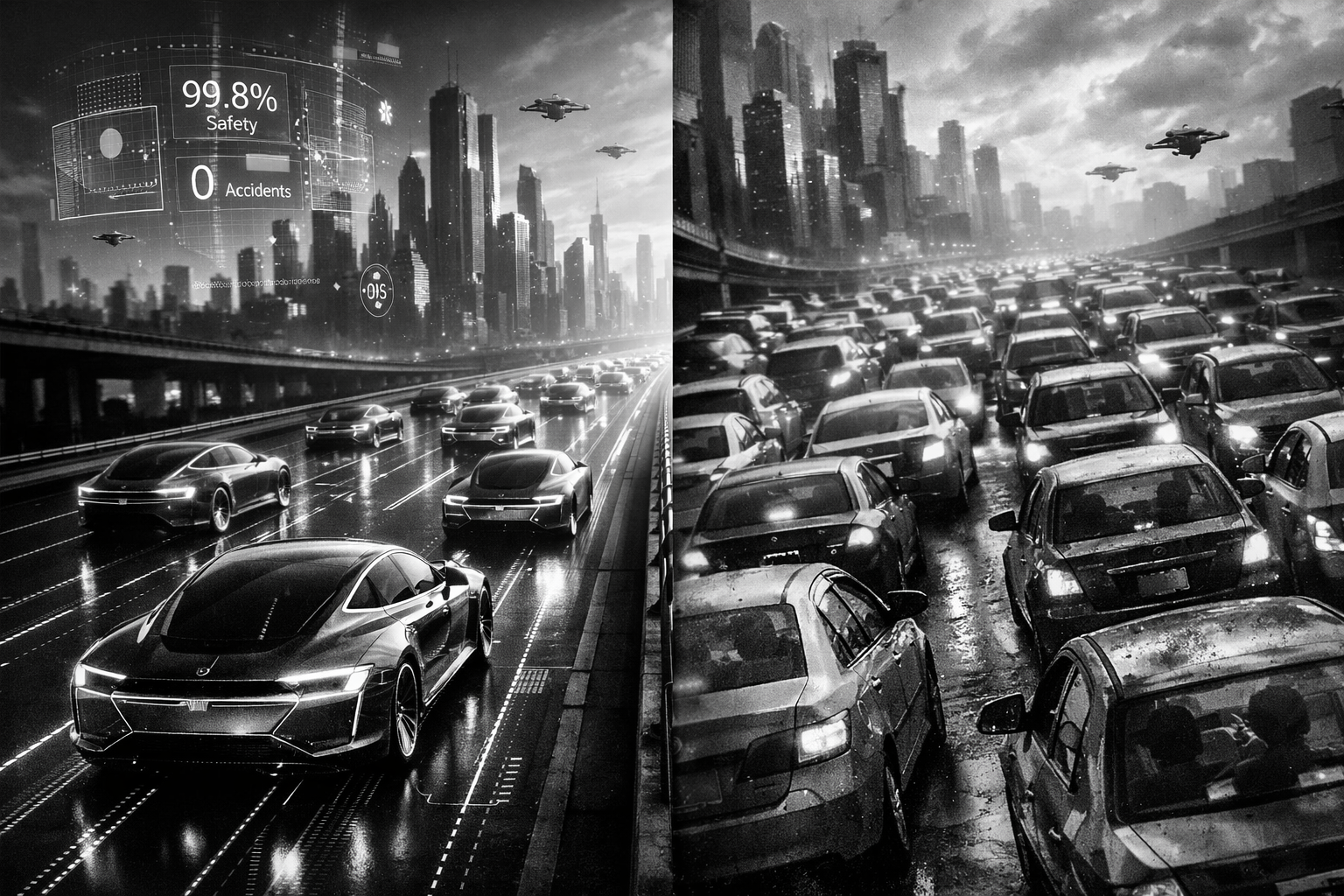
A future where "hands on the wheel" costs extra
Imagine two identical trips across town. One is driven by a certified autonomous system that, mile for mile, is proven to crash far less often. The other is driven by a human, with all the familiar distractions, fatigue, and misjudgments that come with being human. If the first option is demonstrably safer, should the second be treated like a higher-risk choice and taxed accordingly?
That question sounds provocative because driving has long been framed as a right, or at least a normal part of modern life. But governments already price risk and harm into everyday behavior. If autonomy becomes the safer default, manual driving could be reclassified from "normal" to "optional," and optional behaviors are often where taxes land.
The safety claim has to be real, not marketing
A manual-driving tax only makes sense if autonomy is not just impressive in demos, but safer in the messy reality of mixed traffic, bad weather, roadworks, and unpredictable humans. That requires transparent, comparable safety evidence, not selective statistics.
Today, the public sees a blur of claims. Robotaxi operators publish safety snapshots. Car makers promote advanced driver assistance and "full self-driving" branding that can be misunderstood. Regulators collect crash reports, but the data is often hard to compare because exposure, operating domains, and reporting thresholds differ.
For a tax to be defensible, policymakers would need a clear trigger. Think of it like a medical guideline: not "we think it helps," but "across billions of miles, in defined conditions, the autonomous mode reduces serious injury and fatal crashes by X percent, with confidence intervals, audited methods, and public access to the assumptions."
Why taxes follow risk: the "you create costs, you help pay" logic
The strongest argument for taxing manual driving is not moral. It is accounting. Crashes impose costs that do not stay inside the vehicle. Emergency response, hospital care, rehabilitation, disability support, court time, congestion from incidents, property damage, and lost productivity spill into public budgets and the wider economy.
When governments can identify a behavior that predictably increases those costs, they often price it. That is the core logic behind tobacco taxes, alcohol duties, and even congestion charging. The pitch is simple: if a choice raises expected public costs, the price should reflect that risk, and the revenue should fund mitigation.
If autonomy becomes a widely available alternative that reduces crash risk, manual driving starts to resemble a higher-risk elective activity. In that framing, a surcharge is not punishment. It is a risk premium.
Manual driving is not like smoking, and that matters
The "sin tax" analogy is tempting, but it can mislead. Smoking is harmful even when done perfectly. Manual driving is not inherently reckless. Many people drive carefully for decades without a serious crash. The risk comes from probability across millions of drivers and billions of miles, not from the intent of any one person.
That difference changes what a fair policy looks like. A blunt tax on "manual driving" as an identity would be hard to justify. A tax on measurable exposure, in contexts where a safer autonomous option exists, is easier to defend.
What would a "manual-driving surcharge" actually look like?
The most workable designs look less like a yearly license fee and more like usage pricing. The unit is not the driver. It is the mile, the minute, or the trip segment where the human is in control.
A simple version is a per-mile fee that applies only when the vehicle is operated manually in areas and conditions where certified autonomy is available. If the autonomous system is engaged, the surcharge drops to zero or near zero. If the human takes over, the meter starts.
A more realistic version is tiered. Manual driving on an empty rural road at noon is not the same risk as manual driving in dense urban traffic at night in the rain. Congestion pricing already uses time and place to reflect social cost. A manual-driving surcharge could do the same, with higher rates in high-conflict environments where crashes are more likely and more disruptive.
Then there is the capability gap problem. Not all vehicles are equal. Some have robust collision avoidance and lane keeping. Others have none. A policy could set lower rates for vehicles with proven safety tech, even when driven manually, and higher rates for vehicles that lack it. That would quietly turn the tax into a safety upgrade incentive.
The technology question: how do you know who was driving?
Any system that charges differently based on manual versus autonomous control needs a trustworthy signal. That usually means telematics, either from the vehicle, a certified onboard unit, or a secure smartphone-based proxy. The vehicle would log when autonomous mode is engaged, when the human takes over, and where the vehicle is operating.
This is where policy can go wrong fast. If the public believes the surcharge is a backdoor for surveillance, adoption will stall and lawsuits will follow. The design has to minimize data collection. It should store only what is needed to calculate the fee, keep it for the shortest possible time, and allow independent audits. Ideally, the system would compute charges locally and transmit only the bill, not a detailed travel diary.
There is also a fraud angle. If money is on the line, people will try to spoof "autonomous engaged" status. That pushes governments toward certification regimes, tamper-resistant hardware, and penalties that are proportionate but real.
Equity: the policy lives or dies here
A manual-driving tax becomes politically toxic if it reads as "pay extra for being poor." In the early years of autonomy, safer systems will not be evenly available. Some people will live outside service areas. Others will drive older vehicles because that is what they can afford. Many jobs still require manual control, from trades to deliveries to emergency work.
If policymakers want legitimacy, they need to treat autonomy availability as a prerequisite, not an assumption. A surcharge should apply only where a certified autonomous alternative is genuinely accessible, meaning it works in that area, at that time, and for that trip purpose. Otherwise it is not a nudge. It is a penalty for geography.
The second equity lever is what happens to the revenue. If the money disappears into general funds, the public will assume the safety story was a pretext. If it is earmarked for crash response, safer street design, public transport, and targeted mobility credits, the surcharge starts to look like a trade. You pay more for higher-risk driving, and the system uses that money to make everyone safer and more mobile.
A practical approach is to pair any surcharge with automatic rebates or credits for low-income drivers, exemptions for disability-related needs, and carve-outs for essential services. The goal is not to create a new class of "taxed drivers." It is to reduce harm without trapping people.
Insurance will not sit still, and neither will liability
If autonomy truly reduces crashes, insurance pricing will change even without new taxes. Risk will shift from individual drivers toward system operators, fleet owners, and manufacturers, depending on who controls the driving task and how liability is assigned.
A manual-driving surcharge could accelerate that shift by making "human in control" a priced category. Insurers might respond by offering policies that integrate the tax signal, discounting autonomous miles and charging more for manual miles. Or governments might coordinate with insurers so the surcharge replaces some premium components, reducing duplication and confusion.
But there is a trap. If the surcharge is high and insurance also rises for manual driving, the combined cost could become punitive. That might reduce driving, which is partly the point, but it could also push people into noncompliance, uninsured driving, or avoidance behaviors that create new risks.
Could this replace fuel excise as cars go electric?
Many governments rely on fuel taxes to fund roads and transport budgets. As fleets electrify, that revenue erodes. Mileage-based road usage charges are already being discussed in multiple jurisdictions as a replacement.
A manual-driving surcharge could be layered onto that transition. The base charge would fund infrastructure, regardless of drivetrain. The surcharge would reflect safety externalities, charging more when a human chooses to drive in contexts where autonomy is safer and available.
This is also where the policy becomes emotionally charged. People tolerate fuel taxes partly because they feel indirect. A per-mile charge that changes based on who is driving feels personal. That means the communication has to be unusually clear, and the benefits have to be visible.
A credible rollout would start small and be brutally measurable
If a government tried to impose a nationwide manual-driving tax overnight, it would likely fail. The smarter path is to pilot it where autonomy is already operating reliably, where crash costs are high, and where alternatives exist. Dense urban districts are the obvious candidates, especially those already using congestion charging or electronic road pricing.
The pilot should publish metrics that ordinary people can understand. Not just "collisions per million miles," but changes in serious injuries, emergency response load, bus reliability, and insurance claims. It should also publish distributional impacts, showing who paid more, who received credits, and whether the policy widened or narrowed mobility gaps.
And it should include an off-ramp. If the safety advantage is smaller than promised, or if the equity impacts are worse than expected, the surcharge should automatically scale down or pause. A policy that cannot admit uncertainty is not ready for the road.
The cultural backlash is predictable, but not necessarily decisive
Driving is wrapped up in identity. For some, it is freedom. For others, it is work. For enthusiasts, it is joy. A manual-driving surcharge will be read by many as an attempt to price people out of a cherished skill.
Policymakers can reduce that backlash by being honest about what is being priced. The target is not enjoyment. It is risk imposed on others. That is why context matters. A track day is not the same as a school zone. A scenic rural drive is not the same as a congested downtown corridor at rush hour.
If autonomy becomes meaningfully safer, society will still have to decide where manual driving belongs. Maybe it remains common but priced by risk. Maybe it becomes a premium hobby in certain zones. Maybe it stays normal in places where autonomy cannot yet match human adaptability. The tax question is really a governance question about how quickly we want that cultural shift to happen, and who gets to afford it.
So should manual driving be taxed more?
Yes, but only under strict conditions: autonomy must be independently proven safer in the relevant operating domain, the autonomous option must be genuinely available to the people being charged, privacy must be protected by design rather than promised in press releases, and the revenue must visibly buy safety and access rather than simply filling a budget hole.
If those conditions are met, a manual-driving surcharge stops sounding like a punishment and starts looking like a modern version of something governments already do: pricing the real cost of risk, then using the proceeds to make the safer choice easier for everyone.
The uncomfortable possibility is that the first place this policy works will not be where people love driving most, but where they least want to admit it has become optional.