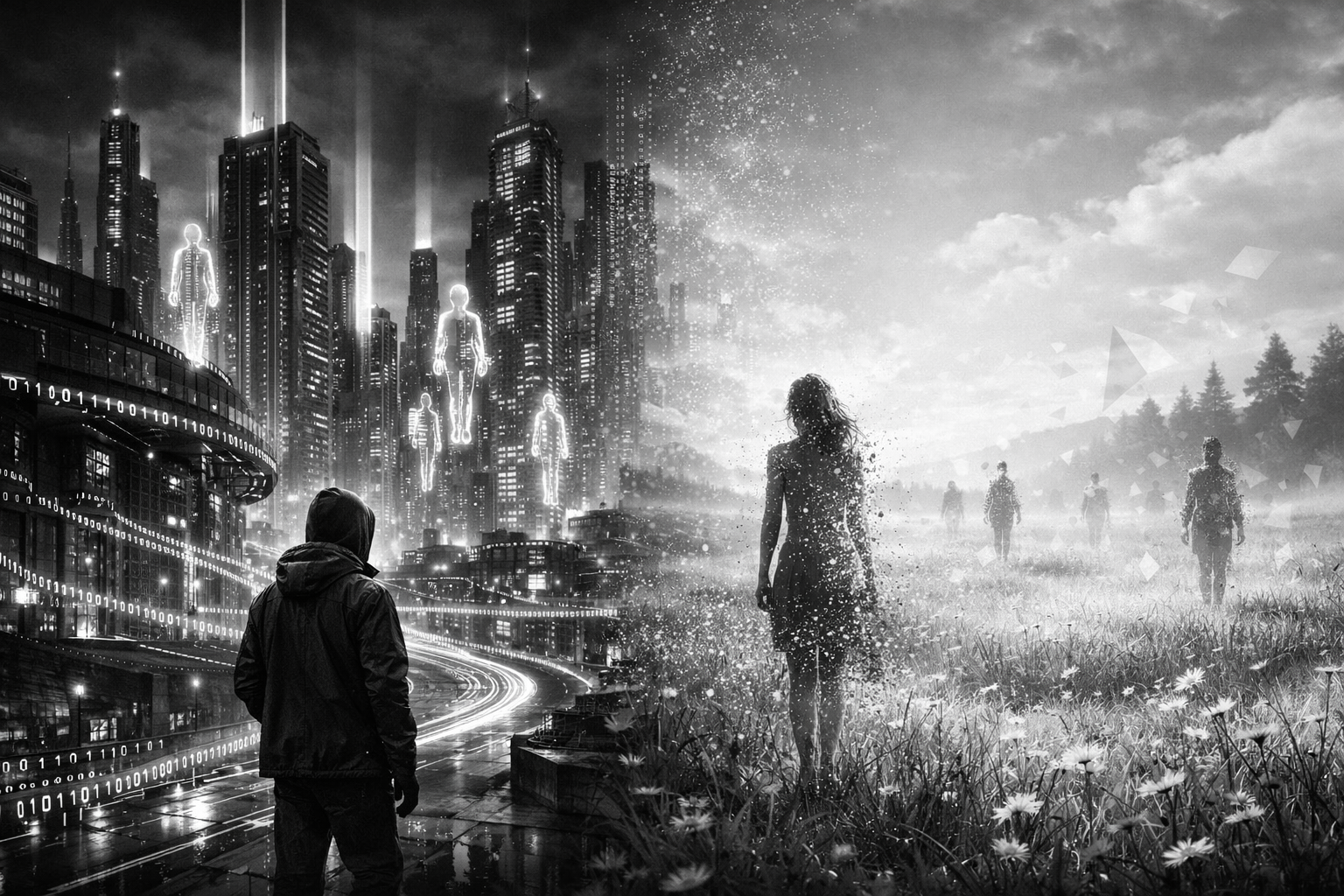
The uncomfortable question nobody can dodge
If a virtual world can reliably make you happier than your real one, what exactly is the rational choice: log off, or lean in?
This is no longer a sci-fi thought experiment. The ingredients are arriving in plain sight. Higher resolution headsets, eye tracking, foveated rendering, spatial audio, and increasingly convincing haptics are pushing immersion toward the point where the brain stops treating it as "media" and starts treating it as "place". The bigger shift is psychological. Fulfillment is not only about realism. It is about meaning, progress, belonging, and control. Virtual environments can tune those dials with a precision the physical world rarely offers.
Why VR can feel more fulfilling than real life
People often assume the tipping point will be visual fidelity, the moment pixels become indistinguishable from photons. That matters, but it is not the main reason virtual life can outperform physical life. The real advantage is that virtual worlds can be designed around human motivation.
Researchers typically describe three drivers of deep immersion. Presence is the sensation of being somewhere. Flow is the state where challenge and skill are perfectly matched. Emotional valence is the felt positivity or negativity of the experience. Modern VR improves presence with higher refresh rates, wider field of view, and lower latency. But flow and emotional valence are where the "more fulfilling" claim becomes plausible, because they can be engineered through goals, feedback, and social systems.
In everyday life, progress is often slow, ambiguous, and expensive. In a well-designed simulation, progress is visible, frequent, and tailored. You can practice a skill with perfect scaffolding. You can join communities that share your niche interests instantly. You can inhabit an identity that feels closer to who you are, or who you want to become, without waiting for permission from geography, money, or social gatekeepers.
The new baseline: engineered meaning
The most important change is subtle. When fulfillment becomes something a platform can deliver on schedule, expectations shift. Real life starts to feel like a badly designed product.
Consider how many frustrations in physical reality are not "natural" but structural. Commuting. Waiting rooms. Bureaucracy. Loneliness in crowded cities. Work that produces little feedback and even less pride. Virtual environments can remove friction and replace it with momentum. They can also replace uncertainty with legibility. You know what matters, what to do next, and how close you are to the goal.
That legibility is powerful. It is also dangerous, because meaning that is too easy to obtain can become meaning that is too easy to manipulate.
What happens to relationships when avatars outperform bodies
The first social shock will not be people abandoning friends. It will be people upgrading the terms of connection.
Virtual spaces can make socializing less intimidating. They can offer shared activities on demand, from cooperative games to live events to quiet "parallel play" rooms where you work alongside others without pressure. For many, especially those with disabilities, anxiety, or isolation, this is not escapism. It is access.
But when virtual interaction becomes smoother than physical interaction, the incentives change. Physical relationships are messy. They involve logistics, compromise, and the slow work of repair. Virtual relationships can be curated, buffered by distance, and supported by systems that reduce conflict. That can be a gift. It can also become a filter bubble for intimacy, where you only experience the parts of other people that are easiest to live with.
A second-order effect follows. If identity continuity is anchored to an avatar, then losing access to that avatar can feel like losing a limb. Platform bans, account theft, or shutdowns stop being customer service issues. They become existential events.
Work, money, and the rise of virtual livelihoods
Once a virtual world is fulfilling, it does not stay a "place you visit". It becomes a place where you build a life. That includes earning.
Digital labor already exists across creator economies, game marketplaces, and virtual goods. The next step is persistence and legitimacy. Persistent worlds with enforceable property rights, stable marketplaces, and credible identity systems can support careers that look less like side hustles and more like professions. Designers, performers, educators, architects of virtual spaces, community managers, and digital craftspeople are early examples. If wages become dependable and transactions become taxable, governments will treat these worlds less like entertainment and more like jurisdictions with economic gravity.
This is where the power question sharpens. If the most fulfilling parts of life happen inside privately owned platforms, then platform governance becomes social governance. Rules about speech, commerce, dispute resolution, and identity are no longer "terms of service". They are the operating system of daily life.
Health: the body keeps score, even when the mind is elsewhere
A world that feels better than reality can quietly train you to dislike reality. That is the core risk behind what some clinicians describe as detachment syndrome, a pattern where real-world stimuli feel dull, social obligations feel heavier, and leaving the simulation triggers irritability or anxiety.
There is also a simple arithmetic problem. Time spent in high-presence environments is time not spent moving, sleeping, or maintaining physical relationships. Some surveys and longitudinal observations suggest a dose-response pattern, where heavy use beyond roughly a part-time job's worth of hours per week correlates with reduced physical activity and worse health markers. The exact thresholds vary by person, but the direction is consistent: the more immersive and rewarding the environment, the more it competes with the habits that keep bodies resilient.
The twist is that VR can also improve health when designed for it. Rehabilitation, exposure therapy, pain distraction, guided fitness, and social support groups can all benefit from presence. The technology is not inherently harmful. The risk comes from a mismatch between what the platform optimizes and what the human organism needs.
The attention economy becomes the fulfillment economy
Social media learned to monetize attention. Immersive platforms will learn to monetize satisfaction.
When a system can measure where you look, how your pupils respond, how your voice changes, how long you linger, and what makes you feel rewarded, it can personalize experiences with unnerving accuracy. Add biosignals from wearables and, eventually, brain-computer interface research that explores interpreting intent or modulating sensation, and the feedback loop tightens further.
This is the moment where "more fulfilling than reality" stops sounding like a compliment and starts sounding like a business model. If fulfillment is delivered through variable rewards, social status ladders, and engineered scarcity, then the platform is not just entertaining you. It is shaping your motivational landscape.
A practical field guide to the near future
The transition will not look like everyone vanishing into headsets overnight. It will look like small, reasonable choices that add up.
First, VR will become the default venue for certain categories of experience that are expensive or inaccessible in physical life. Live events with perfect sightlines. Travel without transit. Training without risk. Social spaces without geography. For many people, that will feel like progress, because it is.
Second, hybrid reality will blur the boundary. Instead of "going to VR", you will layer it onto your home and workplace. The most fulfilling environment will not be a separate universe. It will be your own room, upgraded in real time to match your mood, your goals, and your attention span.
Third, status will migrate. Today, social status is still heavily anchored to physical signals: location, job title, possessions, networks. In persistent virtual worlds, status can be earned through skill, creativity, leadership, and contribution, but it can also be bought, gamed, or granted by platform mechanics. The fight over what counts as "real achievement" will become a cultural fault line.
What regulation will be forced to care about
Policy usually arrives after harm becomes visible. Immersive fulfillment raises a different challenge because the harm can be quiet, private, and voluntary.
The first regulatory pressure point is data. Eye tracking, body movement, voice, and eventually neural signals are not just personal information. They are behavioral leverage. Consent cannot be a single checkbox when the system learns what persuades you better than you do.
The second is consumer protection against predatory monetization. When a platform sells identity, belonging, and progress, it can also sell relief from discomfort it helped create. That is a familiar pattern in gambling-like mechanics, but it becomes more potent when the environment feels like life itself.
The third is equitable access. If the most effective education, training, therapy, and networking move into immersive spaces, then exclusion becomes more than missing out on entertainment. It becomes missing out on opportunity.
How to design "better than real" without breaking people
The most responsible VR design principle of the next decade may sound almost anti-competitive: do not maximize time spent. Maximize life improved.
That starts with honest friction. Breaks that are not nag screens but real off-ramps. Session design that ends on completion rather than endless continuation. Social systems that reward pro-social behavior instead of outrage. Economic systems that do not require constant presence to avoid falling behind.
It also requires portability. If identity and assets are trapped inside one company's servers, users become hostages to policy changes and pricing. Interoperability is often framed as a technical dream. In a world where VR becomes a primary home for meaning, it becomes a mental health feature.
The real choice is not virtual versus physical
The most revealing outcome of "VR that beats reality" is that it exposes what people were missing all along. Not better graphics, but better feedback. Not fantasy, but agency. Not escape, but a life that responds.
If virtual worlds become more fulfilling, the question will not be whether people should be allowed to live there. The question will be why physical reality, as organized by our cities, workplaces, and institutions, was so often the less humane option in the first place.
And once you have experienced a world that listens to you, adapts to you, and rewards your effort with clarity, it becomes hard to accept a reality that insists you should be grateful for the opposite.