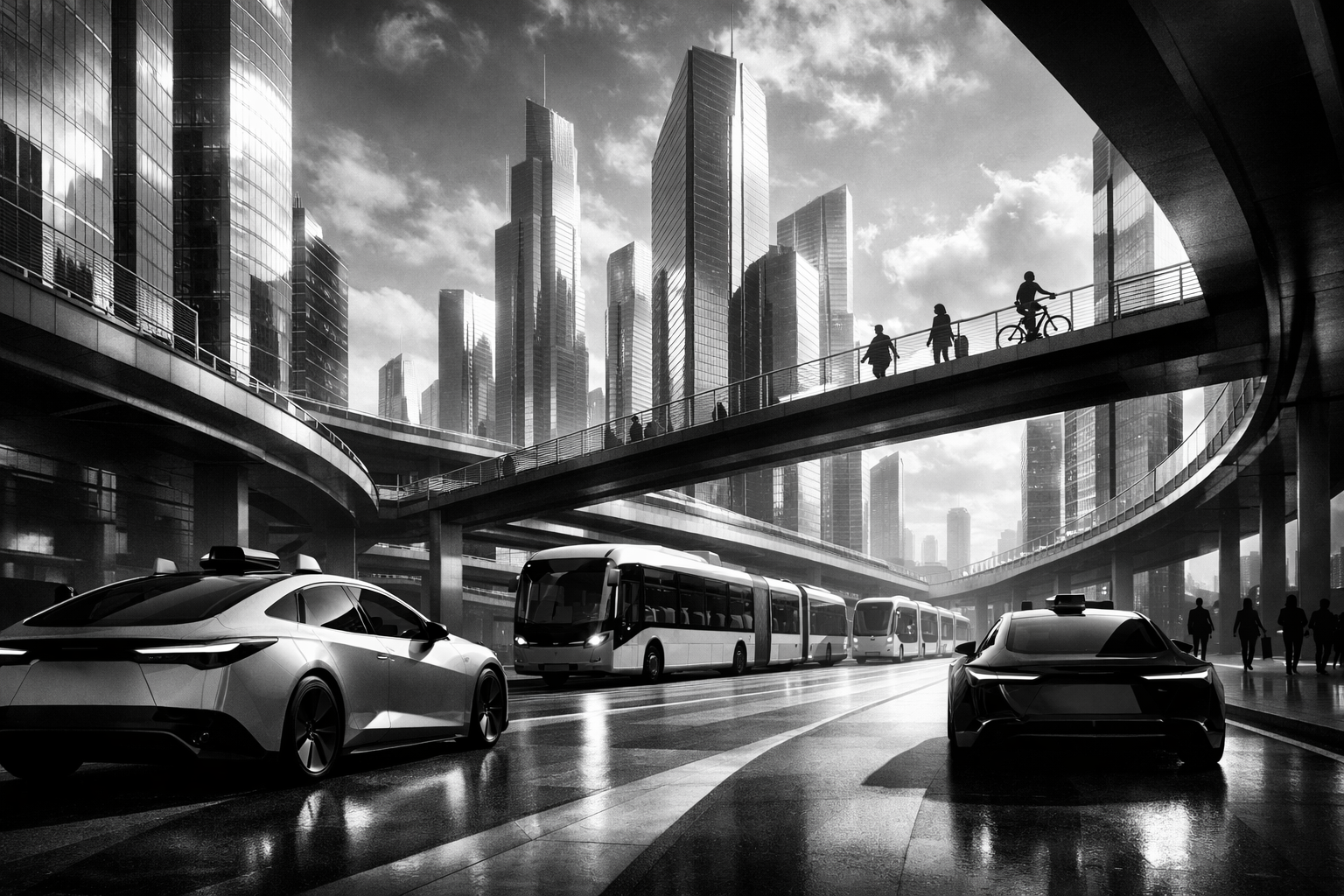
A quiet shift is already showing up in the numbers
If you want to understand the future of public transport, don't start with trains or buses. Start at the curb. That is where autonomous taxis, often called robotaxis, are beginning to change how people move through cities, one short trip at a time. The early evidence suggests a pattern that should focus every transit agency and city hall: when a cheap, reliable door-to-door option appears, some riders stop waiting for the bus.
In corridors where driverless services operate at scale, studies and city-level reporting have pointed to measurable bus ridership declines, often in the mid single digits and sometimes higher on low-frequency routes. The headline is not that public transport is "doomed". The headline is that the weakest parts of the network, the routes with long waits and awkward transfers, are the first to feel the pull.
What autonomous taxis actually are today, not in a brochure
Autonomous taxi services are no longer limited to closed demos. By 2024 and into 2025, fully driverless operations have expanded in selected zones across several major markets, with the most visible deployments in parts of the United States and China. These are typically Level 4 systems, meaning they can drive without a human in defined areas and conditions, but they are not universal "anywhere, anytime" cars.
What matters for public transport is not the autonomy label. It is the operating model. Robotaxis aim for high vehicle utilization, fast dispatch, and pricing that can undercut traditional ride-hailing because there is no driver wage per trip. As fleets grow and hardware costs fall, the economics improve further. That is the engine behind the after-effects now appearing in transit data.
The first after-effect: a new default for short trips
Public transport is strongest when it moves many people along the same corridor at the same time. It is weakest when it asks riders to do extra work: walk farther than they want, wait longer than feels reasonable, or make transfers that add uncertainty. Autonomous taxis target exactly those pain points.
The most immediate change is in first-and-last-mile behavior. A rider who used to walk ten minutes to a stop, then wait, then transfer, now has a competing option that feels simple. Even when the robotaxi is not cheaper than the bus, it can feel "worth it" on days when time is tight, weather is bad, or personal safety is a concern.
This is why early ridership impacts tend to concentrate on routes with longer headways. If a bus comes every five minutes, it is hard to beat. If it comes every fifteen or twenty, a door-to-door service starts to look like a rational upgrade, not a luxury.
The second after-effect: mode substitution that hits buses before rail
When people talk about robotaxis "replacing transit," they often imagine subways and commuter rail. In practice, the early substitution pressure is more likely to land on buses. Buses share the street network with cars, they are more exposed to reliability problems, and they often serve the exact short-to-medium trips that robotaxis can compete for.
In cities where driverless taxi services have been introduced in meaningful service areas, surveys and corridor-level observations have pointed to bus ridership dips in the range of roughly 6 to 9 percent on directly competing segments during peak periods. The effect is not uniform. It is sharper where service is infrequent, where stops are spaced far apart, and where riders already feel the system is fragile.
Rail tends to be more resilient because it is fast, high-capacity, and often avoids traffic. But rail is not immune. If robotaxis become the default for station access, they can change who uses rail and when, and they can shift the political conversation about what deserves funding.
The third after-effect: fare revenue pressure and a budgeting trap
Transit agencies do not just move people. They balance budgets that are already strained by post-pandemic ridership changes, rising operating costs, and political scrutiny. When robotaxis skim off short trips, the damage is not only the lost fare. It is the loss of the easiest fares to collect.
Short trips often have high turnover and can be disproportionately important for farebox recovery on certain routes. If those riders shift to robotaxis, agencies can be left with a harder problem: they still need to run service for equity and coverage, but the remaining ridership may be lower and more dispersed. That can push agencies toward service cuts, which then make the bus less attractive, which then pushes more riders away. It is a feedback loop cities should recognize early.
At the same time, cities are spending more on the "new plumbing" of mobility. Curb upgrades, pickup zones, enforcement, data systems, and integration platforms all cost money. If those investments are made without protecting core transit service, the city can end up funding the competitor while starving the backbone.
The fourth after-effect: the curb becomes the new transit station
A bus stop is simple. A curbside pickup ecosystem is not. Robotaxis concentrate demand at popular corners, outside venues, near stations, and along retail strips. Without management, that demand turns into double-parking, blocked bike lanes, and conflicts with pedestrians. The result can be slower buses and less reliable surface transit, even if the robotaxis themselves are electric and well-behaved.
This is one of the most overlooked after-effects: autonomous taxis can degrade bus performance indirectly. If buses get slower because curbs are chaotic, the bus becomes less competitive, and the shift to robotaxis accelerates. Cities that treat curb space as valuable infrastructure, with clear rules and dynamic allocation, are more likely to keep transit moving.
The fifth after-effect: emissions can improve, or quietly get worse
Robotaxis are often electric, which helps local air quality and can reduce emissions compared with gasoline taxis. But the climate story depends on what trips they replace and how many empty miles they drive.
If a robotaxi replaces a private car trip, emissions can fall. If it replaces a full bus or a busy train, emissions per passenger can rise, even with an EV, because high-occupancy transit is extremely efficient when it is well used. Then there is deadheading, the empty repositioning miles driven to pick up the next passenger or to move into a higher-demand zone. Those miles can erode the green promise, especially in early deployments where demand is uneven.
The uncomfortable truth is that autonomy does not automatically mean fewer cars on the road. It can mean more vehicle miles traveled if pricing and policy encourage solo rides for trips that used to be walked, biked, or taken on transit.
The sixth after-effect: accessibility improves, but equity is not guaranteed
For older adults and people with disabilities, door-to-door service can be transformative. A reliable autonomous taxi that arrives when it says it will, with step-free access and a predictable pickup process, can unlock trips that were previously exhausting or impossible. Some pilots that integrate on-demand mobility into broader city services have reported meaningful increases in usage among these groups when vehicles and booking tools are designed well.
But equity is not a side effect. It is a choice. If robotaxi pricing is dynamic and profit-optimized, low-income neighborhoods can end up paying more, waiting longer, or being served by fewer vehicles. Meanwhile, if transit loses revenue and cuts service, the people who rely on it most can be hit twice. The same technology that can expand mobility can also widen gaps if cities do not set rules early.
What happens next depends on integration, not just adoption
The most important question is not whether robotaxis grow. It is whether they grow as a competitor to public transport or as a feeder to it. Cities have more leverage than the public debate suggests, because robotaxis need permits, curb access, mapping support, charging infrastructure, and often cooperation with local regulators.
The strongest near-term strategy is to treat autonomous taxis as a first-and-last-mile layer that strengthens high-capacity transit. That means integrating trip planning and payment so riders can book a combined journey easily, and it means aligning incentives so the robotaxi leg complements rail and frequent bus corridors rather than cannibalizing them.
Mobility-as-a-Service platforms are often presented as a shiny app problem. In reality, MaaS is a governance problem. Who owns the customer relationship. Who sets fare rules. Who gets access to origin-destination data. Who is accountable when service deserts appear. Those decisions determine whether integration is real or just a marketing screen.
Policy levers that actually change outcomes
If a city wants the benefits of autonomous taxis without hollowing out public transport, it needs to shape the market. Congestion pricing and access rules can discourage empty cruising and solo trips in the most crowded areas. Curb pricing can reduce chaos and protect bus lanes. Data-sharing requirements can help planners see demand shifts early rather than discovering them after a budget crisis.
Cities can also push fleets toward pooling. If robotaxis are allowed to scale primarily as single-occupancy vehicles, they will behave like a more convenient version of ride-hailing, with predictable impacts on congestion and transit substitution. If rules and incentives favor shared rides, the technology starts to look less like a threat and more like a flexible extension of the transit network.
One practical approach is bundling. A monthly pass that includes unlimited transit plus a limited number of robotaxi miles for first-and-last-mile trips can keep riders anchored to the network while still giving them the convenience they want. Another is targeted subsidies that replace low-ridership fixed routes with on-demand autonomous feeder service, but only when it is tied to transit hubs and measured against equity goals.
A 2035 picture: fewer "bus routes," more "mobility guarantees"
By the mid-2030s, many cities may stop thinking in terms of a bus map alone. The more useful promise could be a mobility guarantee: you can reach a frequent corridor within a certain time, at a predictable price, with accessible vehicles, and without needing a car. In dense areas, that guarantee will still be delivered by high-capacity transit. In lower-density areas, it may be delivered by a mix of fixed routes, on-demand shuttles, and autonomous taxis operating under public rules.
The after-effect of autonomous taxis on public transport is not a single outcome. It is a fork in the road. One path leads to a weakened bus network, more traffic, and a city where convenience is sold trip by trip. The other leads to a transit system that finally solves the last mile, protects its fastest corridors, and makes car-free living feel less like a sacrifice and more like a smart default.
The difference will come down to whether cities treat robotaxis as just another product on the street, or as a powerful new tool that must earn its place in the public realm.