The most important "missing piece" in physics is already running the Universe
If you want a single discovery that could genuinely change physics textbooks, it is not another particle in a collider plot. It is dark matter. Whatever it is, it outweighs ordinary matter by roughly five to one, scaffolds galaxies, and leaves fingerprints across the cosmic microwave background. Yet it does not glow, it does not absorb light, and it has never been caught in a detector in a way that convinces everyone.
That tension is why the question matters: could dark matter discoveries rewrite the laws of physics, or would they simply fill in a blank inside the laws we already have? The honest answer is that either outcome is plausible, and the difference hinges on what "discovery" actually looks like.
What dark matter is, and why physicists take it seriously
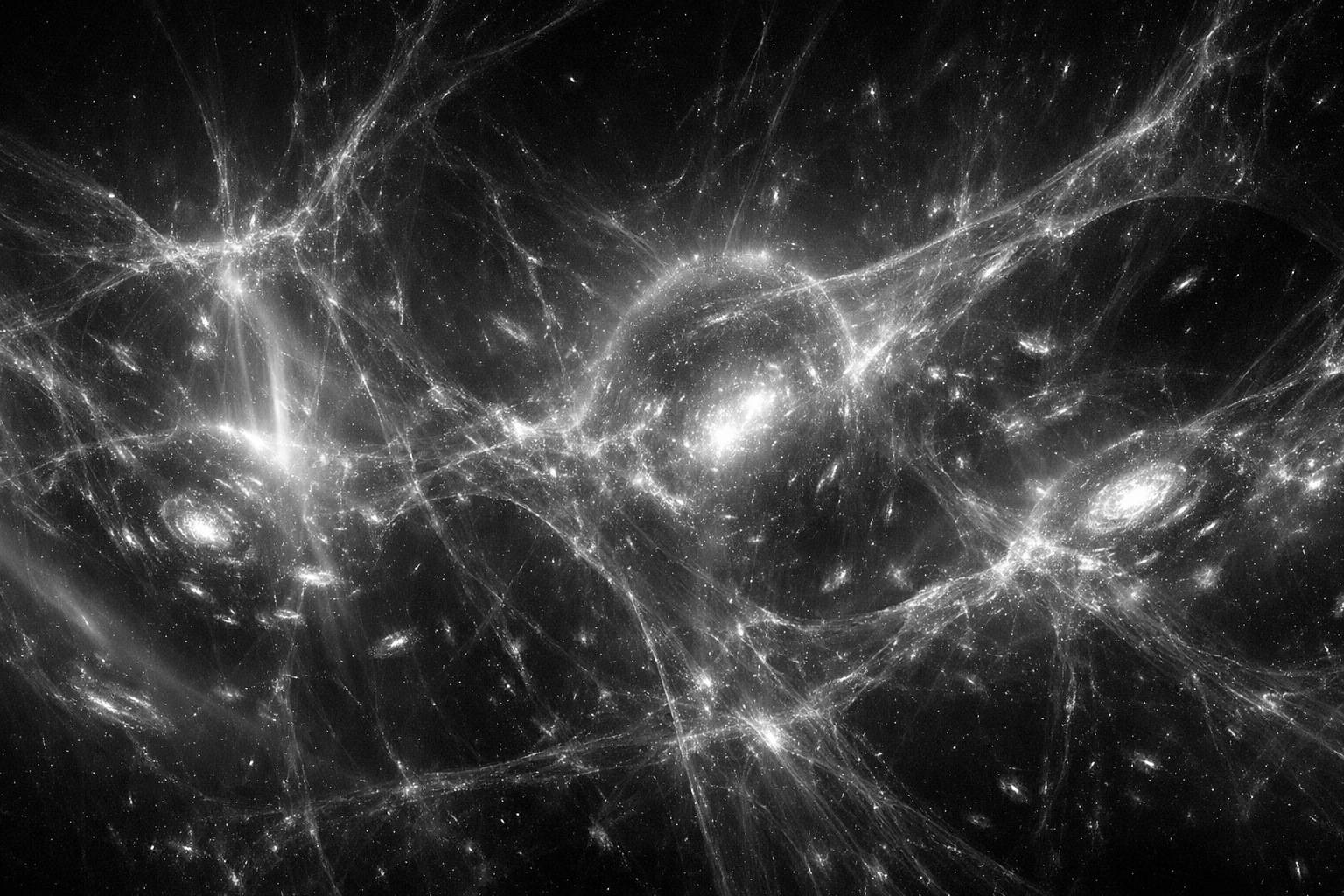
Dark matter is the name we give to the extra gravitating mass implied by multiple, independent observations. Galaxies rotate too fast for their visible mass. Galaxy clusters bend light more strongly than their stars and gas can explain. The pattern of peaks in the cosmic microwave background fits exquisitely when the early Universe contains an additional, non relativistic component that does not behave like ordinary atoms. Large scale structure, the cosmic web of galaxies and voids, grows in a way that strongly prefers cold, long lived matter that clumps early.
These lines of evidence do not rely on one instrument, one team, or one era of astronomy. They stack. That is why the mainstream view is not "maybe dark matter exists," but "something is missing, and it behaves like matter in gravity."
"Rewrite the laws" can mean two very different things
In practice, dark matter could transform physics in one of two ways.
The first is an extension story. Dark matter is a new particle or family of particles, and the Standard Model of particle physics is incomplete. The laws stay, but the cast expands. This is how neutrinos once felt: proposed to save conservation laws, later detected, then folded into a broader framework.
The second is a foundations story. Dark matter is not a particle at all, or it behaves in a way that forces changes to gravity, spacetime, or the equivalence principle. That would be closer to a rewrite, because it would pressure the assumptions that make general relativity and modern cosmology work as a single coherent system.
Most researchers expect the first story. The reason the second story remains alive is simple: we still have no confirmed non gravitational interaction for dark matter, and nature has surprised physicists before.
What would count as a real discovery, not just another hint
Dark matter "discoveries" come in three broad forms, and only some of them would shake fundamental physics.
Direct detection would mean a reproducible signal in underground experiments from dark matter scattering off nuclei or electrons, with the right energy spectrum, the right background rejection, and ideally a telltale annual modulation as Earth moves through the Milky Way's halo. A single experiment is rarely enough. The gold standard would be consistent signals across different detector materials and technologies.
Indirect detection would mean seeing the products of dark matter annihilation or decay, such as gamma rays, neutrinos, or antimatter, with a spatial distribution and spectrum that are hard to mimic with astrophysical sources. This is notoriously difficult because the Universe is full of messy accelerators like pulsars and supernova remnants.
Collider production would mean creating dark matter in high energy collisions and inferring it from missing momentum, plus additional signatures that identify the mediator particle that connects the dark sector to ordinary matter. Missing energy alone is not enough. You need a consistent model that also survives astrophysical and cosmological constraints.
Then there is a fourth category that is quietly becoming more powerful: precision gravitational mapping. Weak lensing surveys, improved measurements of structure growth, and future cosmic microwave background experiments can constrain how "cold," how interactive, and how smooth dark matter really is. This may not identify the particle directly, but it can rule out entire classes of theories.
If dark matter is a particle, the Standard Model still breaks
The Standard Model has no viable dark matter candidate that matches the astrophysical evidence. Neutrinos exist, but they are too light and too fast in the early Universe to build the observed structure on their own. So a confirmed particle dark matter detection would be a clean, unavoidable sign of physics beyond the Standard Model.
That does not automatically mean a rewrite of quantum field theory. It means quantum field theory gets a new sector to describe. The rewrite would be conceptual rather than mathematical: the "known particles" would no longer be the main story of matter. They would be the visible minority.
Depending on what is found, the implications could be dramatic. A weakly interacting massive particle would point toward new symmetries and new mediator particles, and it would reshape how physicists think about naturalness and the hierarchy problem. An axion or axion like particle would connect dark matter to the strong CP problem and could open a new era of precision experiments using resonant cavities, nuclear magnetic resonance techniques, and astrophysical polarization measurements. A sterile neutrino would force a rethink of neutrino mass generation and early Universe thermal history.
In each case, the Standard Model would not be "wrong." It would be incomplete in a way that matters for the largest structures in the cosmos.
The real wildcard is a hidden sector with its own forces
The most rewrite flavored outcome is not merely a new particle, but a new set of interactions. Physicists sometimes call this a hidden sector or dark sector: particles that interact strongly with each other but only weakly with us.
If dark matter has self interactions, it could change how halos form and evolve. That matters because some small scale observations, such as the diversity of galaxy rotation curves and the apparent presence of constant density cores in some dwarf galaxies, have long been discussed as potential tensions with the simplest cold, collisionless picture. Baryonic feedback from star formation can explain a lot, but not necessarily everything in every system. Self interacting dark matter is one way to keep the large scale success of standard cosmology while altering the internal structure of halos.
A confirmed self interaction would not just add a particle. It would add a force. And once you add a force, you add questions about symmetries, conservation laws, and whether there are dark equivalents of electromagnetism, chemistry, or even complex dark bound states. That is where "rewrite" starts to feel less like a metaphor.
Could dark matter force changes to gravity itself?
General relativity has passed every precision test in the Solar System and in many strong field environments. That makes physicists cautious about modifying gravity. Still, the dark matter problem is fundamentally gravitational: we infer it because gravity appears stronger than visible matter can provide.
Modified gravity ideas, including MOND and relativistic extensions, were motivated by the striking regularities in galaxy rotation curves. Some of these frameworks can fit certain galactic data impressively well. The difficulty is doing that while also matching galaxy clusters, the cosmic microwave background peak structure, and the growth of large scale structure without reintroducing some form of unseen mass. In many cases, modified gravity ends up needing dark matter anyway, just in a different role.
So would a dark matter discovery kill modified gravity? Not necessarily. If the discovered dark matter particle cannot reproduce certain galactic scaling relations without additional assumptions, hybrid models could remain attractive. Conversely, if dark matter is detected with properties that neatly explain both cosmology and galaxy dynamics, the motivation to modify gravity weakens sharply.
The most disruptive scenario would be evidence that dark matter does not fall like ordinary matter, or that it couples to gravity through additional fields. That would touch the equivalence principle, one of the deepest assumptions behind general relativity. Even a tiny, composition dependent deviation would be seismic, because it would imply that gravity is not purely geometry in the way Einstein framed it.
How a confirmed detection would ripple through cosmology
Modern cosmology is a precision science built on a model called CDM, shorthand for a cosmological constant plus cold dark matter. It works remarkably well, but it also bakes in assumptions about what dark matter does and does not do.
If dark matter has interactions with ordinary matter beyond gravity, or if it has a non negligible pressure or free streaming length, then the inferred values of key cosmological parameters can shift. That includes the amplitude of matter clustering and the detailed timeline of structure formation. It could also change how researchers interpret tensions between different measurements, such as disagreements in the Hubble constant or in clustering statistics, depending on what future data ultimately show.
Even without solving every tension, a measured dark matter property would turn cosmology from inference to laboratory. Instead of saying "the model prefers cold, collisionless matter," scientists could say "the particle has mass in this range, interacts with this strength, and decoupled at this epoch." That is a different kind of knowledge.
What to watch for in the next wave of experiments
The most useful way to follow dark matter news is to ignore the hype words and look for three specific upgrades in evidence.
First, cross confirmation. A signal that appears in one detector is interesting. A signal that appears in multiple detectors with different targets and systematics is transformative.
Second, a mechanism. If an experiment sees an excess, the next question is whether a consistent particle model can explain it while also surviving collider limits, astrophysical bounds, and cosmological constraints. Dark matter is one of the few topics where every subfield gets a veto.
Third, predictive power. The best discoveries do not just explain one anomaly. They predict a second signature that can be tested quickly, such as a specific recoil spectrum, a correlated gamma ray feature, a mediator particle mass range, or a change in small scale structure that lensing surveys can check.
So, will dark matter rewrite physics or simply complete it?
If dark matter turns out to be a single, cold, stable particle with extremely weak interactions, physics will still change, but in a familiar way. The Standard Model will expand, and the Universe will feel less mysterious while becoming more crowded.
If dark matter instead reveals a rich hidden sector, new long range forces, or any violation of the equivalence principle, then the change will be deeper. It will not just add ingredients. It will alter the recipe, and it will force physicists to re examine which principles are fundamental and which were merely good approximations in a bright, baryonic corner of the cosmos.
Either way, the most unsettling possibility is also the most exciting: that the laws of physics we call "universal" have so far been tested mainly on the kind of matter we can see.