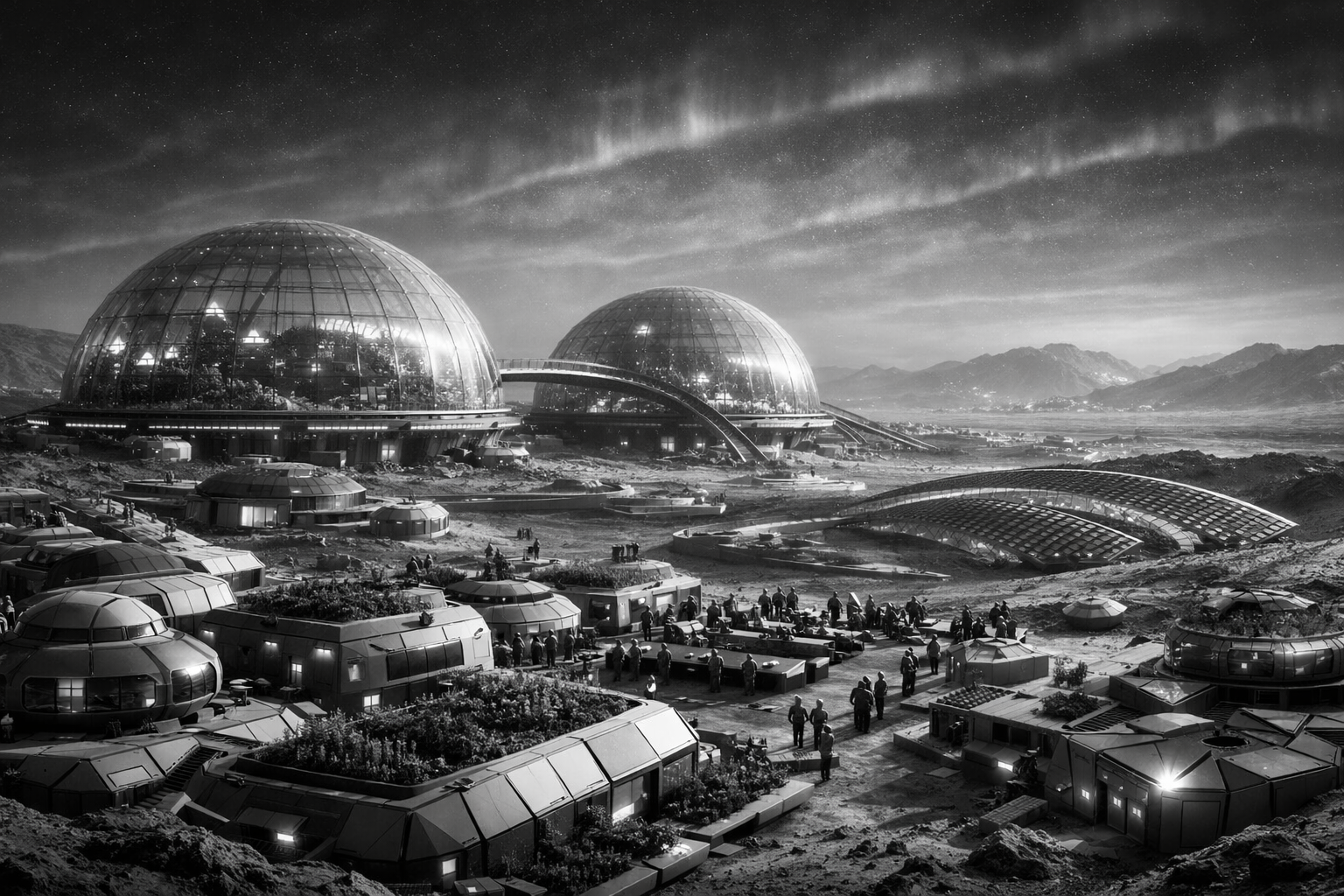
A colony is not a city. It is a social experiment you cannot opt out of.
If you want to know how space colonization will redefine human social structures, stop picturing shiny domes and start picturing a spreadsheet of oxygen, water, calories, radiation exposure, spare parts, and sleep. In the first true off-world settlements, society will not be built around comfort, tradition, or even ideology. It will be built around survival math, and that changes everything from leadership to love.
The most important shift is simple and unsettling. On Earth, most social rules are optional because the environment is forgiving. In space, the environment is not. When one person's mistake can threaten everyone's air, "personal freedom" and "collective responsibility" stop being abstract values and become engineering requirements.
From nations and flags to systems and contracts
For decades, popular stories treated space settlements as extensions of Earth nations, complete with familiar borders and familiar politics. The legal reality is messier. The Outer Space Treaty bars national appropriation, yet it does not eliminate influence, funding leverage, or control through infrastructure. The first durable governance model is likely to look less like a constitution and more like a stack of agreements: launch provider terms, habitat operating rules, medical protocols, safety standards, and dispute procedures.
That sounds sterile, but it is how power will first appear. Whoever controls transport, energy, communications, and life support effectively controls the settlement's options. Early colonies will therefore face a defining question sooner than most people expect. Are you a citizen, an employee, a customer, or a dependent?
If the first long-term habitats are built and supplied by state agencies, governance will likely resemble a mission chain of command with strong safety authority and limited political choice. If they are built by private firms, the default may be corporate policy with a thin layer of local representation. Either way, the pressure for legitimacy will rise as soon as residents are not just rotating crews but people raising children, aging, and planning lives that cannot be "recalled" to Earth.
Scarcity will make equality practical, not just moral
Earth societies can tolerate waste because Earth is large and supply chains are deep. Off-world settlements will be closed-loop economies where every kilogram matters and every failure has a timestamp. That pushes communities toward universal provisioning for essentials, not necessarily out of idealism, but because rationing systems must be trusted to work.
Expect a sharp divide between "life-critical" and "preference" goods. Air, water, staple food, medical care, radiation shelter time, and power allocation will be treated like public utilities with transparent accounting. Luxury will exist, but it will be negotiated against measurable risk. When the greenhouse underperforms, the argument will not be about prices. It will be about calories and crew health.
This is where social structure changes in a way that can surprise people who assume space will amplify inequality. It might, especially through ownership of transport and patents. But inside the habitat, the physics of scarcity tends to flatten status games. You can be the most important person on the manifest, but you still breathe the same air and depend on the same pumps.
Work will become less specialized, and status will follow competence
Modern economies reward narrow specialization. A settlement cannot afford that. The most valued people will be those who can cross boundaries: a mechanic who understands biology well enough to keep a bioreactor stable, a doctor who can also run diagnostics on life-support sensors, a software engineer who can repair a valve and write the patch that prevents it failing again.
That does not mean hierarchy disappears. It means hierarchy becomes situational. In a fire, the safety officer leads. In a medical emergency, the clinician leads. In a power crisis, the systems engineer leads. Authority will rotate with the problem, and the culture will reward those who can hand over control cleanly when the situation changes.
Analog environments on Earth hint at this pattern. Antarctic stations and undersea habitats often develop informal norms where competence earns trust faster than titles do, and where social penalties for unreliability are swift because the group cannot absorb repeated risk. Space will intensify that dynamic.
Privacy will be redefined, not eliminated
A common fear is that space colonies will be surveillance states by necessity. The truth is more nuanced. Monitoring will be unavoidable for life support, radiation exposure, and medical safety. But the social structure that emerges will depend on who owns the data and how it is used.
If biometric and behavioral data flows upward to Earth-based managers or corporate headquarters, residents will feel like assets. If data is locally governed, minimized, and used transparently for safety, it can become a shared tool rather than a leash. The difference between those two futures is not technology. It is governance.
Expect new norms that sound strange on Earth. For example, you may have a strong right to personal communications, but a weak right to conceal actions that affect shared systems. "My business" ends where the air scrubber begins.
Family will shift from private unit to community infrastructure
On Earth, family is often treated as a private sphere. In a small settlement, children are not just personal choices. They are demographic strategy. They affect schooling, medical capacity, habitat volume, food production, and long-term labor planning.
That pressure can produce two very different social outcomes. One is restrictive, where reproduction is tightly regulated through policy, incentives, or medical gatekeeping. The other is communal, where childcare and education become shared responsibilities because the settlement cannot afford isolated households operating like suburban islands.
"Space families" may form around mission roles as much as genetics. Adoption, co-parenting arrangements, and multi-adult households could become normal simply because redundancy is safety. If one caregiver is injured, the child still needs stability. If one specialist is on an emergency shift cycle, the household needs support.
Culture will follow biology too. Low gravity, radiation risk, and medical uncertainty will shape norms around pregnancy, early childhood, and aging. Even the calendar changes. A Martian sol is longer than an Earth day, and Martian seasons stretch differently. Rituals will attach themselves to those rhythms, and identity will quietly detach from Earth's.
Conflict resolution will become a core life-support system
Earth can export conflict. People move away, change jobs, switch communities, or simply disappear into a crowd. A habitat removes those escape valves. That makes dispute resolution as essential as water recycling.
Punishment-heavy justice is hard to sustain when every adult is a critical contributor. You cannot easily imprison your only electrician. You also cannot tolerate repeated sabotage, harassment, or negligence. The likely result is a system that prioritizes early intervention, mediation, and structured accountability, with clear thresholds where someone can be removed from sensitive duties or, in extreme cases, returned to Earth when transport allows.
This is where the romantic idea of rugged individualism tends to fail. The colony that survives is the one that treats mental health, interpersonal friction, and burnout as predictable operational risks. It will train for them the way it trains for decompression.
A new class system could form around access to Earth
One of the least discussed social divides in space is not wealth inside the habitat. It is mobility between worlds. The ability to leave is power. The ability to bring others is more power.
In early phases, return seats will be scarce and expensive. That creates a hierarchy between those who are effectively permanent and those who are rotational. It also creates leverage for whoever controls transport schedules, medical clearance, and cargo priority. A settlement may look egalitarian day to day, yet still be shaped by an external gatekeeper.
Over time, as in-situ manufacturing and local food production improve, that leverage weakens. Autonomy grows. And with autonomy comes the political moment every distant community eventually faces: if we can survive without you, why do you get to rule us?
Identity will move from nationality to "planetary belonging"
The first settlers will arrive carrying passports, languages, and Earth politics. Their children may carry something else: a lived sense that Earth is a place you came from, not the place that defines you.
This is not speculation without precedent. Isolated communities on Earth often develop distinct dialects, rituals, and moral codes faster than outsiders expect, especially when the environment demands cooperation and when shared hardship becomes a story people tell about themselves. In space, the "overview effect" that astronauts describe, seeing Earth as a fragile whole, may become a daily psychological baseline. That can soften old divisions, but it can also create a new one: Earthlings versus off-worlders.
Symbols will change too. Flags matter less than airlocks. Holidays may anchor to launch windows, harvest cycles in the greenhouse, or the anniversary of the first winter survived. Even humor will evolve, because humor is how groups metabolize fear.
The social contract will be written in engineering, then rewritten in politics
In the beginning, the habitat's operating manual will function like a constitution. It will define what you can do, where you can go, what you must report, and what happens when systems fail. That is governance by necessity.
But as settlements scale, necessity stops being enough. People will demand representation, rights, and recourse. They will ask who sets the rules, who benefits from exports, who owns the infrastructure, and who gets a vote when the next dome is built.
The most plausible long-run outcome is not a single model but a patchwork. Some settlements will remain tightly controlled company towns. Some will become participatory polities with strong civic norms because trust is a survival resource. Some will be hybrids, locally democratic but economically dependent on Earth-based trade and standards.
If you want the clearest prediction, it is this. Space colonization will not simply export Earth society to new worlds. It will compress human life until our hidden assumptions about work, family, privacy, justice, and belonging become visible, negotiable, and impossible to ignore.
The first generation will build habitats to keep humans alive; the next generation will decide what kind of humans those habitats are designed to create.