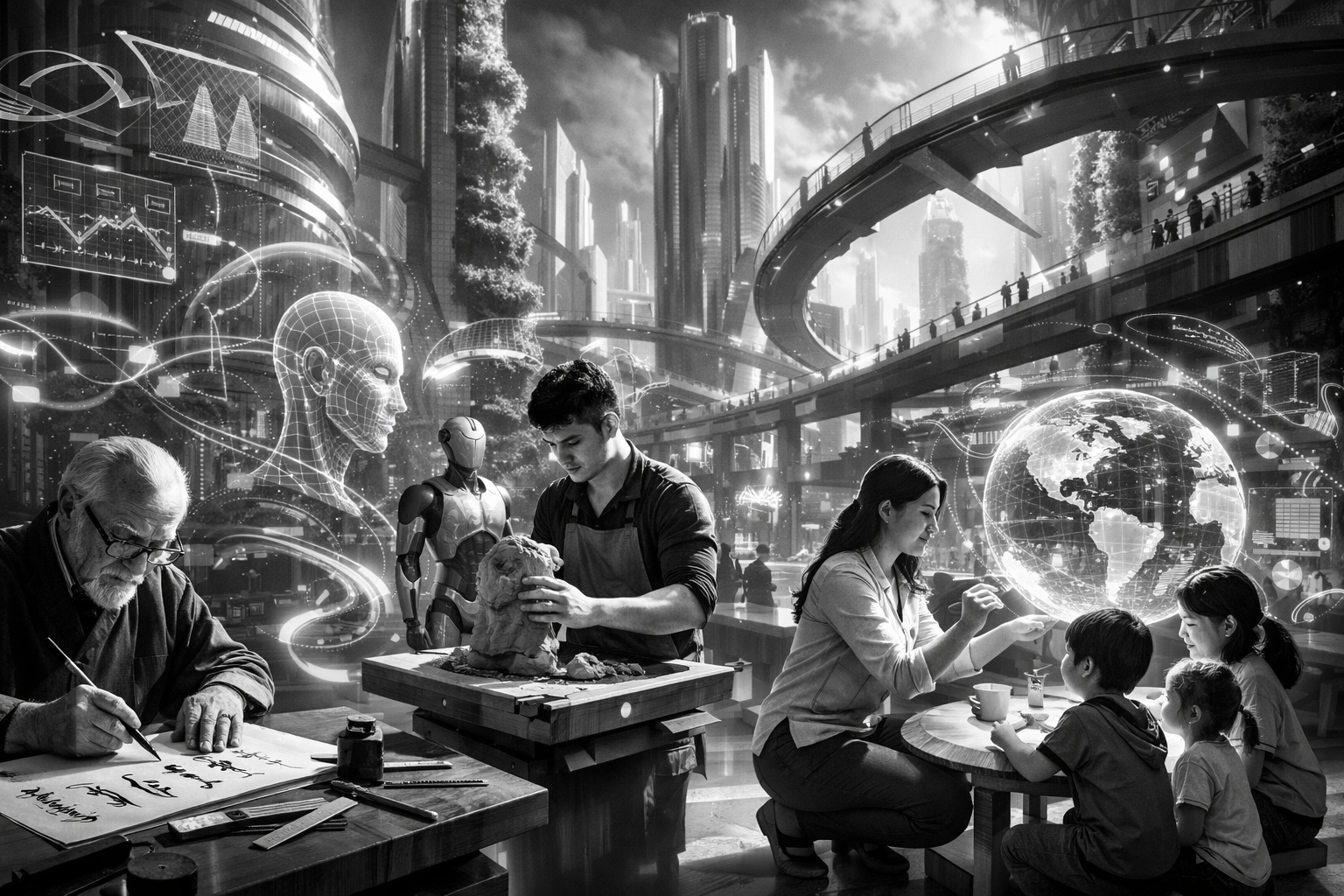
When the machine is better, what are you for?
Imagine waking up to a world where the market no longer needs your best skill. Not because you failed, but because a model can do it faster, cheaper, and often better. For many people, that is not just an economic threat. It is an identity threat. If work has been the main way you prove your value, then widespread AI capability forces a blunt question: what gives a human life purpose when productivity is no longer scarce?
This question is arriving early, not someday. The World Economic Forum's Future of Jobs Report 2023 projected that by 2027 around 34 percent of tasks could be automated, while also forecasting new roles in AI oversight and human machine collaboration. OECD analysis in 2024 warned that a meaningful share of jobs in developed economies face a high probability of substantial transformation due to large language models. The numbers vary by sector, but the direction is consistent. More tasks will be done by machines, and more humans will feel replaceable.
The mistake is assuming purpose is a byproduct of employment. Work can be a powerful container for meaning, but it is not the only one. In fact, tying purpose to employability is a relatively modern bargain, and it is one technology keeps renegotiating.
The hidden deal we made with work
For two centuries, industrial economies trained people to treat paid work as the central storyline of adulthood. You pick a lane, you climb, you earn, you retire. Along the way you get structure, status, community, and a sense that your effort matters. Even when jobs were exhausting, they offered a clear answer to "What did you do today?"
AI breaks that storyline because it targets not only manual repetition but also cognitive routines. Drafting, summarising, coding, basic legal research, first pass medical imaging reads, customer support, design mockups. These were once "safe" because they looked like thinking. Now they look like pattern completion, which is exactly what modern AI is good at.
When the labour market stops rewarding a skill, people often interpret it as the world no longer rewarding them. That is the psychological trap. The market prices output. Purpose is about meaning, agency, and impact. Those can overlap with a job, but they are not the same thing.
Purpose has components, and none of them require a payroll
Positive psychology tends to converge on three ingredients that make life feel purposeful. You are meaningfully engaged in something that matters to you. You have agency, which means you can set goals and move toward them. You can see impact, even if it is small and local.
Viktor Frankl, writing from the harshest possible evidence base, argued that meaning can be found through creating work, through love and responsibility, and through the attitude we take toward suffering we cannot avoid. That framework is useful in an AI economy because it does not depend on being economically indispensable. It depends on being morally and relationally awake.
So the practical challenge becomes less "How do I beat AI?" and more "How do I build a life where my sense of worth is not hostage to automation?"
The new status game: from being useful to being trusted
In many workplaces, the highest status used to go to the person who could produce the most. In an AI saturated environment, production becomes abundant. What becomes scarce is judgment people trust.
Trust is not a soft concept. It is a measurable economic force. When outputs can be generated instantly, the bottleneck shifts to deciding what should be generated, what should be shipped, what should be believed, and what should be allowed. That is governance, ethics, and accountability. It is also leadership in the unglamorous sense: taking responsibility when the system fails.
This is one reason "human in the loop" roles keep appearing in forecasts. Not because humans are better at the raw task, but because society still needs someone to own the consequences. If an AI system denies a loan, misroutes a patient, or amplifies a lie, the public does not accept "the model did it" as a moral endpoint.
Five ways to build meaning when machines take over work
1. Separate your identity from your output
If your self respect is built on being the best performer, AI will feel like a permanent insult. A more resilient identity is built on values rather than comparative advantage. Values survive competition.
A simple practice is to rewrite your personal "about me" without job titles. Replace "I am a marketer" with "I help people make good decisions under uncertainty" or "I translate complexity into clarity." The first can be automated. The second is a lifelong craft that can be expressed in many arenas, paid or unpaid.
This is not motivational poster advice. It is a strategic move. When your identity is portable, you can adapt without feeling erased.
2. Choose arenas where humans are still the point
There are domains where the product is not information, but relationship. Therapy is an obvious example, but so is coaching, teaching, mediation, caregiving, community organising, and mentorship. Even when AI assists, the human is the point because the outcome depends on trust, safety, and the feeling of being seen.
This is also true in high stakes negotiation and diplomacy, and in any setting where people need to believe that another person is accountable. AI can propose options. It cannot carry moral responsibility in the way societies recognise.
If you want a practical filter, ask whether success in the role depends on someone saying, "I trust you," rather than "I like your output." The first is harder to automate.
3. Become the director, not the performer
Many people will keep working, but the nature of work will tilt from doing to directing. That means framing problems, setting constraints, defining what "good" looks like, and checking outputs against reality. It also means knowing when not to use AI.
In practice, this looks like building "taste" and "judgment" in a domain. A designer who can articulate why a concept fits a culture. A product lead who can sense second order effects. A clinician who can integrate patient context that never appears in the data. A journalist who can tell when a clean narrative is suspiciously clean.
AI makes drafts cheap. It makes discernment valuable.
4. Build purpose through contribution that is not monetised
One of the most liberating shifts in an AI economy is remembering that impact is not the same as income. Volunteerism, civic participation, mutual aid, coaching a youth team, helping a neighbour navigate bureaucracy, restoring a local habitat. These activities create visible impact and social connection, two of the strongest buffers against purposelessness.
OECD work on social cohesion has repeatedly linked sustained community engagement with higher self reported wellbeing. The mechanism is straightforward. You can see the effect of your effort, and other people can see it too.
If AI reduces working hours over time, the question will not be "What will people do all day?" It will be "Do we have enough pathways for contribution outside the market?" Communities that answer that early will feel richer than their GDP suggests.
5. Treat learning as a lifestyle, not a rescue plan
Reskilling is often framed as panic. It works better as identity. Lifelong learning is not only about staying employable. It is also one of the cleanest sources of agency. When you can still grow, you can still aim.
The most durable learning in an AI era is cross disciplinary. It is the ability to combine domains, to ask better questions, to test claims, and to understand systems. Countries experimenting with project based learning and adult upskilling pathways are implicitly betting on this: not that everyone will become an AI engineer, but that more people can become adaptable generalists with a strong ethical compass.
A useful personal rule is to always have one skill you are learning for money and one you are learning for meaning. The second one keeps your sense of self from being audited by the labour market.
What society can do so purpose does not become a luxury good
Individual strategies matter, but they are not enough if the structure of life becomes unstable. Purpose is easier to pursue when basic needs are secure and time is not constantly under threat. That is why debates about reduced workweeks, universal basic services, and targeted income supports keep resurfacing whenever automation accelerates.
UBI pilots and guaranteed income experiments have reported modest improvements in wellbeing and mental health in several settings, though results vary by design and context. The more consistent lesson is not that money buys meaning. It is that financial stability buys breathing room, and breathing room makes it possible to choose meaningful commitments rather than whatever pays fastest.
There is also a governance angle that rarely gets framed as existential, but should. If AI systems reshape labour markets, then impact assessments should include human capital effects, not as a footnote but as a core metric. Regulatory frameworks such as the EU AI Act are pushing toward more accountability and risk management. The next step is treating "purpose displacement" as a real social cost, alongside bias, privacy, and safety.
A practical exercise: the purpose portfolio
If your purpose currently sits inside one job, you have concentration risk. A more resilient approach is to build a purpose portfolio across different sources of meaning. One part can be paid work, even if it changes. Another part can be relationships and care. Another can be craft, learning, or community contribution.
Try mapping your week into three columns. In the first, list what gives you energy because you are improving. In the second, list what gives you energy because you are helping. In the third, list what gives you energy because you are connected. If one column is empty, that is not a moral failure. It is a design problem, and design problems can be solved.
AI will keep getting better at tasks. The human opportunity is to get better at choosing tasks that make a life feel worth living, and then building the social systems that let more people do the same, even when the machines are winning on the scoreboard.
If the age of AI forces us to stop asking "What do you do?" and start asking "What do you stand for?", that might be the most productive disruption of all.