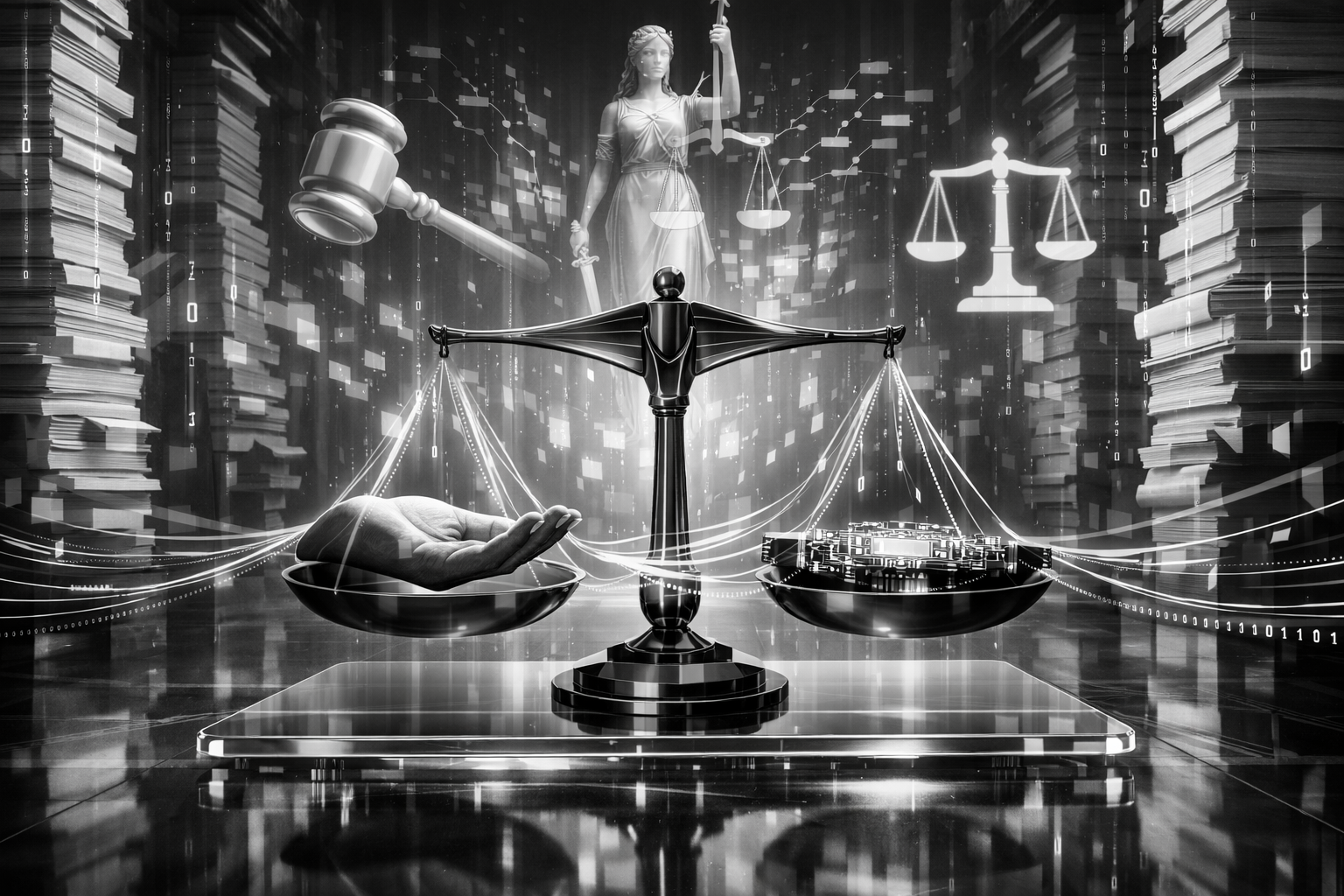
The tempting promise: fewer loopholes, faster laws, fairer outcomes
If you've ever read a law and thought, "How did anyone think this wording was a good idea?", you're already halfway to the case for AI-written legislation. Modern statutes are long, technical, and often stitched together through amendments that pile up over decades. That complexity is not just annoying. It creates loopholes, inconsistent enforcement, and a legal system that feels navigable only to specialists.
Large language models now write fluent legal text on demand. They can mimic legislative style, generate definitions, and produce explanatory notes in seconds. The provocative question is whether that fluency can be turned into something deeper: laws that are not only clearer and cheaper to produce, but closer to "perfectly just".
The answer depends on what you mean by justice, and on whether you want AI to replace lawmakers or to change how lawmaking is done.
Why law is hard to "perfect" in the first place
Legal systems have always wrestled with a basic tension. Codified law tries to be complete and stable, like the Code of Hammurabi or modern civil codes. Common law evolves through precedent, adapting case by case, but it grows into a dense forest of decisions that can be hard to reconcile.
Both approaches are attempts to solve the same problem: society changes faster than rules can be written, and rules written too broadly become unfair, while rules written too narrowly become gameable.
That is why "perfectly just laws" is a seductive phrase and a dangerous one. Justice is not a formatting problem. It is a moving target shaped by culture, politics, economics, and moral disagreement.
What AI can genuinely do well in legislative drafting
Strip away the hype and there is still a strong, practical case for AI in lawmaking. Not because it has a moral compass, but because it is unusually good at language-heavy work that humans do slowly and inconsistently.
It can reduce drafting errors that humans routinely miss
Legislation fails in predictable ways. Definitions drift across sections. Obligations contradict exceptions. A single "and" where an "or" was intended changes the scope of a power. Cross-references break after amendments. These are not philosophical failures. They are quality-control failures.
AI systems can be used as consistency checkers that scan drafts for internal contradictions, missing definitions, circular references, and collisions with existing statutes. This is closer to "linting" code than replacing Parliament, but it matters because many real-world injustices begin as mundane ambiguity.
It can translate legalese into plain language without losing structure
One of the quiet revolutions in legal tech is not drafting new rules, but making existing rules legible. Governments have experimented with AI-generated summaries and guided explanations that help citizens understand obligations and benefits without hiring a lawyer.
This does not change the law on paper, but it changes the law in practice. A right you cannot understand is a right you cannot reliably use.
It can generate multiple versions of a clause for policy teams to debate
Drafting is often a bottleneck. Policy teams know what they want to achieve, but translating intent into enforceable text takes time and specialist skill. AI can produce alternative formulations quickly, each with different trade-offs in scope, discretion, and enforceability.
Used well, this speeds up deliberation rather than bypassing it. It gives lawmakers more options to argue about, and it makes the hidden choices in wording easier to see.
It can stress-test laws against edge cases before they are passed
Every law meets reality in messy ways. People find loopholes. Businesses restructure to avoid obligations. Enforcement agencies interpret powers expansively. Courts discover unintended consequences.
AI can help simulate how a draft might behave when confronted with adversarial scenarios. You can ask it to play the role of a regulated company, a defense lawyer, a civil liberties group, or a budget-constrained regulator. This is not a guarantee of safety, but it is a cheap way to surface failure modes early, when fixes are still politically and administratively feasible.
Where the "perfectly just" idea breaks down
Even if AI could draft flawless text, justice is not only about textual quality. It is about values, legitimacy, and accountability. These are the areas where today's AI is weakest, and where society has the least tolerance for mistakes.
Justice requires value choices, not just pattern matching
Consider a simple policy conflict: privacy versus security. Or rehabilitation versus punishment. Or free speech versus protection from harm. There is no purely technical answer to these trade-offs. They are moral and political decisions that societies revisit repeatedly.
Large language models do not discover values. They reproduce patterns from data and instructions. If you ask an AI to write a "fair" law, it will implicitly import a definition of fairness from its training material and from the preferences of whoever designed the system and wrote the prompts. That may align with public values, or it may quietly diverge.
Training data can fossilize yesterday's biases into tomorrow's statutes
Law is not neutral history. Past legal texts reflect past power. If an AI is trained heavily on jurisdictions with particular cultural assumptions, it may draft laws that sound universal while marginalizing minority legal traditions or social realities.
This risk is not hypothetical. We have already seen controversy around algorithmic tools used in parts of the justice system, especially where models influence bail, sentencing, or parole decisions. Legislative drafting is upstream of those decisions. If bias enters at the drafting stage, it can scale across an entire legal regime.
Opacity is a due process problem, not just a technical inconvenience
In a democracy, people are supposed to be able to ask, "Why is the law written this way?" and get an answer that points to reasons, evidence, and accountable decision-makers.
With AI-generated text, the "why" can become slippery. A model may produce a clause because it is statistically likely, not because it is justified. Even if you can trace sources, you may still struggle to explain why one formulation was chosen over another.
That matters because legal legitimacy depends on reasons that can be challenged. If the rationale for a rule cannot be articulated, contesting it becomes harder, and power shifts away from citizens toward whoever controls the system.
Law is adaptive, but AI systems are often snapshots
Legal systems evolve through feedback loops. Courts interpret statutes. Legislatures amend them. Agencies issue guidance. Society changes, and the law follows, sometimes slowly, sometimes abruptly.
Many AI deployments, by contrast, are trained on a fixed corpus and updated on a schedule. That creates a lag. In fast-moving domains such as digital privacy, crypto markets, or biosecurity, a lag is not just inconvenient. It can be destabilizing.
So what would "AI-written law" realistically look like?
The most plausible future is not an AI that replaces lawmakers. It is a pipeline where AI drafts, critiques, and tests, while humans supply values, legitimacy, and final accountability.
Step one: AI as a drafting co-pilot, not an author of record
In practice, this means AI generates early drafts, definitions, and explanatory notes, while legislative counsel and policy teams edit aggressively. The AI's job is speed and coverage. The human job is judgment.
This division of labor is already emerging in many professional settings. The key is to formalize it so that responsibility is never ambiguous. If a clause causes harm, "the model wrote it" cannot be an acceptable defense.
Step two: verification layers that treat laws like safety-critical systems
If AI is involved, legislative drafting starts to resemble engineering. Drafts should be automatically checked for conflicts with constitutional constraints, collisions with existing statutes, and ambiguous language that invites arbitrary enforcement.
Some teams are experimenting with multi-model or multi-agent approaches where one system drafts, another attacks the draft, and a third checks compliance. The point is not to create an illusion of certainty. It is to make failure more expensive for the draft and cheaper for the reviewers to detect.
Step three: provenance and explainability built into the text itself
A promising direction is to require AI-assisted drafts to carry traceable provenance. That can include citations to source materials, links to policy instructions, and a record of major alternatives considered and rejected.
This is less glamorous than "AI writes perfect laws," but it is closer to what democratic accountability needs. It turns AI from a mysterious author into a documented assistant whose work can be audited.
Step four: public consultation that becomes interactive, not performative
Public consultation often fails because citizens cannot parse what is being proposed. AI can help here by turning draft laws into interactive explanations, scenario walkthroughs, and plain-language Q&A that reveals who is affected and how.
That does not guarantee better politics, but it can reduce the information gap that makes consultation feel like a box-ticking exercise.
Could AI ever write "perfectly just" laws?
Not in the way the phrase is usually meant. Perfect justice implies a settled moral consensus and a stable world. We have neither. What AI can do is remove some of the avoidable unfairness that comes from human limits: unclear drafting, inconsistent terminology, inaccessible language, and slow iteration.
In other words, AI is more likely to revolutionize the legal system by making law clearer, more testable, and easier to update than by making it morally perfect.
The most interesting possibility is not that AI will decide what justice is, but that it will force lawmakers to be explicit about what they mean by it, because a machine can only optimize what humans are willing to define.