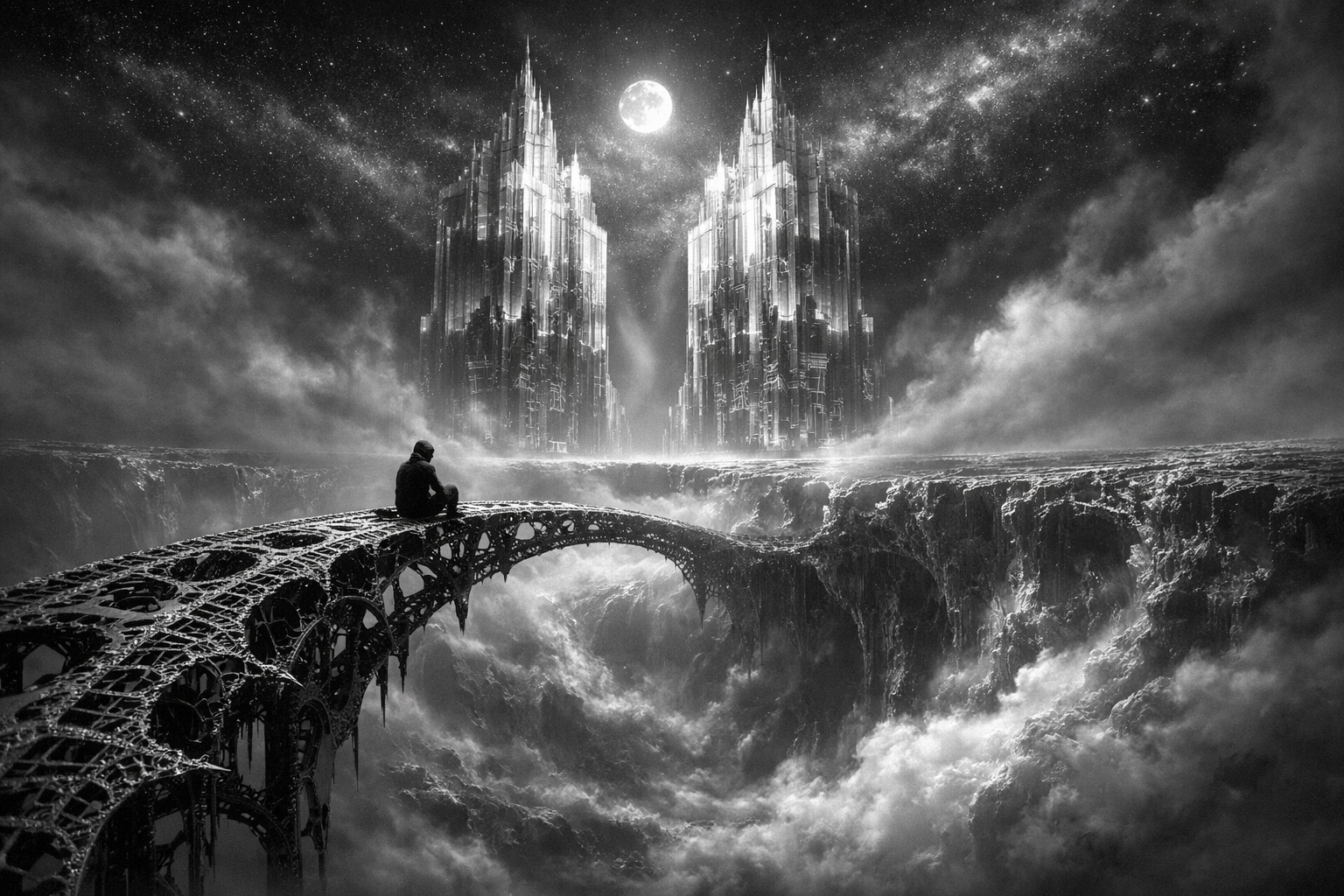
The dream that feels too real to dismiss
You wake up with the strange certainty that you were somewhere else. Not "somewhere" in the way a story is somewhere, but somewhere with weight and texture and history. A street you have never walked, a friend you have never met, a life that seems to have been running long before you arrived. If the multiverse is real, it is tempting to ask the most human question possible: could dreams be glimpses into a parallel universe?
This idea thrives because it sits at the intersection of two mysteries we still cannot fully tame. One is dreaming, a nightly production that can be more immersive than cinema and more emotionally persuasive than logic. The other is modern physics, where serious models allow for realities beyond our observable universe. Put them together and you get a hypothesis that feels like it should be either profound or provably wrong. The truth, for now, is more interesting than either extreme.
What science can say with confidence about dreams
Most vivid dreaming happens during rapid eye movement sleep, or REM. In this state, the brain is not "off." It is busy, selective, and chemically different from waking life. Studies using brain imaging and electrophysiology consistently show patterns that fit the experience: emotion and memory systems are highly engaged, while regions involved in deliberate reasoning and reality checking are less active. That combination helps explain why dreams can feel urgent and meaningful while also being wildly inconsistent.
A useful way to think about dreaming is as an internal simulation. The brain takes fragments of memory, emotion, recent concerns, and sensory noise, then stitches them into a narrative that is coherent enough to inhabit. It is not a random slideshow. It is closer to a predictive engine running offline, testing scenarios, rehearsing social situations, and reorganizing what matters. That is why dreams often borrow familiar faces, familiar places, and familiar fears, even when the plot is unfamiliar.
This "simulation" framing is not a poetic metaphor. It is a practical description that matches what we can measure. External stimuli can be incorporated into dreams in real time. A sound in the room becomes a siren in the dream. A light becomes a sunrise. The direction of influence is clear: the sleeping brain is building a world from inside, occasionally sampling the outside.
What physicists mean by "parallel universes"
"Parallel universe" is a single phrase that hides several different ideas. In quantum mechanics, the Many Worlds Interpretation suggests that when a quantum event has multiple possible outcomes, all outcomes occur, each in a different branch of reality. In cosmology, some versions of inflation imply "bubble universes," vast regions of space with different properties. In string theory, there is the idea of a landscape of possible vacuum states, each corresponding to different low-energy physics.
These are not fantasy concepts invented to sound mystical. They are attempts to make sense of equations and observations. But they share a crucial limitation: none of these multiverse ideas has been directly observed, and several are difficult to test with current technology. That matters because it sets the boundary for what can responsibly be claimed. If the multiverse itself is not empirically confirmed, then "dreams as multiverse access" is a hypothesis built on top of a hypothesis.
Why the idea feels plausible anyway
Dreams and multiverse stories share a structure that our minds find irresistible. In dreams, improbable outcomes happen without apology. You make one choice and the world changes. You open a door and the rules are different. That resembles the branching logic people associate with Many Worlds, where every possibility is realized somewhere.
There is also the emotional realism. A dream can carry the feeling of lived experience, including the sense that you have a backstory you cannot fully recall. The brain is good at generating that feeling because it is the same brain that generates the feeling of "being you" while awake. When the dream supplies a convincing sense of continuity, it can feel less like imagination and more like memory.
Then there is the occasional coincidence that keeps the myth alive. You dream of a person you have not seen in years and they message you the next day. You dream of a place and later discover it exists. These moments are sticky because they are rare, and because we remember hits more vividly than misses. The brain is a pattern detector, and dreams are a pattern generator. Put them together and you get meaning, whether or not meaning is warranted.
Where the "glimpse" claim runs into hard limits
To argue that dreams are glimpses into parallel universes, you need more than a feeling of realism. You need information that could not plausibly come from the dreamer's memory, inference, or sensory environment, and that can be verified independently. That is the standard that separates a compelling story from a testable claim.
So far, controlled research has not produced reliable evidence that dreams deliver non-local information. Experiments can show that the sleeping brain weaves in sounds, touches, and other cues from the room. They can show that dream content correlates with emotional concerns and memory processing. What they do not show is a consistent channel by which a dreamer learns verifiable facts about distant events or alternate histories.
There is also a category error hiding in the popular version of the idea. Many Worlds, for example, is not a theory that says consciousness travels between branches. It is an interpretation of quantum mechanics about how outcomes relate to the wavefunction. Even if Many Worlds were correct, it would not automatically imply that a sleeping brain can tune into other branches like a radio. That extra step is not in the physics.
A more grounded explanation for "alternate life" dreams
Some dreams feel like you are living as a different person. You have a different job, different relationships, even a different moral compass. This can be unsettling, but it is also one of the most revealing features of dreaming. The brain is not only replaying memories. It is exploring identity.
In waking life, your sense of self is stabilized by routine, social feedback, and continuous sensory input. In REM sleep, that scaffolding loosens. The brain can recombine traits, roles, and emotions into a temporary "self model" that fits the dream narrative. It is not evidence of another universe. It is evidence that the self is, in part, a construction that can be reconfigured.
This also explains why dreams can produce genuine insight. If the brain is simulating social situations and emotional outcomes, it can stumble into new perspectives. You might wake up understanding why a conflict hurts, or why a decision scares you, or what you actually want. The value is real even if the world was not.
Lucid dreaming: the closest thing to "testing" the dream world
If you want to treat the question seriously, lucid dreaming is the most practical laboratory available. In lucid dreams, the dreamer becomes aware they are dreaming and can sometimes influence the environment. Researchers have used pre-agreed eye movement signals to allow lucid dreamers to communicate from within REM sleep, creating a bridge between subjective experience and objective measurement.
Lucidity does not prove parallel universes. But it does something more useful: it shows that the dream world is responsive to attention, expectation, and intention. When you change what you believe will happen, the dream often changes to match. That is a strong clue about mechanism. A parallel universe should not reliably reshape itself because you decided to test gravity by jumping off a balcony.
If you are curious, a simple experiment is to pick one stable test you will run whenever you become lucid. Try reading a sentence twice, checking a clock twice, or turning a light switch on and off. Many lucid dreamers report that text and clocks behave strangely, not because the universe is different, but because the brain is generating details on demand and struggles with precise, stable symbols.
Quantum language is seductive, but it rarely does the work people think it does
Quantum theory is often invoked to give the parallel-universe dream idea a scientific glow. The problem is that quantum effects are not a free pass to claim anything mysterious is therefore plausible. The brain is warm, wet, noisy, and large. Whatever quantum events occur at microscopic scales are overwhelmingly averaged out by classical biology at the level where thoughts and narratives form.
That does not mean physics is irrelevant to consciousness. It means that if someone claims dreams are quantum portals, they need to specify a mechanism that survives known constraints, makes predictions, and can be tested. Without that, "quantum" becomes a decorative word, not an explanation.
So why keep the question alive at all?
Because the question points to something true, even if the literal claim is unproven. Dreams are alternate realities in the only sense that matters to your nervous system: while you are in them, they are the world. They can change your mood, your memory, your relationships, and your choices the next day. They can frighten you into caution or soften you into forgiveness. They can make you feel grief for someone who never existed, and relief when you realize they never had to.
If you want a practical way to use this without drifting into fantasy, treat recurring dream themes as data. Notice what shows up when you are stressed, what appears when you feel trapped, what changes when you feel safe. Keep a short dream log for two weeks and look for patterns in emotion rather than plot. The brain is often less interested in telling you a story than in highlighting what you have not processed.
And if the multiverse ever becomes testable, the most surprising outcome may not be that dreams were portals all along, but that the brain's private universe was already strange enough to prepare us for whatever reality turns out to be.
Maybe the real provocation is this: if your mind can generate a world that feels complete in the dark, how certain are you that waking life is the only reality you have learned to inhabit?