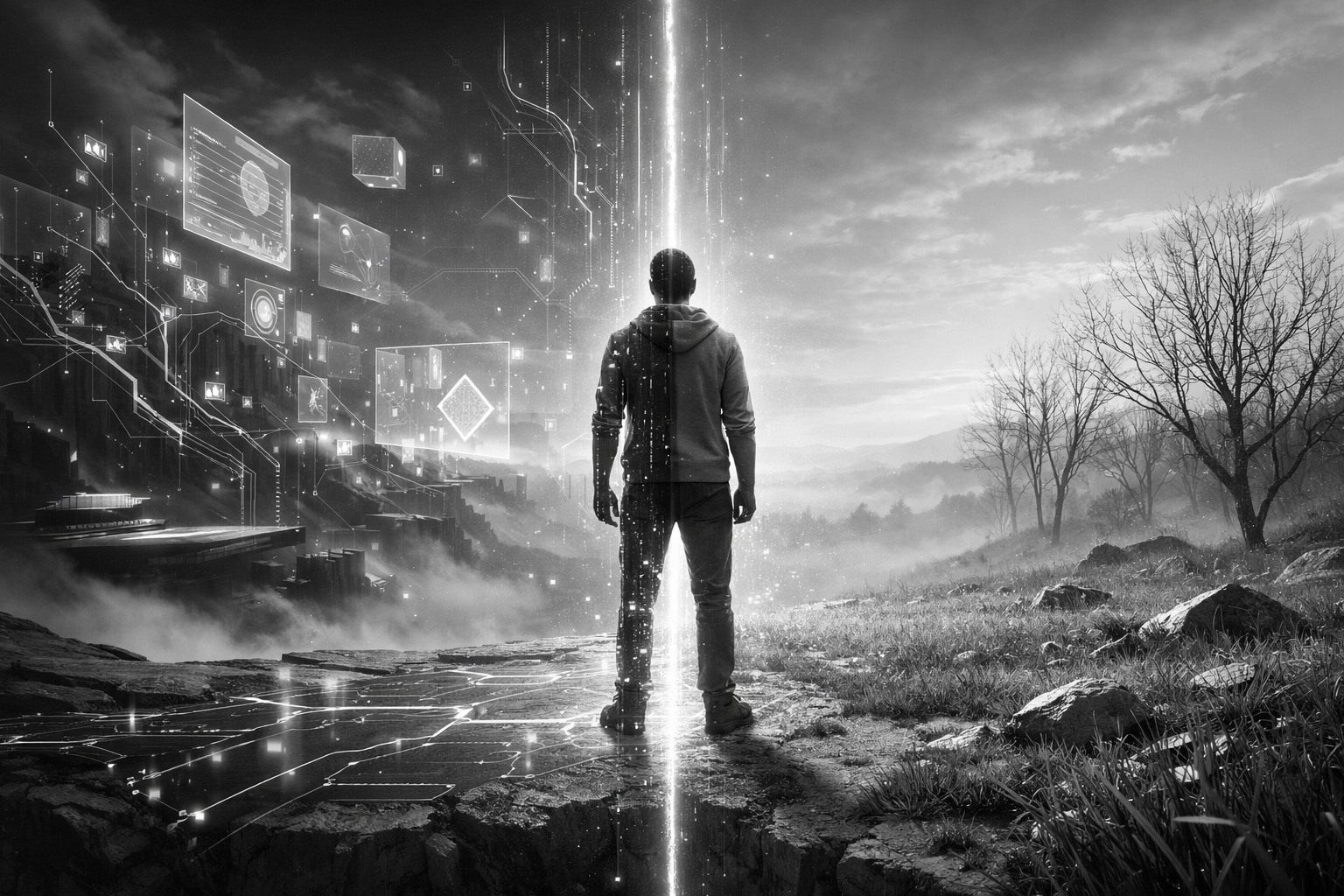
The uncomfortable question nobody can dodge
If a headset can reliably give you more joy, more progress, more belonging and fewer disappointments than your day-to-day life, what exactly is it asking you to leave behind? This is no longer a sci-fi thought experiment. The ingredients that make experiences feel meaningful, autonomy, competence, connection and flow, are increasingly easier to manufacture in virtual reality than in the physical world.
The real shift is not that VR looks better. It is that VR is learning how to satisfy the human brain with precision. When that happens at scale, the consequences ripple through mental health, relationships, education, work and even politics. The question is not whether some people will prefer virtual worlds. It is what happens when preferring them becomes rational.
What "more fulfilling" actually means, and why VR can win
Fulfillment is often treated like a vague feeling, but psychology has a fairly practical model. People tend to feel satisfied when they have agency over their choices, when they get better at something that matters, when they feel close to others and when they enter flow, that state where challenge and skill match so well that time seems to disappear.
Physical life can deliver all of that, but it is messy. Feedback is slow. Progress is uneven. Social circles are constrained by geography, time and luck. VR, by contrast, can be tuned. It can give immediate feedback, adjust difficulty in real time, surround you with people who share your niche interests and remove friction that makes real-world goals feel exhausting.
That is the core advantage. VR is not just an escape. It is an environment where the rules can be rewritten to make meaning easier to access.
The technology curve: why "good enough" suddenly becomes "hard to resist"
For years, VR's biggest limitation was that your body never fully believed it. Latency, narrow field of view, blurry optics and awkward controllers kept the experience in the category of impressive demo rather than alternate place. That gap has been shrinking fast.
Higher-resolution displays, better lenses and low latency reduce the subtle discomfort that reminds you it is fake. Spatial audio has become convincing enough that your attention follows sound the way it does in real rooms. Haptics are still uneven, but force feedback and multi-point tactile systems are improving the sense that actions have weight and consequence.
The accelerant is AI. When virtual characters remember you, respond with emotional nuance and help co-create worlds on demand, VR stops feeling like content you consume and starts feeling like a place that adapts to you. That is when fulfillment becomes personalized, and personalization is notoriously sticky.
Why your brain can prefer immersive worlds
The brain is not designed to reward "reality." It rewards signals that historically meant survival and social success. Progress, status, belonging, novelty and control are powerful levers. VR can pull them more consistently than everyday life.
One reason is presence. When sensory cues line up well enough, your brain allocates attention as if you are truly there. That makes achievements feel earned, social moments feel intimate and threats feel urgent, even when you intellectually know you can remove the headset.
Another reason is the reward loop. In physical life, effort and reward are often separated by days, months or years. In VR, feedback can be immediate and perfectly calibrated. You attempt, you improve, you see the result, you get recognition. That tight loop is a reliable recipe for flow.
Then there is identity. In virtual spaces you can experiment with how you look, how you speak and how you show up socially. For some people, that is not fantasy. It is relief. If your offline environment punishes self-expression, VR can feel like the first place you are allowed to be fully yourself.
Where VR already beats physical reality, without needing a perfect headset
The most convincing evidence is not entertainment. It is the places where VR is already outperforming traditional methods because it offers something the physical world cannot.
In medical training, simulation can compress experience. A trainee can repeat rare scenarios, get objective feedback and practice without risking harm. In exposure therapy for phobias and PTSD, clinicians can control intensity with precision, pause when needed and repeat safely. In education, virtual labs can make abstract concepts tangible, and learners often report higher engagement because they are doing rather than watching.
Even in everyday work, embodied collaboration can reduce the fatigue of flat video calls. When people share a spatial environment, even as avatars, turn-taking and attention feel more natural. It is not magic. It is simply closer to how humans evolved to communicate.
The upside: a world where meaning is easier to access
If VR becomes more fulfilling than physical reality for large numbers of people, the best-case scenario is not mass withdrawal. It is mass capability.
People who struggle with mobility, chronic pain or social anxiety could gain access to richer lives. Someone living far from opportunity could learn skills in immersive environments that feel like apprenticeships rather than lectures. Communities could form around interests instead of geography, which can be a lifeline for those who feel isolated offline.
There is also a quieter benefit. VR can make practice enjoyable. If you can enter flow more easily, you can build competence faster. That can spill back into physical life, improving confidence, employability and mental health.
The hidden cost: when fulfillment becomes a trap
The same design that makes VR fulfilling can make it hard to leave. If your best friends are there, your progress is there and your identity feels more coherent there, the physical world starts to look like the place you endure between sessions.
This is where "identity drift" enters the conversation. When your virtual self is consistently more competent, more admired or more expressive than your offline self, returning can feel like shrinking. Over time, that mismatch can create irritability, detachment and a sense that real life is dull or pointless. Not because it is, but because it is not optimized.
There is also the risk of engineered dependence. A platform that profits from time spent has incentives to keep you inside. If it can measure your attention, stress and arousal through biometrics, it can learn exactly what keeps you engaged. That is not inherently evil, but it is powerful, and power without guardrails tends to be abused.
What changes in society when "digital migration" becomes normal
If a meaningful share of people spend large portions of their lives in immersive spaces, daily life reorganizes around that fact. Work becomes less tied to cities. Education becomes less tied to campuses. Social status becomes less tied to physical signals like clothing, cars and neighborhoods, and more tied to digital reputation, skill and creativity.
That shift creates new winners and losers. People with access to high-quality hardware, safe spaces and strong digital literacy will benefit first. Those without bandwidth, money or supportive environments may fall further behind, not because they lack talent, but because they lack entry.
It also changes what we fight about. If your community, income and identity are anchored in a platform, platform governance becomes politics. Moderation becomes law. Terms of service become a kind of constitution, except you do not get to vote.
A practical guide to staying grounded without rejecting the future
The goal is not to fear VR. The goal is to prevent a fulfillment gap so wide that physical life feels like a downgrade. That requires design choices from companies, but it also requires habits from users.
Start by treating VR like a powerful tool rather than a place you disappear into. Go in with an intention. Practice a skill, meet friends, do therapy homework, build something. When the session ends, do a short re-entry ritual that reconnects you to your body and environment. A glass of water, a short walk, a few minutes of daylight. It sounds trivial, but it reduces the jarring contrast that makes reality feel flat.
Pay attention to what you are using VR to solve. If it is boredom, that is normal. If it is loneliness, that is understandable. If it is avoidance of responsibilities or relationships you care about, that is a signal to adjust. The most dangerous pattern is not high usage. It is usage that steadily replaces the parts of life that keep you stable.
Choose platforms that respect exits. Look for experiences that do not punish you for logging off, that do not rely on endless streaks and that make it easy to pause without losing social standing. If a world is truly fulfilling, it should not need to threaten you with loss to keep you coming back.
What responsible VR should look like as it gets more persuasive
As immersive tech becomes more emotionally effective, the baseline expectation should change. Biometric monitoring should be opt-in, clearly explained and easy to disable. Systems that adapt difficulty and narrative to keep you in flow should also include friction that helps you leave, especially for younger users.
The most promising idea is "fulfillment-balanced design." Build worlds that deliver mastery and connection, but also encourage transfer back to physical life. A fitness app that makes you stronger outside VR. A language world that pushes you to have one real conversation a week. A therapy space that ends with grounding exercises and a plan for tomorrow morning.
If VR becomes the place where you feel most alive, the next frontier is making sure that aliveness does not stop at the edge of the headset, but leaks into the rest of your life in ways that make you harder to manipulate and easier to love.
The future is not virtual or physical. It is negotiated.
A fully immersive future is not inevitable in the way gravity is inevitable. It is inevitable in the way convenience is inevitable, meaning it wins unless we deliberately design around its downsides. The most important question is not whether virtual reality can become more fulfilling than physical reality. It is who gets to define what "fulfilling" means, and what they are allowed to measure, optimize and sell.
Because the moment a world can reliably give you purpose on demand, the rarest skill will be choosing when to accept it.