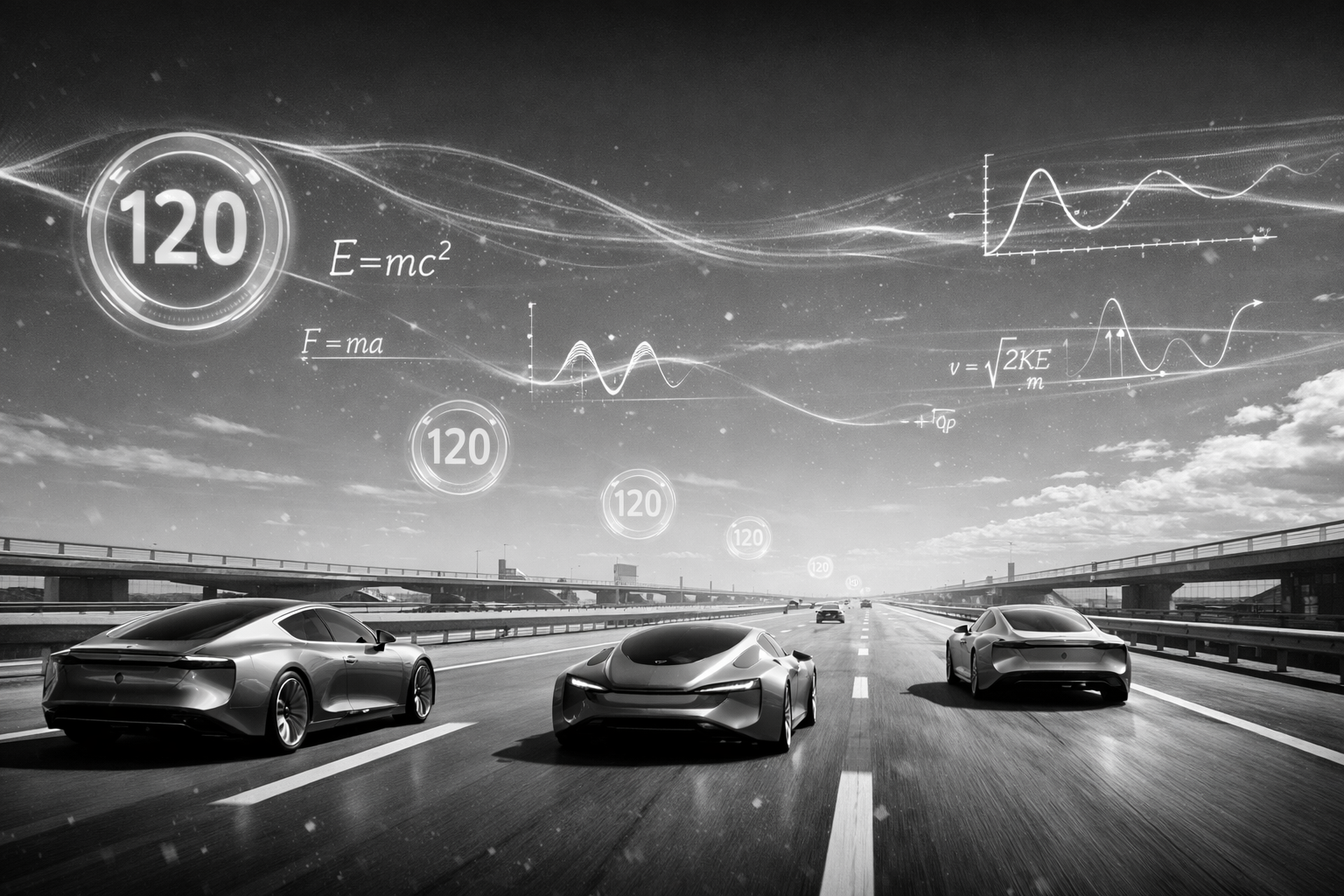
The uncomfortable truth: speed limits are not mainly about speed
If you want a fast way to start an argument, ask a room full of drivers what the "right" highway speed limit should be. But the more interesting question is this: what if the limit is not really a number for humans at all, but a safety compromise for human mistakes?
Autonomous vehicles promise to remove the biggest variable in road safety, the driver. If that promise holds at scale, it forces a policy rethink that sounds almost heretical: could roads become safe enough to raise speed limits significantly, or even make fixed limits feel obsolete?
The answer is not a simple yes or no. It is a conditional "sometimes", and the conditions are where the real story lives.
Why speed limits exist in the first place
Modern speed limits are a blend of engineering, politics, and psychology. In many places they are influenced by the "85th percentile" idea, which assumes most drivers choose a reasonable speed for the road and that setting limits near that speed improves compliance and reduces risky speed differences.
That logic quietly assumes something else: humans are inconsistent. They get distracted, misjudge gaps, overreact, underreact, and occasionally do something inexplicable. Speed limits are partly a buffer against that unpredictability.
Autonomous driving challenges the premise. If vehicles can perceive hazards earlier, react faster, and coordinate with each other, the buffer might shrink. But shrinking the buffer does not automatically mean raising the number on the sign.
The physics that no software update can repeal
Even perfect autonomy cannot negotiate with kinetic energy. As speed rises, stopping distance grows, and crash forces rise sharply. The relationship is unforgiving: doubling speed roughly quadruples kinetic energy. That matters because injury risk is tied to the energy that reaches the human body, not to how "smart" the vehicle felt a millisecond before impact.
This is the first hard limit on "no more speed caps forever" narratives. Autonomous systems can reduce the chance of a crash, but if a crash does happen at higher speed, the consequences can be worse. Any serious proposal to raise limits has to show that the reduction in crash frequency outweighs the increase in crash severity.
That trade-off is not theoretical. It is exactly what regulators and insurers will interrogate.
Where autonomy really can change the speed equation
Autonomous vehicles have three advantages that matter directly for speed policy: perception, reaction time, and coordination.
Perception is not just "seeing" farther. It is seeing consistently, in all directions, without fatigue. Radar and cameras can track multiple objects at once, and in some designs lidar adds precise depth mapping. In clean conditions, that can mean earlier detection of a stopped vehicle, debris, or a pedestrian near the roadway edge.
Reaction time is the obvious win. Humans often take around a second or more to perceive and respond to a hazard. Automated systems can respond in fractions of that, assuming the hazard is correctly classified and the system is not in a degraded state. At highway speeds, shaving even half a second can translate into dozens of feet of avoided travel before braking begins.
Coordination is the sleeper feature. If vehicles can share intent and hazards through vehicle-to-vehicle and vehicle-to-infrastructure communication, they can smooth traffic waves, reduce sudden braking, and avoid the chain reactions that turn minor disturbances into multi-car crashes. In a world where cars behave more like a synchronized flow than a collection of individual gambles, higher average speeds become more plausible.
The mixed-traffic problem: the future arrives one lane at a time
The biggest obstacle to higher speed limits is not whether an autonomous vehicle can drive safely at 85 mph on an empty test track. It is whether it can do so next to a human driver who is texting, tailgating, or making a last-second exit dive.
In mixed traffic, autonomous systems often drive defensively because they have to. They leave larger gaps, anticipate erratic merges, and avoid aggressive lane changes. That caution can be a safety benefit, but it also means the road's overall risk profile is still dominated by human behavior.
As long as humans and autonomous vehicles share the same space, the speed limit is still a group policy. It has to protect the least predictable participant, not the most capable one.
What "safe enough" would actually mean to regulators
Raising speed limits is not a reward for innovation. It is a public safety decision that needs a measurable safety case. In practice, that means transparent evidence that a higher-speed operating regime produces fewer deaths and serious injuries per mile, not just fewer fender benders.
Regulators will likely demand proof across several dimensions. They will want performance in bad weather and low visibility, because that is where sensors degrade and where humans already struggle. They will want evidence that the system handles rare but catastrophic scenarios, such as a stopped vehicle just beyond a crest, a tire carcass at night, or a wrong-way driver.
They will also want clarity on responsibility. If a vehicle is certified to operate at a higher speed and something goes wrong, the liability conversation shifts from "driver misconduct" to "system compliance". That is not a small legal tweak. It changes how crashes are investigated, how recalls work, and how software updates are regulated.
Dynamic speed limits: the most realistic "post-limit" future
If speed limits change because of autonomy, the most likely outcome is not unlimited speed. It is variable speed that finally makes sense.
Today, many roads already use dynamic signs that lower limits during congestion, rain, or incidents. Autonomous vehicles could make that approach far more precise. Instead of a blanket number for everyone, the road could broadcast a speed envelope based on real-time conditions, and vehicles could adjust smoothly rather than abruptly.
In that world, the question becomes less "Can we raise the limit?" and more "Can we prove the risk is low enough right now?" A clear day on a limited-access highway with light traffic might justify higher speeds. Heavy rain, glare, or dense merging zones might pull speeds down automatically.
This is also where autonomy could reduce the political friction. Variable limits can be framed as a safety tool rather than a culture war about freedom versus enforcement.
Dedicated autonomous lanes and corridors: the speed laboratory
If policymakers ever approve meaningfully higher speeds, it will probably start in places designed to reduce conflict. Think limited-access highways with gentle curves, strong lane markings, good maintenance, and fewer unpredictable interactions.
Dedicated lanes for highly automated vehicles could act as a controlled environment where headways are consistent and coordination is possible. Freight corridors are often mentioned because trucks benefit economically from time savings, and platooning can reduce aerodynamic drag while keeping spacing precise.
But there is a catch. A dedicated lane is only as safe as its entry and exit points. The most dangerous moments are often where traffic mixes, where a human driver cuts in, or where a disabled vehicle blocks the lane. Higher speeds amplify the cost of those transitions, so the infrastructure and enforcement around them would need to be unusually robust.
The cybersecurity and spoofing angle nobody wants to headline
Higher speeds increase the value of trust. If vehicles rely on digital messages about hazards, signal phases, or speed advisories, then authentication and redundancy become safety-critical.
A spoofed message that triggers sudden braking can cause a pile-up. A spoofed message that hides a hazard can be worse. Even without malicious intent, faulty infrastructure broadcasts or mapping errors can create systemic risk if many vehicles respond the same way at the same time.
This does not mean higher-speed autonomy is impossible. It means the safety case must include security as a first-class requirement, not an afterthought.
So could autonomous vehicles eliminate speed limits?
On public roads, full elimination is unlikely, at least in the way people imagine it. The limiting factor is not only driving skill. It is the combination of physics, infrastructure variability, weather, and the reality that rare failures still happen.
What could disappear is the idea that one static number fits all conditions. Autonomy makes a stronger case for speed limits that behave more like a live safety rating than a permanent ceiling.
There is also a plausible split future. Mixed-traffic roads may keep conservative limits for decades, while certain autonomous-only corridors adopt higher maximums under strict operating rules. That would feel like a speed limit revolution to the people using those corridors, even if the rest of the network stays familiar.
A practical way to think about it: the "safety budget"
Every road has a safety budget, whether anyone calls it that or not. You spend it on speed, on throughput, on convenience, and on tolerance for mistakes. Human driving spends a lot of that budget compensating for distraction and inconsistency.
Autonomous vehicles could free up some of that budget by reducing common crash causes like late braking, drifting, and missed hazards. Policymakers could choose to spend the savings on fewer deaths, or on higher speeds, or on a bit of both.
The most responsible path is likely incremental. Raise speeds where the environment is simple and the evidence is strong. Keep them lower where pedestrians, cyclists, complex intersections, and unpredictable behavior dominate the risk.
And if you want a real sign that the world is changing, watch for the moment speed limits stop being a number we argue about and start being a number the road negotiates with the vehicle, in real time, based on what safety it can actually guarantee.