AI
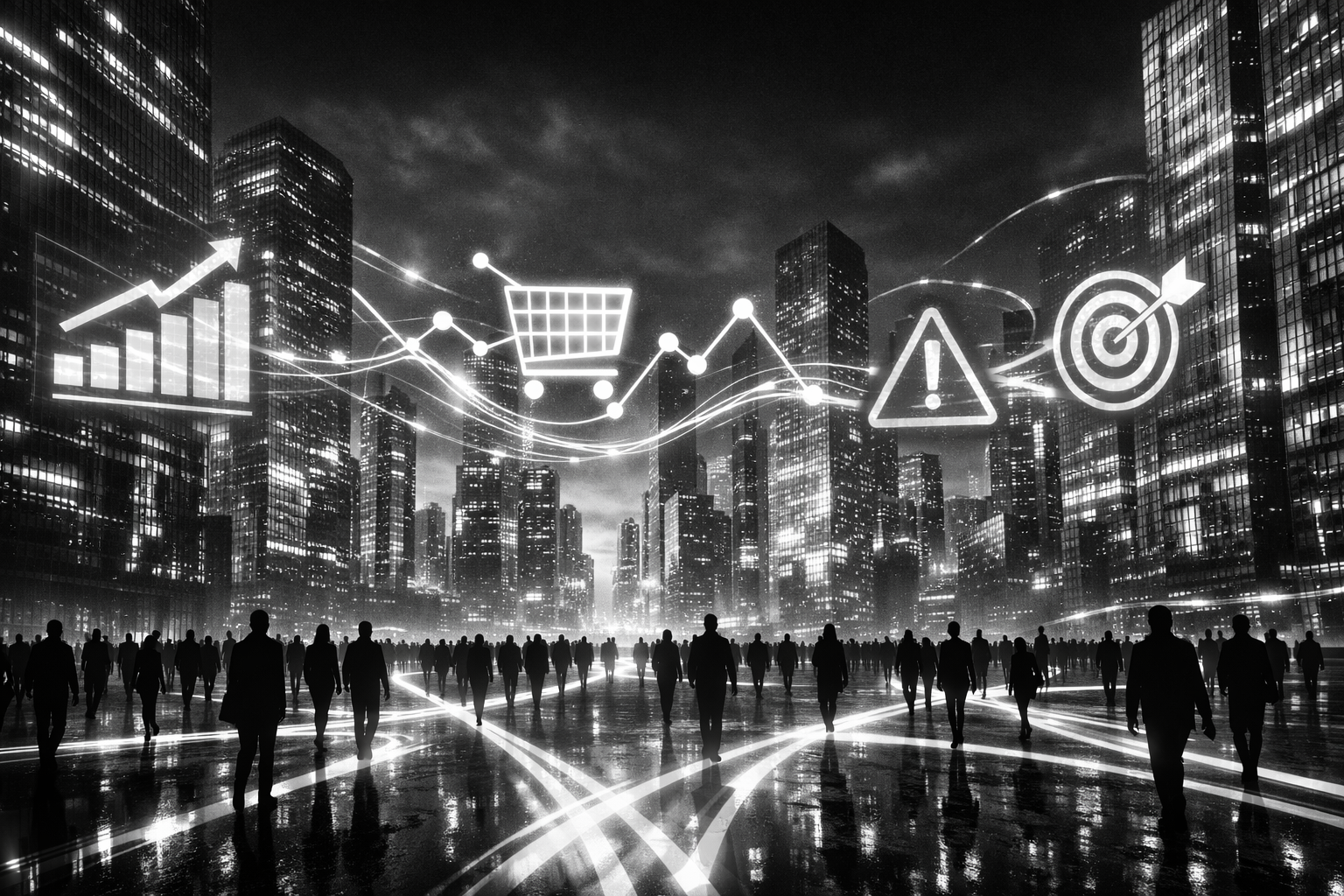
What if the most valuable thing about you isn't what you did yesterday, but what you're likely to do tomorrow? That is the quiet promise behind predictive AI trained on surveillance data: not just watching the world, but forecasting it. The question is no longer whether human behavior can be predicted at all. It is how far prediction can go before it becomes a tool for steering, sorting, and silently narrowing choices.
From "tracking" to "forecasting"
Surveillance used to be about records. A camera captured a moment. A transaction log stored a purchase. A phone ping placed a device near a tower. Predictive modeling changes the purpose of those records. It treats them as training data, then asks a forward-looking question: given a long trail of past behavior, what comes next?
This shift has been decades in the making. Statistical forecasting and simulation matured in the 1960s and 1970s, then accelerated after 2000 as storage became cheap, networks became fast, and GPUs made it practical to train large machine learning models on huge datasets. Recommendation engines and credit scoring proved the commercial value of pattern extraction. Today, the same logic is applied to movement, social interaction, and risk.
What counts as "surveillance data" now
The modern surveillance ecosystem is less a single system than a patchwork of sensors and databases that can be linked. Digital footprints include card payments, app events, web browsing signals, and location traces. Physical sensors include CCTV, doorbell cameras, license plate readers, WiFi and Bluetooth beacons that infer presence, and smart meters that reveal household routines. Public sector datasets add another layer, from immigration and benefits records to health claims and policing incident logs.
On their own, many of these streams are mundane. Combined, they become a behavioral timeline. The predictive leap happens when AI models learn the rhythms inside that timeline and output probabilities: the next place you will go, the likelihood you will miss a payment, the chance you will respond to an ad, the risk score assigned to a person or neighborhood.
Why behavior becomes predictable faster than people expect
Human behavior feels spontaneous from the inside. From the outside, it often looks patterned. The more granular the data, the more those patterns stand out. Time-stamped micro-decisions reduce the "noise" that used to hide regularity. A single purchase says little. A year of purchases, locations, and screen time says a lot.
Modern models are also better at remembering context. Sequence models, including recurrent neural networks and transformers, can learn that the meaning of an action depends on what came before it. A late-night train ride might be a one-off. A late-night train ride every Friday after a specific shift pattern is a routine. Add graph-based methods that learn relationships between people, places, and devices, and prediction becomes less about isolated events and more about systems of behavior.
Accuracy improves again when many imperfect predictors are combined. Ensembles and stacked models can turn weak signals into stronger forecasts. This is one reason "smart city" pilots can predict short-term traffic congestion well: they fuse historical travel logs with real-time sensor feeds and learn the repeating structure of commuting.
A useful mental model
Predictive surveillance rarely "knows" what you will do. It estimates what people like you, in situations like yours, tend to do next. The power comes from scale: when the system can place you into many overlapping groups at once, the probability distribution tightens.
What AI can predict well, and what it struggles with
Predictability is domain-specific. It is strongest where incentives and constraints are stable, and where behavior repeats. Commuting patterns, store visits, content consumption, and response to discounts are often forecastable in the short term. So are operational outcomes like call center demand, fraud likelihood, and near-term churn.
It gets harder when the target is rare, high-stakes, or shaped by sudden context shifts. Predicting violent crime by individuals, for example, runs into a basic statistical problem: even a model that looks "accurate" on paper can generate many false positives because the event is uncommon. Predicting political unrest, mental health crises, or radicalization is even more fragile because the drivers are nonlinear and heavily context dependent.
There is also a ceiling imposed by human adaptability. When people learn they are being monitored, they change. Some do it consciously, by leaving phones at home or altering browsing habits. Others do it indirectly, because the environment changes around them. Prediction is easiest when the system is invisible. It becomes harder when it is felt.
The part that should worry you: feedback loops
The most underestimated feature of predictive surveillance is that it can make itself "right." When a prediction influences what happens next, the model is no longer a passive observer. It becomes part of the causal chain.
In commerce, this can look harmless. If a system predicts you will buy running shoes and shows you a discount, it may increase the chance you do. The model appears accurate, and the business celebrates. In public services, the same dynamic can be corrosive. If a neighborhood is flagged as high risk and receives more patrols, more incidents are detected there, which can reinforce the original label even if underlying behavior did not change.
Feedback loops also reshape personal opportunity. A risk score can affect whether you get a loan, which affects whether you can move, which affects where you work, which affects future risk scores. Prediction becomes a kind of invisible infrastructure. It does not just forecast behavior. It can channel it.
The hidden technical limits that keep forecasts from becoming fate
Even with massive data, predictive systems remain probabilistic. They can be overconfident for mundane reasons. Sensors drift. Cameras misidentify faces under poor lighting. Location data can be imprecise indoors. Databases contain missing fields and duplicated identities. When models train on flawed labels, they learn flawed patterns.
Another limit is distribution shift. Models learn from yesterday's world. When the world changes, performance can collapse. A pandemic, a new transit line, a sudden economic shock, or a cultural shift can break the assumptions baked into historical data. This is why serious research now emphasizes uncertainty quantification and continual learning, so systems can update without pretending they are certain.
There is also a practical limit: prediction is easier at the group level than the individual level. It is often straightforward to forecast that a city will have a rush-hour spike. It is much harder to forecast which specific person will do something unusual next Tuesday. The closer you get to individual "pre-crime" certainty, the more you run into rare-event math, messy causality, and ethical landmines.
Where regulation and ethics collide with capability
The legal landscape is trying to catch up to the technical one. Data protection rules such as the EU's GDPR constrain how personal data can be collected and used, and they raise expectations around transparency and contestability for high-impact decisions. In practice, the hardest question is not whether a model is "accurate," but whether it is legitimate to build it in the first place, and whether the people affected can understand and challenge outcomes.
This is where privacy-preserving AI enters the conversation. Federated learning can train models without centralizing raw data, and differential privacy can reduce the risk of re-identification by injecting carefully calibrated noise. These techniques help, but they do not magically remove power imbalances. A system can be privacy-preserving and still be used to rank, exclude, or manipulate.
How to tell when "prediction" becomes "control"
If you want a practical test, look for three signals. First, whether the prediction is used for convenience or for gatekeeping. Recommendations are one thing. Denying housing, employment, insurance, or freedom based on a score is another.
Second, whether the system can be audited. If the model is a black box, the data sources are unclear, and the appeal process is vague, the forecast is effectively unchallengeable. That is when errors become sticky and bias becomes institutional.
Third, whether the system creates a loop. If the prediction changes the environment in a way that makes the prediction more likely to be observed, you are no longer measuring reality. You are shaping it.
So, could human behavior become predictable?
Large parts of human behavior are already predictable in the ways that matter to institutions: where crowds will form, which customers will churn, which routes will clog, which households will respond to a message, which transactions look suspicious. As surveillance data becomes more comprehensive and models become better at learning context, the forecasts will sharpen, especially in the short term.
But predictability is not destiny. The world changes, people adapt, and the most consequential decisions are often the least pattern-like. The real risk is not that AI will perfectly predict you. It is that imperfect predictions will be treated as truth, then used to quietly decide what you are allowed to do next.
The future hinge is simple: will predictive systems be built to serve people with clear limits and accountability, or will they be built to serve institutions by turning probability into permission?